Why This Matters Now
The metaverse is moving beyond gaming into manufacturing, retail, healthcare, education and enterprise collaboration. Digital twins, AI-generated environments and spatial computing are creating new business models that connect physical operations with virtual simulation. Companies that invest early gain operational data, remote collaboration capabilities and new revenue channels before platform ecosystems become consolidated.
Market Overview
The Metaverse Market encompasses hardware, software platforms and services that enable persistent virtual environments using VR, AR, mixed reality, blockchain and artificial intelligence technologies.
Demand is expanding as enterprises seek immersive collaboration tools, digital simulation capabilities and virtual commerce platforms. Gaming remains the largest consumer use case, but industrial digital twins and remote workforce applications are rapidly gaining importance.
Supply dynamics are shifting toward integrated ecosystems where hardware vendors, cloud providers, game engines and AI platform companies collaborate to deliver scalable virtual environments. Major technology companies are investing heavily in spatial computing infrastructure, content creation tools and real-time rendering capabilities.
Macroeconomic factors supporting growth include 5G deployment, cloud computing expansion, rising digital content consumption and increasing enterprise automation initiatives.
Key Trends Driving Growth
Technology and Innovation
AI is accelerating the creation of virtual assets, environments and interactive characters. Digital twin platforms allow manufacturers to simulate operations before deploying physical changes, reducing production risk and improving efficiency.
Regulatory Influence
Governments are increasing scrutiny of digital identity, virtual asset ownership and data privacy. Regulatory frameworks will influence how cross-platform identity management and virtual commerce evolve.
Sustainability Impact
Digital simulation reduces the need for physical prototypes and some business travel, creating efficiency benefits for manufacturing and enterprise operations.
Hardware and Infrastructure Costs
Advances in semiconductor performance and spatial computing hardware are improving rendering quality while gradually lowering deployment costs for enterprise users.
Globalization and Trade
Cross-border collaboration platforms are becoming a competitive advantage for multinational companies managing distributed design, engineering and training operations.
Explore detailed analysis, insights, and growth opportunities
Segment Insights
Dominant Segment: Desktop Devices
43.4% share in 2025
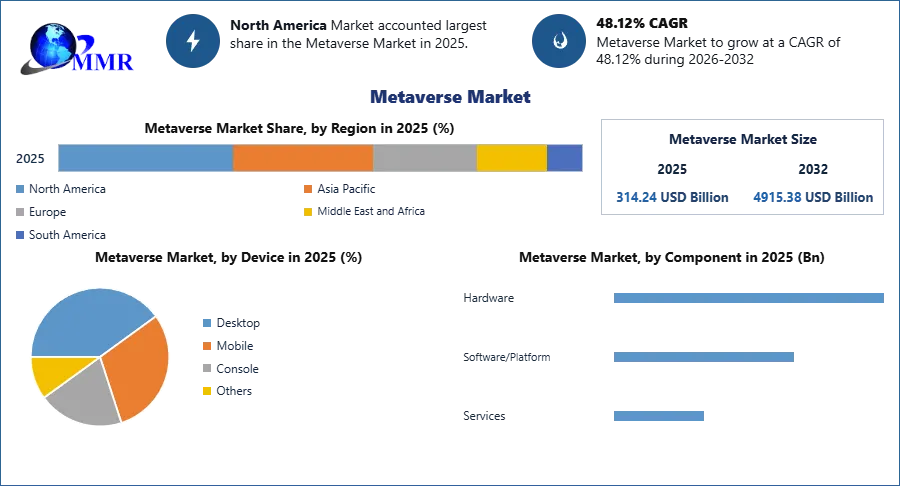
Desktop devices led the market with 43.4% share in 2025 due to strong demand from online gaming, content creation and high-performance virtual reality applications.
Business impact is significant because desktops provide the processing power required for advanced graphics rendering, industrial simulation and professional metaverse development tools.
Fastest-Growing Segment: Mobile Devices
Fastest CAGR
Mobile devices are expected to record the fastest growth through 2032 as smartphone-based AR experiences and mobile gaming continue expanding globally.
Business impact extends to retail, social media and digital commerce, where mobile access dramatically increases the addressable user base for metaverse platforms.
Additional Key Sub-Segments
Hardware
VR headsets, AR glasses and spatial computing devices remain critical for immersive experiences.
Software/Platform
Platform providers are gaining importance as interoperability and identity management become strategic differentiators.
Blockchain Technology
Supports virtual asset ownership, digital identity and decentralized commerce models.
Enterprise Applications
Industrial simulation, training and remote collaboration are gaining share beyond consumer gaming.
Regional Growth Story
North America
43% share
North America dominates through heavy investment from Meta, NVIDIA, Microsoft and other major technology companies. The region benefits from strong cloud infrastructure, advanced semiconductor ecosystems and early enterprise adoption of VR and AR technologies.
Europe
27% CAGR
Europe is projected to grow at approximately 27% CAGR, driven by gaming expansion, industrial digitalization and healthcare applications using remote VR-assisted procedures.
Asia Pacific
Fast-growing
Asia Pacific is emerging as a major production and demand center. China, Japan, South Korea and India are investing in gaming ecosystems, mobile metaverse platforms and manufacturing-oriented digital twin projects.
Middle East & South America
Emerging
Smart city initiatives, digital tourism projects and enterprise modernization programs are creating new opportunities for metaverse infrastructure providers.
Competitive Landscape
The market is consolidating around a few powerful ecosystem players that control hardware, software platforms, cloud infrastructure and developer tools.
Meta Platforms remains the strongest consumer VR platform operator, while NVIDIA is establishing a leadership position in industrial digital twins through Omniverse.
Microsoft focuses on enterprise collaboration and mixed reality integration, while Apple is targeting the premium spatial computing segment with Vision Pro.
Epic Games and Unity Technologies compete for developer mindshare through real-time 3D engines that power virtual environments across gaming and enterprise applications.
Platform interoperability is becoming the next competitive battleground. Companies that provide open APIs, cross-platform asset management and AI-assisted content creation are likely to gain enterprise adoption faster than closed ecosystem providers.
Recent Developments
- October 2025: Apple launched an upgraded Vision Pro with the M5 chip, improving spatial computing performance and display rendering.
- August 2025: NVIDIA introduced new Omniverse libraries and Cosmos world foundation models for industrial digital twins.
- June 2025: Meta released the Quest 3 V77.1026 update with enhanced spatial tracking and interface improvements.
- October 2025: NVIDIA shifted Omniverse toward an integrated developer-first platform using GitHub and NGC Catalog.
- June 2026: Meta announced the removal of Horizon Worlds from Quest headsets, signaling a strategic shift toward AGI-focused infrastructure.
Future Outlook
The strongest long-term winners will be companies that combine AI-driven content generation, open developer ecosystems and industrial digital twin capabilities while addressing cybersecurity and interoperability risks at scale.
Analyst Perspective – Yash Ghosalkar
The metaverse is transitioning from a consumer-focused virtual ecosystem to a foundational enterprise technology. While gaming and immersive entertainment continue to drive user adoption, the next wave of value creation will come from industrial digital twins, AI-powered spatial computing, and enterprise collaboration platforms. Companies that prioritize interoperability, scalable infrastructure, cybersecurity, and real-world business applications will be best positioned to capture long-term market leadership as the metaverse evolves into the next generation of the internet.” — Yash Ghosalkar, Market Research Analyst
About Maximize Market Research
Maximize Market Research Pvt. Ltd. (MMR) is a global market research and consulting company that provides reliable, data-focused, and practical business insights. The firm serves a wide range of industries, including healthcare, pharmaceuticals, technology, automotive, electronics, chemicals, personal care, and consumer goods. Through market forecasts, competitive analysis, strategic consulting, and industry impact assessments, MMR helps organizations understand changing market conditions, identify growth opportunities, and make informed business decisions for long-term success.
Contact Us :
2nd Floor, Navale IT Park Phase 3
Pune Banglore Highway, Narhe
Pune, Maharashtra 411041, India
+91 9607365656
sales@maximizemarketresearch.com
