The Smart Stadium Revolution: Digitizing the Fan Experience and Infrastructure Economy
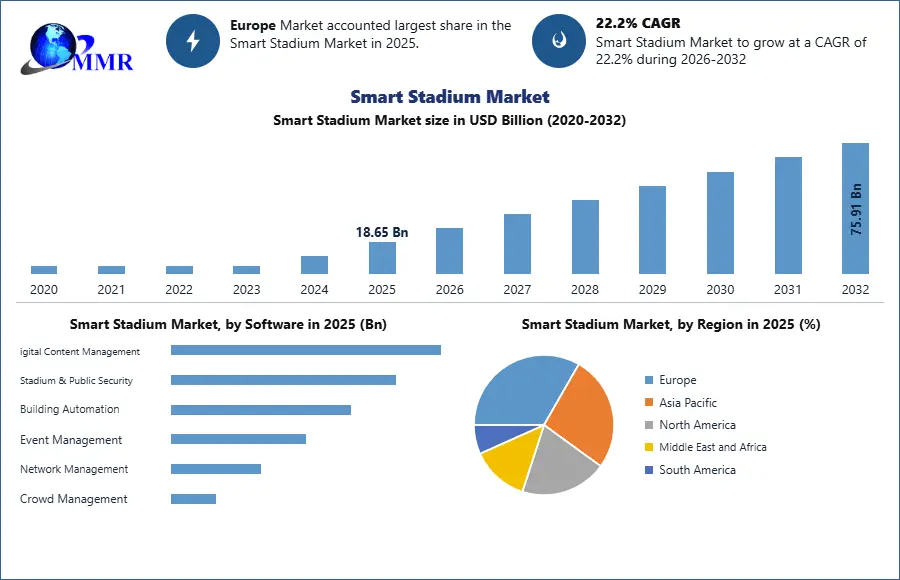
The global stadium landscape is undergoing a radical transition as the traditional brick-and-mortar venue evolves into a high-density, data-saturated digital ecosystem. The Smart Stadium Market, valued at USD 18.65 billion in 2025, is projected to scale to USD 75.89 billion by 2032, expanding at a CAGR of 22.2%, fueled by an urgent industry need to pivot from high-maintenance physical structures to agile, tech-optimized assets.
Why This Matters Now
Stadium operators face an existential challenge: the rising cost of physical maintenance and the necessity of creating year-round revenue streams to justify massive capital investments. Traditional venues are operationally inefficient and prone to volatile revenue cycles. The shift to smart technology—integrating sensors, advanced connectivity, and real-time analytics—is no longer a luxury but the primary strategy for reducing CAPEX and OPEX while meeting spectator demand for hyper-personalized digital experiences.
Market Overview: The Data-Driven Arena
A smart stadium serves as a convergence point for wired and wireless networks, leveraging a dense web of IoT sensors, high-definition cameras, and digital signage. This infrastructure tracks everything from real-time concession availability to parking density and crowd flow. By utilizing predictive maintenance and energy management software, stadium managers can significantly lower energy consumption—a critical move in an era of tightening global carbon-emission regulations. The shift from manual oversight to automated facility management is effectively turning stadiums into intelligent, living components of a city’s infrastructure.
Key Trends Driving Growth
The push for green initiatives is transforming venue operations. As energy costs and carbon footprint transparency become core regulatory and social pressures, stadiums are partnering with organizations like the Green Sports Alliance to implement sustainable energy management systems. Concurrently, the deployment of 5G and edge computing is enabling immersive technologies. Spectators now demand instant gratification, utilizing augmented reality (AR) glasses for real-time player statistics and virtual reality (VR) to enhance viewing perspectives from any seat—or even from home.
Furthermore, autonomous mobility is set to redefine stadium logistics. With parking spaces increasingly viewed as prime real estate for potential high-density residential or commercial redevelopment, stadiums are shifting toward autonomous vehicle drop-off models. This move requires sophisticated software integrations for traffic flow and queue management, underscoring the necessity for robust cloud-based backend systems.
𝐃𝐨𝐰𝐧𝐥𝐨𝐚𝐝 𝐏𝐃𝐅 𝐁𝐫𝐨𝐜𝐡𝐮𝐫𝐞 @https://www.maximizemarketresearch.com/request-sample/3771/
Segment Insights
The market is bifurcating into specialized software layers that prioritize operational efficiency and service layers that focus on integration speed.
Dominant Segment: Building Automation Software. As of 2030, this segment is expected to hold 34% of the market share. Its dominance is driven by the urgent need for integrated facility management, parking optimization, and energy oversight, which collectively reduce operational waste.
Fastest-Growing Segment: Deployment & Integration Services. Growing at a significant CAGR, this segment is essential as venues strive to harmonize disparate enterprise systems, partner networks, and spectator applications into a unified, functional ecosystem.
Regional Growth Story: The European Benchmark
Europe currently leads the smart stadium market, with a projected 38% market share by 2030. This growth is underpinned by stringent public safety regulations that mandate high-tech monitoring and crowd control infrastructure. European stadium operators are aggressively integrating social media data with stadium operations to boost fan engagement and safety. Meanwhile, the Asia-Pacific region is currently the fastest-growing market, with a projected CAGR of 23.7%, as domestic sports organizations accelerate the adoption of smart infrastructure to standardize the fan experience and capture new advertising revenue streams.
Competitive Landscape: The Shift to Platform Economics
Competitive dominance in the smart stadium sector is shifting toward vendors capable of providing full-stack ecosystem integration. Companies are no longer just selling sensors or cameras; they are selling the “stadium operating system.” The current landscape signals a pivot toward platform-based services where cybersecurity, cloud scalability, and API ecosystems dictate market winners.
Acquisitions and partnerships now focus on expanding cloud-based digital content management and advanced security suites. Technology providers who can prove that their platform integrates seamlessly with existing, often aging, stadium infrastructure possess the highest pricing power. The market is consolidating around firms that offer end-to-end support—from initial consulting and hardware integration to continuous cloud-based software updates and cybersecurity resilience.
Recent Developments
Sustainable Energy Integration: Increased adoption of energy management software to lower CO2 emissions and meet climate compliance targets.
Crowd and Traffic Management: Deployment of advanced real-time routing algorithms to minimize fan congestion and maximize safety.
Contactless Monetization: Rapid rollout of cashless and pre-booking platforms for parking and concessions to drive secondary spending.
Immersive Tech Deployment: Pilot projects for AR-enabled historical and real-time player data feeds.
Strategic Implications
For technology leaders, CIOs, and investors, the smart stadium is an exercise in data monetization. The core value lies in the data generated by the crowd and the equipment. Operators who treat their venue as a digital platform—open to third-party developers, data analytics firms, and advertising partners—will thrive. The barrier to entry is high, requiring substantial upfront investment, but the ability to optimize energy, security, and foot traffic creates a sustainable economic advantage that legacy venues cannot match.
Future Outlook
As we approach 2032, the divide between smart stadiums and traditional venues will be measured by their agility in platform adoption. The venues that integrate 5G, edge computing, and cloud-native management will become the hub of hyper-connected urban life, while those that lag will struggle with mounting maintenance costs and declining fan engagement. The future belongs to operators who treat the stadium not as a building, but as a digital service provider that happens to host sports.
Analyst Perspective“The move toward smart stadiums is an infrastructure-first initiative that transcends sports, effectively turning large-scale venues into testing grounds for urban technology,” says Yash Ghosalkar, Lead Analyst at Maximize Market Research. “The massive capital infusion we are seeing into building automation and cloud-integrated services confirms that the industry has shifted its focus from construction to ongoing, data-driven optimization.”
About Maximize Market Research
Maximize Market Research Pvt. Ltd. (MMR) is a global market research and consulting company that provides reliable, data-focused, and practical business insights. The firm serves a wide range of industries, including healthcare, pharmaceuticals, technology, automotive, electronics, chemicals, personal care, and consumer goods. Through market forecasts, competitive analysis, strategic consulting, and industry impact assessments, MMR helps organizations understand changing market conditions, identify growth opportunities, and make informed business decisions for long-term success.
2nd Floor, Navale IT Park Phase 3
Pune Banglore Highway, Narhe
Pune, Maharashtra 411041, India
+91 9607365656
sales@maximizemarketresearch.com
