Agriculture Analytics Market
Key Highlights
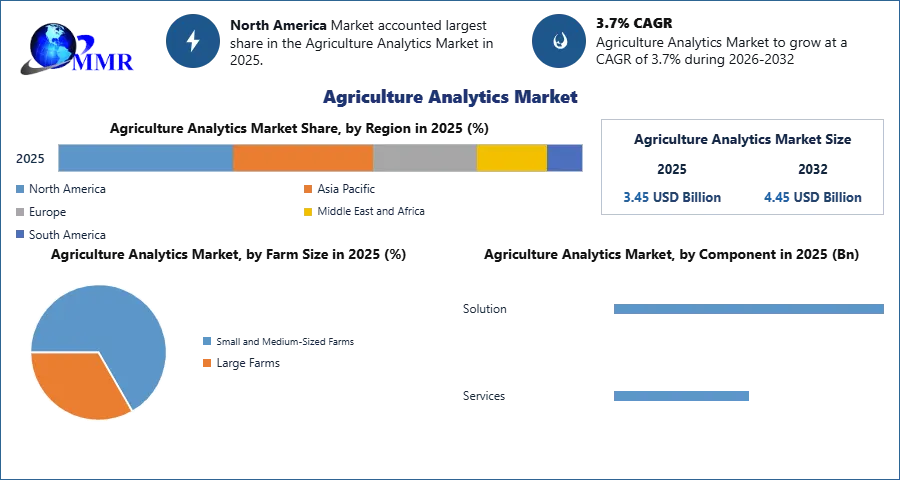
- Global Agriculture Analytics Market is expected to reach USD 4.45 billion by 2032.
- Market is projected to grow at a 3.7% CAGR during 2026–2032.
- Rising food demand and climate volatility are accelerating analytics adoption across farming operations.
- Government support for modern agricultural practices continues to strengthen digital agriculture investments.
- Livestock analytics represents the fastest-growing application segment.
- AI, cloud platforms, IoT, and predictive analytics are becoming core technologies for agricultural decision-making.
Why This Matters Now
Agriculture has entered a data competition. Food security, climate uncertainty, and resource constraints are forcing producers to replace intuition with predictive intelligence. Technology vendors, cloud providers, agribusinesses, and investors increasingly view agricultural analytics as strategic infrastructure rather than a niche software category.
The Agriculture Analytics Market is expected to reach USD 4.45 billion by 2032 at a 3.7% CAGR, signaling continued investment in digital decision-making. For technology suppliers, this growth translates into expanding demand for AI-enabled software, cloud-based farm management, and connected analytics platforms capable of improving productivity while reducing operational risk.
Market Overview
Modern agriculture increasingly depends on data generated from machinery, sensors, weather systems, satellite imagery, livestock monitoring equipment, and field operations. Analytics platforms transform these data streams into recommendations that improve yield forecasting, irrigation scheduling, disease detection, and resource allocation.
The market’s momentum is supported by three structural forces: rising global food demand, government initiatives promoting modern farming technologies, and increasingly unpredictable environmental conditions. Each factor increases the value of real-time intelligence, making analytics a competitive requirement rather than an optional capability.
The report also identifies barriers that technology providers must address. Limited data standardization, fragmented data aggregation practices, and insufficient technical expertise among many farmers continue to slow broader adoption despite growing interest in digital agriculture.
Key Trends Driving Growth
Artificial intelligence is shifting agriculture from reactive management to predictive operations. Machine learning models increasingly support crop forecasting, disease detection, irrigation optimization, and operational planning, helping farmers make faster decisions with greater confidence.
Cloud computing is expanding analytics accessibility across agricultural ecosystems. Software-as-a-Service deployment reduces infrastructure requirements while enabling continuous updates, remote collaboration, and scalable analytics for enterprises operating across multiple locations.
Automation is becoming another defining trend. Connected equipment, IoT-enabled sensors, RFID technologies, robotic systems, GPS platforms, and integrated farm management software continuously generate operational data that improves forecasting accuracy and operational efficiency.
Digital transformation is also extending beyond farms. Agribusinesses, food processors, insurers, financial institutions, and supply chain operators increasingly rely on agricultural analytics to improve procurement planning, risk management, and sustainability reporting.
Climate resilience has emerged as another major investment driver. As weather variability increases, predictive analytics helps producers anticipate production risks, allocate resources more efficiently, and improve long-term planning.
𝐃𝐨𝐰𝐧𝐥𝐨𝐚𝐝 𝐏𝐃𝐅 𝐁𝐫𝐨𝐜𝐡𝐮𝐫𝐞 @https://www.maximizemarketresearch.com/request-sample/24415/
Segment Insights
- Dominant Segment: The report identifies agriculture analytics solutions as the primary technology foundation supporting market expansion through advanced analytical capabilities and decision support.
- Fastest-Growing Segment: Livestock Analytics, supported by growing adoption of RFID, GPS tracking, robotic milking systems, feeding systems, farm management software, genetic management tools, behavior monitoring, calf management, and cattle sorting technologies. The segment benefits from increasing demand for real-time operational intelligence across livestock production.
Regional Growth Story
North America continues to benefit from mature precision agriculture adoption, advanced digital infrastructure, and significant investments in agricultural technology. Enterprise farms increasingly integrate AI, cloud platforms, IoT devices, and predictive analytics into daily operations to maximize productivity and operational efficiency.
Europe remains focused on sustainable agriculture, regulatory compliance, and technology-enabled resource optimization. Digital farming initiatives continue supporting modernization while helping producers address environmental objectives and operational resilience.
Asia-Pacific represents a significant long-term opportunity as governments encourage agricultural modernization to strengthen food security. Countries including China and India are investing in digital farming initiatives that improve productivity while supporting increasingly sophisticated agricultural ecosystems.
Developed agricultural markets including Germany, Japan, South Korea, the United Kingdom, and the United States continue expanding precision agriculture capabilities through automation, digital platforms, and connected farming technologies that improve operational visibility and resource management.
Competitive Landscape
Competition is shifting from standalone software products toward integrated agricultural intelligence ecosystems. Technology providers increasingly compete on platform capabilities that combine AI, cloud computing, IoT connectivity, predictive analytics, and automation into unified operational environments.
Market leadership will increasingly depend on ecosystem strength rather than individual applications. Vendors capable of integrating weather intelligence, machinery data, satellite imagery, livestock monitoring, and operational planning into a single analytical platform will strengthen customer retention while expanding recurring software revenue.
Platform interoperability is becoming another competitive differentiator. As agricultural enterprises adopt multiple digital technologies, seamless integration between equipment manufacturers, cloud providers, analytics vendors, and farm management systems will increasingly influence purchasing decisions.
Artificial intelligence readiness is similarly emerging as a strategic advantage. Vendors investing in predictive models, automated recommendations, and real-time decision support position themselves to capture growing enterprise demand for intelligent agriculture platforms.
Recent Developments
- Growing adoption of AI-powered predictive analytics across agricultural operations.
- Expansion of cloud-based agricultural analytics platforms supporting scalable digital farming.
- Increased deployment of RFID, GPS, robotic milking systems, and connected livestock monitoring technologies.
- Government initiatives continue promoting modernization of agricultural practices.
- Greater industry focus on climate resilience and data-driven agricultural planning.
Strategic Implications
Technology providers should prioritize integrated cloud-native platforms capable of combining AI, automation, IoT connectivity, and predictive intelligence within unified agricultural workflows.
Enterprise buyers increasingly evaluate analytics investments based on measurable productivity improvements rather than software functionality alone. Vendors demonstrating operational outcomes—including yield optimization, resource efficiency, and risk reduction—are positioned to strengthen competitive differentiation.
Investors should recognize that agricultural analytics increasingly intersects with broader digital transformation themes including artificial intelligence, enterprise software, cloud computing, automation, and sustainability technologies. This convergence expands strategic opportunities well beyond traditional agricultural markets.
Future Outlook
The next phase of market competition will center on autonomous decision support rather than data collection alone. Artificial intelligence, connected equipment, and cloud-native analytics will increasingly automate operational recommendations across crop production and livestock management.
Organizations that build interoperable AI platforms capable of transforming agricultural data into continuous operational intelligence will define the industry’s next generation of digital leadership, while those relying on fragmented, manual decision-making risk falling permanently behind.
Analyst Perspective
“Agriculture is rapidly becoming a data-first industry. Organizations that combine analytics, automation, and intelligent decision-making into everyday farming operations will be better positioned to improve productivity, strengthen resilience, and compete in an increasingly technology-driven agricultural economy.” — Yash Ghosalkar
About Maximize Market Research
Maximize Market Research Pvt. Ltd. (MMR) is a global market research and consulting company that provides reliable, data-focused, and practical business insights. The firm serves a wide range of industries, including healthcare, pharmaceuticals, technology, automotive, electronics, chemicals, personal care, and consumer goods. Through market forecasts, competitive analysis, strategic consulting, and industry impact assessments, MMR helps organizations understand changing market conditions, identify growth opportunities, and make informed business decisions for long-term success.
2nd Floor, Navale IT Park Phase 3
Pune Banglore Highway, Narhe
Pune, Maharashtra 411041, India
+91 9607365656
sales@maximizemarketresearch.com
