Key Highlights
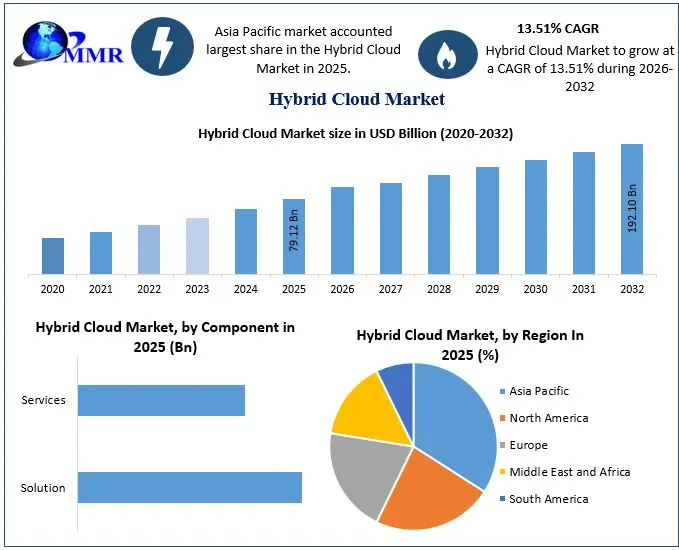
- Market valued at USD 79.12 billion in 2025.
- Forecast to reach USD 192.10 billion by 2032.
- Expected CAGR stands at 13.51% during 2026–2032.
- Services remain the largest component supporting enterprise cloud migration.
- SaaS continues to dominate service model adoption through subscription-based deployment.
- BFSI leads cloud investments across industry verticals.
- Asia Pacific represents the largest regional opportunity due to rapid digital transformation.
- AI workloads and hybrid infrastructure modernization are reshaping vendor strategies.
Why This Matters Now
Enterprises are redesigning IT environments to support AI applications, remote operations, cybersecurity, and regulatory compliance simultaneously. Hybrid cloud provides the flexibility to distribute workloads between public and private environments while maintaining governance over critical data. As organizations replace legacy infrastructure, hybrid cloud has become a strategic platform for digital business rather than a temporary migration solution.
Market Overview
The Hybrid Cloud Market covers technologies and services that integrate private infrastructure with public cloud platforms to deliver scalable computing, storage, networking, and application management. Organizations increasingly rely on hybrid architectures to balance operational flexibility with security and compliance requirements.
Demand is accelerating as enterprises modernize aging infrastructure without disrupting business operations. Hybrid deployments allow companies to move selected workloads to the cloud while retaining mission-critical applications within private environments. This approach reduces infrastructure costs, improves business continuity, and enables faster deployment of digital services.
Supply-side competition continues to intensify as cloud providers expand managed services, AI integration, cybersecurity capabilities, and automation platforms. Strategic partnerships between infrastructure vendors and software providers are reducing deployment complexity while improving workload portability.
Macroeconomic factors including digital transformation initiatives, AI investment, remote workforce adoption, and government-backed cloud infrastructure programs continue supporting long-term market expansion.
Key Trends Driving Growth
Artificial intelligence is becoming a primary driver of hybrid cloud investment. Organizations require distributed infrastructure capable of processing AI workloads across public cloud, private cloud, and edge environments without compromising data governance.
Cloud-native application development is increasing demand for containerized infrastructure, enabling enterprises to deploy applications consistently across multiple environments while reducing operational complexity.
Regulatory requirements surrounding data sovereignty are encouraging businesses to retain sensitive information within private environments while utilizing public cloud resources for scalable computing. This trend is particularly evident across financial services, healthcare, and government sectors.
Security investment remains a priority as organizations adopt encryption, identity management, workload monitoring, and zero-trust architectures to secure distributed cloud environments.
Competitive pricing from hyperscale providers has also improved enterprise adoption. Subscription-based cloud models reduce capital expenditure while providing predictable operating costs and flexible resource allocation.
Growing international digitalization has strengthened cross-border cloud deployment strategies, encouraging vendors to expand regional data centers and localized cloud infrastructure.
Explore detailed analysis, insights, and growth opportunities
Segment Insights
Dominant Segment – Services
Services represent the leading component segment as enterprises increasingly require consulting, migration, integration, managed services, and continuous cloud optimization.
Organizations rarely migrate complex workloads independently. Professional service providers simplify implementation, improve security compliance, and reduce deployment risk. As hybrid environments become more sophisticated, long-term managed services generate recurring revenue while strengthening customer retention.
Business impact is significant because service providers become long-term strategic partners rather than one-time implementation vendors.
Fastest-Growing Segment – Software as a Service (SaaS)
SaaS is projected to record the fastest expansion among service models due to flexible subscription pricing, rapid implementation, and simplified maintenance.
Remote work and distributed business operations continue increasing enterprise demand for browser-based applications accessible from multiple locations. SaaS also reduces software maintenance responsibilities while accelerating digital transformation initiatives.
This shift enables software vendors to generate recurring subscription revenue while customers benefit from faster deployment and lower ownership costs.
Additional Segment Insights
Infrastructure as a Service (IaaS) continues supporting enterprise workload migration during peak computing demand, allowing organizations to scale resources without significant capital investment.
Platform as a Service (PaaS) remains increasingly important for software developers building cloud-native applications and accelerating innovation cycles.
Within industry verticals, BFSI maintains the strongest adoption due to increasing online banking, digital payments, cybersecurity requirements, and regulatory compliance. Healthcare and government organizations are also expanding hybrid deployments to protect sensitive information while improving operational efficiency.
Large enterprises continue leading adoption because of complex infrastructure requirements, although SMEs increasingly utilize hybrid cloud solutions to improve scalability without large upfront investments.
Regional Growth Story
Asia Pacific remains the largest regional market, supported by extensive cloud infrastructure investment, government digital transformation initiatives, and rapid enterprise modernization. China continues expanding cloud adoption across e-commerce, AI, manufacturing, and digital public services while investing heavily in next-generation technologies.
North America remains one of the most mature hybrid cloud markets, driven by hyperscale cloud providers, enterprise AI deployment, and continuous investment in cybersecurity and cloud-native applications.
Europe continues strengthening adoption through stricter data governance regulations and increasing demand for sovereign cloud infrastructure. Organizations increasingly deploy hybrid models to satisfy regulatory compliance while maintaining operational flexibility.
Latin America, the Middle East, and Africa are gradually increasing cloud investment as digital infrastructure improves and businesses modernize legacy IT environments. These regions present long-term expansion opportunities for global cloud providers.
Competitive Landscape
Competition is concentrated among established enterprise technology companies with comprehensive cloud ecosystems. Microsoft, Amazon Web Services, Google, IBM, Oracle, VMware, Hewlett Packard Enterprise, Dell EMC, Cisco Systems, and Rackspace continue strengthening their positions through platform expansion rather than price competition.
Strategic partnerships have become the preferred growth strategy because enterprises increasingly demand integrated infrastructure, cybersecurity, AI services, and cloud management within unified platforms.
Recent collaborations between infrastructure vendors and software companies demonstrate an industry shift toward delivering complete hybrid cloud ecosystems capable of managing AI workloads, distributed computing, and regulatory compliance simultaneously.
Acquisitions continue expanding vendor capabilities in data management, cloud security, automation, and real-time analytics, creating higher barriers to entry for smaller competitors.
Recent Developments
- May 2026: Unisys partnered with Rafay Systems to simplify hybrid cloud management for AI-native workloads.
- May 2026: Cohesity expanded its strategic alliance with Hewlett Packard Enterprise to strengthen AI-powered data security and cyber resilience.
- April 2026: Nokia collaborated with Blaize Holdings and PT Datacomm Diangraha to accelerate hybrid AI infrastructure deployment across Southeast Asia.
- April 2026: Astreya introduced AI OpsHub to automate operations across complex hybrid IT environments.
- March 2026: IBM completed the acquisition of Confluent to integrate real-time data streaming into its hybrid cloud and AI platform.
- March 2026: Tencent Cloud expanded European operations by launching a third availability zone in Frankfurt to support hybrid cloud and AI services.
Future Outlook
Vendors that combine AI-ready infrastructure, enterprise-grade security, and unified hybrid cloud management platforms will capture the largest share of enterprise modernization spending through 2032.
Analyst Perspective -Yash Ghosalkar
The Hybrid Cloud Market is entering a new phase where enterprise spending is shifting from basic cloud migration to intelligent workload optimization. Organizations are increasingly adopting hybrid cloud architectures to balance scalability, security, and regulatory compliance while supporting AI-driven applications and data-intensive operations. Strategic partnerships, AI integration, and cloud management innovations are becoming the primary competitive differentiators among leading vendors
About Maximize Market Research
Maximize Market Research Pvt. Ltd. (MMR) is a global market research and consulting company that provides reliable, data-focused, and practical business insights. The firm serves a wide range of industries, including healthcare, pharmaceuticals, technology, automotive, electronics, chemicals, personal care, and consumer goods. Through market forecasts, competitive analysis, strategic consulting, and industry impact assessments, MMR helps organizations understand changing market conditions, identify growth opportunities, and make informed business decisions for long-term success.
Contact Us :
2nd Floor, Navale IT Park Phase 3
Pune Banglore Highway, Narhe
Pune, Maharashtra 411041, India
+91 9607365656
sales@maximizemarketresearch.com
