RPA in Insurance Market
Key Highlights
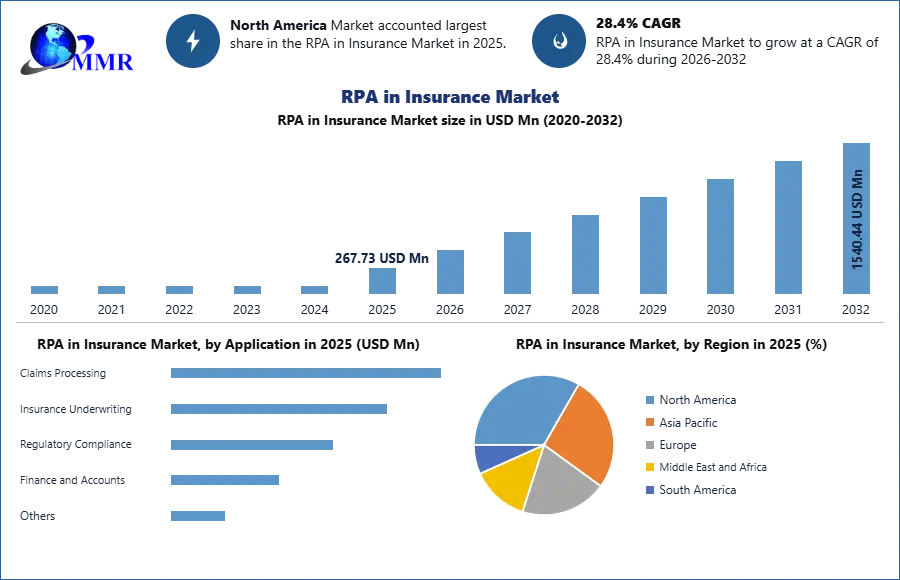
- The RPA in Insurance Market was valued at USD 267.73 Million in 2025.
- The market is projected to reach USD 1,540.44 Million by 2032.
- Revenue is expected to grow at a 28.4% CAGR from 2026 to 2032.
- AI-driven automation is transforming claims processing, underwriting, and policy administration.
- Cloud-based automation platforms continue accelerating enterprise insurance modernization.
- Intelligent process automation is improving operational efficiency, compliance, and customer experience.
Why This Matters Now
Insurance is shifting from document-intensive operations to intelligent digital workflows. Competitive advantage increasingly depends on how quickly insurers can automate repetitive processes, improve decision-making, and deliver seamless customer experiences through AI-enabled enterprise platforms.
The RPA in Insurance Market, valued at USD 267.73 Million in 2025, is expected to reach USD 1,540.44 Million by 2032, growing at a 28.4% CAGR. That expansion reflects a structural shift toward enterprise automation, creating strategic opportunities for software vendors, cloud providers, AI developers, insurers, investors, and digital transformation leaders seeking operational scalability and cost efficiency.
Market Overview
Robotic Process Automation (RPA) has become a foundational technology for modern insurance operations. What began as a tool for automating repetitive administrative tasks has evolved into an enterprise platform supporting claims processing, underwriting, policy servicing, customer onboarding, regulatory reporting, fraud detection, and financial reconciliation.
The insurance industry faces increasing pressure to process growing transaction volumes while improving customer responsiveness and maintaining strict regulatory compliance. RPA addresses these challenges by automating rule-based workflows, reducing manual intervention, and improving process consistency across core insurance functions.
The market’s strong growth reflects broader enterprise investment in digital transformation. Insurance companies increasingly integrate automation with artificial intelligence, cloud computing, machine learning, and analytics to build more agile and resilient operating models.
Automation is also helping insurers respond to workforce challenges. By eliminating repetitive manual tasks, organizations enable employees to focus on customer engagement, complex risk assessment, and higher-value strategic activities.
Key Trends Driving Growth
Artificial intelligence is expanding the capabilities of robotic process automation. AI-powered automation now supports intelligent document processing, natural language understanding, predictive decision-making, and automated exception handling, allowing insurers to process increasingly complex workflows with minimal human intervention.
Hyperautomation has emerged as a defining trend across the insurance industry. Organizations are combining RPA, AI, machine learning, workflow orchestration, and analytics into integrated automation platforms capable of managing end-to-end business processes.
Cloud migration continues accelerating automation deployment. Cloud-native RPA platforms provide scalable infrastructure, simplified implementation, centralized governance, and continuous software updates while enabling insurers to automate operations across distributed business units.
Enterprise software modernization is another major growth catalyst. Insurance companies increasingly integrate automation platforms with policy administration systems, customer relationship management software, enterprise resource planning applications, claims management systems, and financial platforms to create connected digital ecosystems.
Customer experience has become a strategic priority. Automated workflows reduce claims settlement times, accelerate policy issuance, improve response accuracy, and provide customers with faster, more transparent service experiences.
Cybersecurity and regulatory compliance also influence purchasing decisions. Automation platforms increasingly incorporate identity management, audit trails, encryption, access controls, and governance capabilities that help insurers maintain compliance while protecting sensitive customer information.
Generative AI is beginning to strengthen automation strategies by assisting document summarization, customer communication, knowledge retrieval, and workflow optimization, expanding the role of intelligent automation beyond traditional rule-based processing.
𝐃𝐨𝐰𝐧𝐥𝐨𝐚𝐝 𝐏𝐃𝐅 𝐁𝐫𝐨𝐜𝐡𝐮𝐫𝐞 @https://www.maximizemarketresearch.com/request-sample/215442/
Segment Insights
- Dominant Segment: The report identifies the leading market segment contributing the largest share of RPA adoption across insurance operations, supported by growing enterprise demand for process automation and operational efficiency.
- Fastest-Growing Segment: The report identifies the fastest-growing segment driven by increasing investments in cloud-based automation, AI integration, and intelligent insurance workflows.
Regional Growth Story
North America continues leading the adoption of robotic process automation across insurance organizations through strong investment in enterprise software, artificial intelligence, cloud computing, and digital transformation initiatives. Large insurers increasingly deploy intelligent automation to improve operational resilience and customer experience.
Europe continues expanding automation investments as insurers strengthen regulatory compliance, operational governance, and digital modernization strategies. Organizations increasingly integrate AI-powered automation into enterprise-wide digital transformation programs.
Asia-Pacific is becoming one of the fastest-expanding opportunities as insurance markets in China, India, Japan, and South Korea accelerate cloud adoption, digital insurance platforms, and intelligent automation initiatives. Rapid digitalization and increasing insurance penetration continue encouraging investment in scalable automation technologies.
The United Kingdom and Germany remain important innovation centers where insurers continue modernizing legacy infrastructure while adopting cloud-native enterprise software and AI-powered operational platforms.
Competitive Landscape
Competition is shifting from standalone RPA tools toward comprehensive intelligent automation ecosystems. Vendors increasingly compete by combining robotic process automation with artificial intelligence, machine learning, cloud computing, analytics, and enterprise integration capabilities.
Platform interoperability is becoming a major competitive advantage. Insurance companies increasingly prioritize vendors capable of integrating automation across policy management, claims processing, underwriting, finance, customer engagement, and compliance functions within unified digital platforms.
Artificial intelligence readiness has become another strategic differentiator. Vendors investing in intelligent decision support, generative AI, predictive analytics, and autonomous workflow management are positioning themselves to capture the next phase of enterprise automation spending.
The market also reflects broader platform consolidation across enterprise software. Partnerships among cloud providers, automation vendors, AI developers, and enterprise application providers are creating end-to-end insurance technology ecosystems capable of supporting long-term digital transformation.
As automation becomes central to insurance competitiveness, pricing power will increasingly favor vendors demonstrating measurable reductions in processing time, operational costs, compliance risk, and customer service delays.
Recent Developments
- AI-powered automation capabilities continue expanding across insurance workflows.
- Cloud-native RPA platforms are accelerating enterprise deployment.
- Intelligent document processing is improving claims and underwriting efficiency.
- Hyperautomation initiatives are integrating RPA with AI, analytics, and workflow orchestration.
- Insurance organizations continue modernizing legacy systems through enterprise automation investments.
Strategic Implications
Technology providers should prioritize AI-first automation platforms capable of integrating robotic process automation, machine learning, cloud computing, cybersecurity, and enterprise software into unified insurance operations.
Insurance CIOs increasingly evaluate automation investments based on measurable outcomes including faster claims settlement, improved underwriting productivity, lower operational costs, enhanced regulatory compliance, and stronger customer satisfaction. Vendors capable of delivering quantifiable business value will strengthen long-term market positioning.
For investors, the market represents a convergence of enterprise SaaS, artificial intelligence, cloud computing, intelligent automation, digital insurance, cybersecurity, and workflow orchestration. This convergence creates long-term growth opportunities extending beyond traditional automation software.
Future Outlook
The next generation of insurance automation will move beyond task execution toward autonomous digital operations where AI continuously interprets documents, orchestrates workflows, predicts operational bottlenecks, and supports real-time decision-making across the insurance value chain.
Insurers that combine robotic process automation with AI-driven enterprise intelligence will define the future of digital insurance, while organizations dependent on fragmented manual processes will steadily lose speed, efficiency, customer trust, and competitive relevance.
Analyst Perspective
“Robotic Process Automation is evolving into the intelligent operating system for modern insurance enterprises. Organizations that integrate AI, cloud technologies, intelligent automation, and connected enterprise platforms will achieve superior operational agility, stronger compliance, and sustainable competitive advantage.” — Yash Ghosalkar
About Maximize Market Research
Maximize Market Research Pvt. Ltd. (MMR) is a global market research and consulting company that provides reliable, data-focused, and practical business insights. The firm serves a wide range of industries, including healthcare, pharmaceuticals, technology, automotive, electronics, chemicals, personal care, and consumer goods. Through market forecasts, competitive analysis, strategic consulting, and industry impact assessments, MMR helps organizations understand changing market conditions, identify growth opportunities, and make informed business decisions for long-term success.
2nd Floor, Navale IT Park Phase 3
Pune Banglore Highway, Narhe
Pune, Maharashtra 411041, India
+91 9607365656
sales@maximizemarketresearch.com
