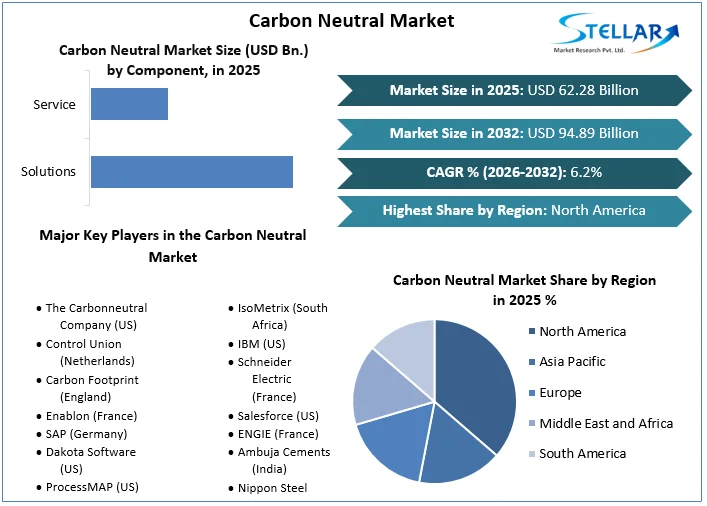
The Carbon Neutral Market is experiencing rapid growth as governments, corporations, and financial institutions intensify their efforts to achieve net-zero emissions and combat climate change. Carbon neutrality involves balancing greenhouse gas emissions through emission reductions, renewable energy adoption, energy efficiency improvements, carbon removal technologies, and verified carbon offset projects. Increasing regulatory pressure, corporate sustainability commitments, and investor focus on environmental, social, and governance (ESG) performance are accelerating the adoption of carbon-neutral strategies across industries.
Businesses are integrating carbon management into long-term operational planning, investing in low-carbon technologies, and strengthening climate resilience to meet evolving stakeholder expectations. As global economies transition toward sustainable development, carbon neutrality has become a strategic priority for sectors including manufacturing, energy, transportation, construction, agriculture, and consumer goods.
𝐃𝐨𝐰𝐧𝐥𝐨𝐚𝐝 𝐅𝐫𝐞𝐞 𝐏𝐃𝐅 𝐁𝐫𝐨𝐜𝐡𝐮𝐫𝐞: https://www.stellarmr.com/report/req_sample/Carbon-Neutral-Market/148
Net-Zero Commitments Drive Market Expansion
One of the primary growth drivers of the Carbon Neutral Market is the growing number of net-zero commitments announced by governments and private organizations. Countries worldwide are implementing long-term climate action plans aligned with international environmental goals, while businesses are establishing science-based emission reduction targets to strengthen sustainability performance.
Organizations are investing in renewable energy procurement, electrification, energy-efficient infrastructure, sustainable supply chains, and carbon accounting systems to reduce operational emissions. Carbon neutrality has become an important competitive differentiator, helping companies enhance brand reputation, attract environmentally conscious consumers, and meet investor expectations.
Growing pressure from shareholders, regulators, and customers continues to accelerate corporate decarbonization initiatives across multiple industries.
Renewable Energy Adoption Supports Market Growth
The rapid expansion of renewable energy is reshaping the carbon-neutral landscape. Solar, wind, hydroelectric, geothermal, and bioenergy projects are enabling businesses to replace fossil fuel-based electricity with cleaner energy sources.
Power purchase agreements (PPAs), on-site renewable energy installations, and renewable energy certificates (RECs) are becoming increasingly popular tools for organizations seeking to reduce carbon emissions. Energy storage systems and smart grid technologies further improve renewable energy integration while enhancing grid stability and operational efficiency.
Declining renewable energy costs and supportive government policies continue to strengthen investment opportunities in clean energy infrastructure.
Carbon Management Technologies Gain Momentum
Technological innovation is playing a critical role in advancing carbon neutrality. Organizations are adopting sophisticated carbon accounting software, artificial intelligence, Internet of Things (IoT) sensors, and data analytics platforms to monitor, measure, and reduce greenhouse gas emissions across operations and supply chains.
Carbon capture, utilization, and storage (CCUS) technologies are gaining increasing attention for reducing industrial emissions, particularly in hard-to-abate sectors such as cement, steel, chemicals, and power generation. Direct air capture, nature-based carbon sequestration, and advanced carbon removal solutions are also emerging as important components of comprehensive decarbonization strategies.
Digital technologies enable businesses to improve transparency, streamline regulatory reporting, and optimize sustainability performance through real-time emissions monitoring.
ESG Reporting and Regulatory Compliance Shape Investment
Environmental regulations and ESG reporting requirements are becoming increasingly influential in corporate decision-making. Governments are implementing stricter carbon disclosure standards, emissions trading systems, and climate-related financial reporting frameworks to improve accountability and accelerate decarbonization.
Organizations are strengthening sustainability governance by integrating climate risk assessments, lifecycle emissions analysis, and transparent reporting into corporate strategies. Financial institutions increasingly evaluate carbon performance when making lending and investment decisions, encouraging businesses to prioritize long-term climate resilience.
Compliance with evolving environmental regulations is expected to remain a significant driver of market expansion across developed and emerging economies.
𝐀𝐜𝐜𝐞𝐬𝐬 𝐭𝐡𝐞 𝐅𝐮𝐥𝐥 𝐑𝐞𝐩𝐨𝐫𝐭: https://www.stellarmr.com/report/Carbon-Neutral-Market/148
Carbon Offsets and Nature-Based Solutions Expand Opportunities
Carbon offset programs continue to play an important role in helping organizations address residual emissions that cannot yet be eliminated. Investments in reforestation, afforestation, ecosystem restoration, soil carbon sequestration, wetland conservation, and renewable energy projects support verified carbon credit generation.
Nature-based solutions are gaining increased recognition for delivering multiple environmental benefits, including biodiversity conservation, water resource protection, and climate adaptation. Companies are carefully selecting high-quality, independently verified carbon credits as part of broader decarbonization strategies while prioritizing direct emission reductions wherever possible.
Growing demand for credible carbon offset projects is supporting the expansion of voluntary carbon markets and sustainability financing mechanisms.
Regional Market Outlook
Europe remains a leading region in the Carbon Neutral Market, supported by ambitious climate policies, carbon pricing mechanisms, renewable energy investments, and comprehensive sustainability regulations. Countries such as Germany, France, the United Kingdom, the Netherlands, and the Nordic nations continue to advance net-zero initiatives across multiple sectors.
North America represents another significant market, driven by increasing corporate sustainability commitments, clean energy investments, and technological innovation. The United States and Canada continue expanding renewable energy capacity, carbon management technologies, and ESG-focused business practices.
The Asia-Pacific region is expected to register the fastest growth during the forecast period. China, Japan, South Korea, India, and Australia are investing heavily in renewable energy, green hydrogen, electric mobility, carbon capture technologies, and sustainable industrial transformation to support long-term climate objectives.
Latin America and the Middle East & Africa are emerging as promising markets due to growing renewable energy development, natural carbon sequestration opportunities, and increasing participation in international climate initiatives.
Competitive Landscape
The Carbon Neutral Market is characterized by collaboration among renewable energy developers, carbon management technology providers, environmental consulting firms, financial institutions, industrial companies, and sustainability solution providers. Organizations are investing in digital carbon accounting platforms, emissions reduction technologies, renewable energy infrastructure, and climate innovation to strengthen competitive positioning.
Strategic partnerships, mergers, sustainability investments, and research initiatives continue to accelerate the commercialization of advanced decarbonization solutions. Companies are also expanding consulting services that help businesses develop net-zero roadmaps, improve ESG reporting, and implement science-based climate strategies.
Future Outlook
The future of the Carbon Neutral Market remains highly promising as climate action, clean energy adoption, and sustainable economic development become central priorities worldwide. Advances in carbon capture technologies, artificial intelligence, renewable energy systems, green hydrogen, circular economy practices, and digital carbon management will continue transforming the global decarbonization landscape.
Growing regulatory support, expanding corporate net-zero commitments, increasing investor focus on ESG performance, and rising consumer demand for sustainable products are expected to sustain long-term market growth. Organizations that prioritize innovation, transparent carbon management, renewable energy integration, and science-based climate strategies will be well positioned to lead the transition toward a low-carbon economy and achieve lasting competitive advantage.
About Stellar Market Research:
Stellar Market Research is a multifaceted market research and consulting company with professionals from several industries. Some industries we cover include medical devices, pharmaceutical manufacturers, science and engineering, electronic components, industrial equipment, technology and communication, cars and automobiles, chemical products and substances, general merchandise, beverages, personal care, and automated systems.
Contact Stellar Market Research:
Address: Phase 3, Navale IT Zone, S.No. 51/2A/2, Office No. 202, 2nd floor, Near, Navale Brg, Narhe, Pune, Maharashtra 411041
Website: http://stellarmr.com/
Email: sales@stellarmr.com
Mobile: +91 9607365656
