Key Highlights
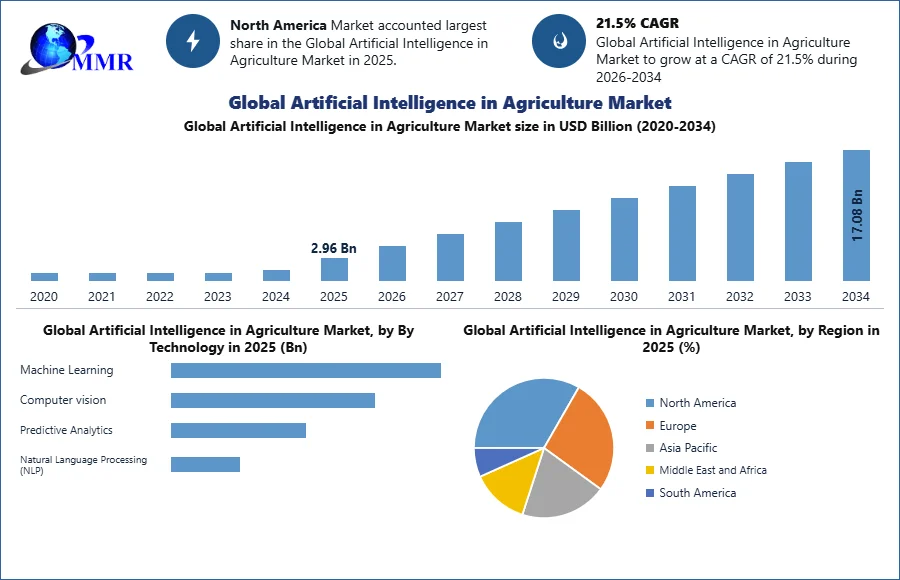
- Artificial Intelligence in Agriculture Market was valued at USD 2.96 Billion in 2025.
- The market is projected to reach USD 17.08 Billion by 2034, expanding at a 21.5% CAGR.
- Precision farming and intelligent farm management continue to redefine agricultural productivity.
- AI-enabled automation is reducing operational costs while improving yield forecasting and resource utilization.
- Cloud-based agricultural platforms and connected farm ecosystems are accelerating enterprise-scale deployment.
- Governments and agritech companies are increasing investments in digital farming infrastructure and AI innovation.
Why This Matters Now
Agriculture has entered a technology race. Climate volatility, labor shortages, rising input costs, and food security concerns are forcing governments, agribusinesses, and farmers to replace intuition with data-driven decision making.
Artificial intelligence is emerging as the operating system of modern agriculture. Computer vision, predictive analytics, machine learning, autonomous equipment, and connected sensors are moving from pilot projects to production-scale deployments. That transition is reshaping investment priorities across software vendors, cloud providers, equipment manufacturers, and digital infrastructure companies.
Market Overview
The Artificial Intelligence in Agriculture Market was valued at USD 2.96 Billion in 2025, with revenue forecast to grow at a 21.5% CAGR, reaching nearly USD 17.08 Billion by 2034. That pace of expansion signals more than technology adoption. It reflects agriculture’s shift toward intelligent decision-making where AI optimizes irrigation, predicts disease outbreaks, improves harvest planning, and enhances supply chain efficiency.
Unlike earlier waves of agricultural digitization that focused primarily on data collection, today’s AI platforms generate actionable recommendations in real time. The commercial opportunity extends across software developers, cloud service providers, drone manufacturers, sensor suppliers, equipment manufacturers, and enterprise analytics vendors as farms increasingly become connected digital ecosystems.
Key Trends Driving Growth
Artificial intelligence adoption is moving beyond isolated farm applications toward integrated agricultural platforms. Machine learning models are processing satellite imagery, drone data, weather intelligence, and field sensors simultaneously, enabling highly accurate operational decisions.
Cloud computing is expanding the accessibility of AI tools for farms of varying sizes. AI-as-a-Service models reduce upfront infrastructure costs while allowing continuous software updates and scalable analytics capabilities.
Automation is becoming another defining trend. Autonomous tractors, robotic harvesting systems, precision spraying technologies, and AI-powered irrigation management are reducing labor dependency while improving productivity.
Cybersecurity and agricultural data governance are also becoming strategic priorities as connected farming increases exposure to digital risks. Market participants are investing in secure cloud architectures, compliance frameworks, and trusted data-sharing ecosystems to support large-scale deployment.
Meanwhile, sustainability goals continue to reinforce adoption. AI helps reduce fertilizer usage, optimize water consumption, minimize pesticide application, and improve resource efficiency without sacrificing yields.
Get a free sample:https://www.maximizemarketresearch.com/request-sample/25885/
Segment Insights
- Dominant Segment: The supplied MMR report identifies multiple market segments across technology, component, deployment mode, enterprise type, application, end user, and region, but the publicly available summary does not specify the dominant segment.
- Fastest-Growing Segment: Not publicly disclosed in the supplied report summary.
- AI software platforms continue expanding enterprise demand by enabling predictive decision support.
- Precision farming remains one of the most commercially significant application areas as growers seek measurable productivity improvements.
- Machine learning, computer vision, and predictive analytics are driving increasingly sophisticated agricultural intelligence platforms.
Regional Growth Story
North America continues to benefit from advanced precision agriculture adoption, strong cloud infrastructure, and substantial investments in agricultural automation. Large commercial farming operations increasingly deploy AI-enabled equipment, connected sensors, and enterprise software platforms.
China is expanding AI-enabled agricultural modernization through digital infrastructure investments and smart farming initiatives designed to improve productivity and food security.
India represents one of the fastest-evolving digital agriculture ecosystems. Government-backed digital agriculture initiatives, expanding rural connectivity, agritech startups, and affordable cloud platforms are increasing AI accessibility for farmers.
Germany, the United Kingdom, Japan, and South Korea continue investing in robotics, industrial automation, sensor technologies, and sustainable agricultural innovation. These markets increasingly integrate artificial intelligence with advanced manufacturing capabilities to strengthen agricultural competitiveness while addressing labor shortages and environmental objectives.
Competitive Landscape
Competition is shifting from individual AI tools toward comprehensive digital agriculture ecosystems.
Technology companies are integrating artificial intelligence with cloud computing, IoT platforms, edge analytics, and enterprise software to create end-to-end farm management platforms. Equipment manufacturers increasingly differentiate themselves through embedded intelligence rather than hardware alone, strengthening customer retention through software subscriptions and continuous platform enhancements.
Strategic collaborations between cloud providers, agritech companies, equipment manufacturers, satellite imaging firms, and agricultural data specialists demonstrate that future competitive advantage will depend on ecosystem integration instead of standalone products.
The competitive environment also signals growing pricing power for vendors capable of delivering measurable productivity gains, regulatory compliance, cybersecurity resilience, and seamless interoperability across increasingly connected agricultural operations.
Recent Developments
- AI adoption continues expanding across precision farming, crop monitoring, and intelligent farm management.
- Cloud-enabled agricultural platforms are supporting scalable deployment of AI applications.
- Strategic investments are accelerating research, innovation, and commercialization of agricultural AI technologies.
- Governments continue supporting digital agriculture through policy initiatives, regulatory frameworks, and modernization programs.
- Technology providers are strengthening AI capabilities through partnerships focused on connected agriculture ecosystems.
Strategic Implications
Technology leaders should view agriculture as one of the largest emerging enterprise AI markets rather than a traditional industrial sector. Every connected farm generates high-value operational data that can support recurring software revenues, AI model improvements, and long-term customer relationships.
Cloud providers have opportunities to expand AI-as-a-Service offerings tailored to agricultural workloads. Telecom operators benefit from increasing demand for reliable rural connectivity supporting autonomous machinery, IoT devices, and edge computing.
Investors should monitor companies capable of combining artificial intelligence, cloud infrastructure, robotics, geospatial analytics, and enterprise software into scalable agricultural platforms. Those integrated ecosystems are positioned to capture larger shares of long-term digital agriculture spending.
Future Outlook
The next phase of agricultural transformation will be defined less by machinery ownership and more by intelligence ownership. Organizations that combine AI, cloud platforms, automation, and connected infrastructure into unified digital farming ecosystems will shape global agricultural productivity, while those delaying AI adoption risk falling permanently behind the industry’s accelerating technology curve.
Analyst Perspective
“Artificial intelligence is becoming a strategic production asset rather than simply another farm technology. Organizations that integrate AI with precision agriculture, automation, cloud platforms, and data-driven decision making will establish long-term competitive advantage across the global agricultural value chain.” — Yash Ghosalkar
About Maximize Market Research
Maximize Market Research Pvt. Ltd. (MMR) is a global market research and consulting company that provides reliable, data-focused, and practical business insights. The firm serves a wide range of industries, including healthcare, pharmaceuticals, technology, automotive, electronics, chemicals, personal care, and consumer goods. Through market forecasts, competitive analysis, strategic consulting, and industry impact assessments, MMR helps organizations understand changing market conditions, identify growth opportunities, and make informed business decisions for long-term success.
2nd Floor, Navale IT Park Phase 3
Pune Banglore Highway, Narhe
Pune, Maharashtra 411041, India
+91 9607365656
sales@maximizemarketresearch.com
