Key Highlights
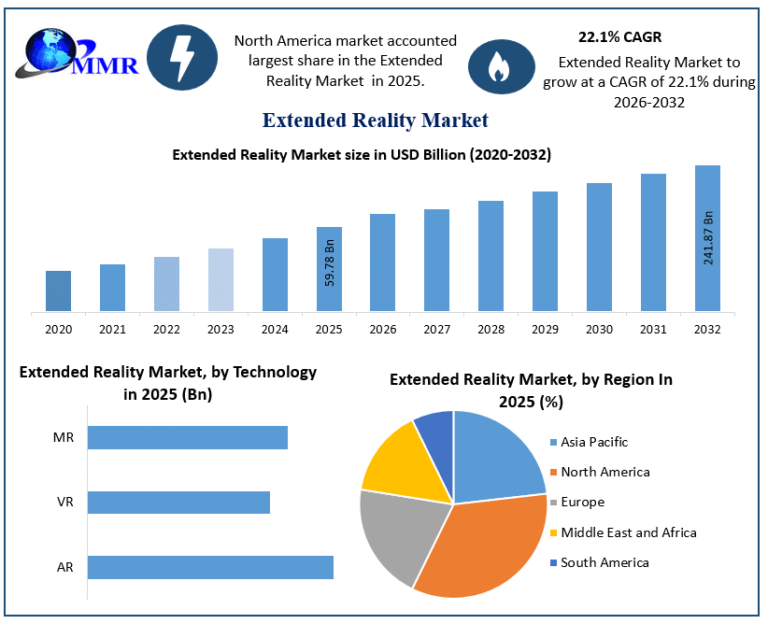
- Extended Reality Market valued at USD 59.78 billion in 2025.
- Market projected to reach USD 241.87 billion by 2032.
- CAGR estimated at 22.1% during 2026–2032.
- Software remained the largest offering segment.
- North America maintained market leadership.
- AI, 5G and edge computing continue to improve immersive experiences.
- Enterprise training, healthcare and industrial applications are expanding beyond gaming.
- Smart glasses innovation is accelerating mainstream XR adoption.
Why This Matters Now
Extended Reality is moving from consumer entertainment into enterprise infrastructure. Manufacturers are deploying XR for workforce training, healthcare providers are using immersive simulations for clinical education, and businesses are integrating spatial computing into design, maintenance and collaboration workflows. Falling hardware costs, AI-enabled devices and expanding 5G coverage are reducing deployment barriers, creating new revenue opportunities for hardware manufacturers, software developers and enterprise solution providers.
Market Overview
The Extended Reality Market comprises augmented reality, virtual reality and mixed reality technologies that blend physical and digital environments through immersive hardware and software platforms. The market serves industries including gaming, healthcare, manufacturing, education, automotive, retail and enterprise collaboration.
Demand is being driven by organizations seeking more efficient training, remote collaboration and interactive customer engagement. Consumers are also adopting XR through gaming, live virtual events and wearable smart devices.
Supply-side dynamics are improving as semiconductor advances, micro-OLED displays, AI processors and lightweight wearable devices become commercially viable. Software ecosystems continue expanding, enabling developers to build increasingly realistic applications across multiple platforms.
Macroeconomic factors including digital transformation initiatives, enterprise automation, expanding 5G infrastructure and AI investment are strengthening long-term market demand while encouraging technology vendors to accelerate product innovation.
Key Trends Driving Growth
Artificial intelligence is making XR systems more responsive through intelligent scene recognition, gesture control and personalized content generation. Combined with spatial computing, AI enables immersive experiences that extend beyond entertainment into industrial and commercial environments.
The rollout of 5G networks and edge computing is reducing latency, allowing cloud-based XR applications to operate with greater responsiveness. This improves remote collaboration, industrial maintenance and real-time visualization.
Healthcare, manufacturing and education are replacing conventional classroom-based instruction with immersive simulation platforms that improve knowledge retention while reducing operational risks.
Open standards and interoperability initiatives are improving cross-platform compatibility, allowing developers to build applications that function across multiple hardware ecosystems while lowering software development costs.
Miniaturization of wearable devices and smart glasses is making XR products more practical for daily enterprise and consumer use, supporting broader commercial adoption.
Explore detailed analysis, insights, and growth opportunities
Segment Insights
Dominant Segment: Software
Software accounted for the largest share of the Extended Reality Market because it enables content creation, application development, real-time rendering and immersive user experiences. Continuous improvements in graphics engines, AI algorithms and spatial computing frameworks have increased software capabilities across gaming, healthcare and enterprise collaboration.
The business impact is significant because software generates recurring revenue through subscriptions, application licensing and enterprise platforms. It also supports faster innovation cycles than hardware, allowing vendors to continuously expand functionality without replacing physical devices.
Fastest-Growing Segment: Commercial Applications
Commercial applications are emerging as one of the fastest-growing segments as enterprises integrate XR into employee training, maintenance, product visualization, customer engagement and remote assistance.
Organizations benefit from lower operational costs, reduced training risks and improved workforce productivity. Enterprise demand also creates opportunities for software developers, cloud providers and systems integrators.
Additional Key Sub-Segments
Augmented Reality (AR) continues expanding due to smartphone compatibility and increasing adoption of smart glasses for industrial, healthcare and retail applications.
Virtual Reality (VR) remains a major revenue contributor through gaming, virtual collaboration and simulation-based workforce training.
Mixed Reality (MR) is gaining strategic importance by combining digital overlays with real-world interaction, particularly for engineering, manufacturing and medical visualization.
Hardware continues evolving with lighter headsets, improved displays and AI-enabled processors, although software remains the higher-value revenue generator.
Regional Growth Story
North America remains the largest regional market, supported by major technology companies, strong venture capital investment and early enterprise adoption. The region also benefits from advanced cloud infrastructure, AI innovation and widespread commercial deployment across healthcare, manufacturing and defense.
Europe continues expanding through industrial digitization, research collaboration and increasing adoption of immersive training platforms across manufacturing and education sectors.
Asia Pacific is becoming a major production and innovation hub due to electronics manufacturing capabilities, expanding consumer demand and significant investments from technology companies in China, Japan, South Korea and Taiwan. Hardware manufacturing capacity strengthens the region’s global competitiveness.
Middle East, Africa and South America are gradually increasing adoption through digital transformation initiatives, education modernization and smart city investments, although deployment remains at an earlier stage than mature markets.
Competitive Landscape
Competition is concentrated among established technology companies with strengths across hardware, software and platform ecosystems. Microsoft continues leveraging enterprise software integration to strengthen commercial XR adoption, while Google and Apple focus on combining AI, wearable devices and ecosystem connectivity.
Qualcomm strengthens the market through XR chipsets that enable next-generation wearable devices, while NVIDIA supplies advanced graphics processing essential for immersive rendering. Unity Technologies and Epic Games provide development platforms that support content creation across industries.
Strategic partnerships are becoming increasingly important. Collaborations between hardware manufacturers, software developers and eyewear companies are expanding product capabilities while lowering barriers to adoption. Companies with integrated hardware, software and AI ecosystems are strengthening their competitive positioning as enterprise demand accelerates.
Recent Developments
- May 2026: Meta introduced Ray-Ban Meta Blayzer Optics and Scriber Optics prescription smart glasses with EssilorLuxottica, expanding AI-powered wearable offerings.
- January 2026: RayNeo launched the world’s first standalone eSIM-enabled AR glasses, enabling independent mobile connectivity.
- January 2026: XReal partnered with ASUS to introduce ROG XREAL R1 gaming glasses featuring high-refresh-rate micro-OLED displays.
- June 2025: Snap unveiled new Specs smart glasses powered by an advanced augmented reality operating system.
- June 2025: Khronos Group introduced Spatial Entities Extensions, improving interoperability across augmented and mixed reality platforms.
Future Outlook
Companies that successfully combine AI-powered software ecosystems with lightweight wearable hardware and enterprise-focused XR solutions will capture the greatest competitive advantage as immersive computing becomes a mainstream business platform.
Analyst Perspective – Yash Ghosalkar
Yash Ghosalkar, Market Research Analyst, believes the Extended Reality (XR) market is transitioning from a consumer-focused technology to a critical enterprise productivity platform. The convergence of AI, spatial computing, 5G connectivity, and next-generation wearable devices is accelerating adoption across healthcare, manufacturing, education, and industrial training.
About Maximize Market Research
Maximize Market Research Pvt. Ltd. (MMR) is a global market research and consulting company that provides reliable, data-focused, and practical business insights. The firm serves a wide range of industries, including healthcare, pharmaceuticals, technology, automotive, electronics, chemicals, personal care, and consumer goods. Through market forecasts, competitive analysis, strategic consulting, and industry impact assessments, MMR helps organizations understand changing market conditions, identify growth opportunities, and make informed business decisions for long-term success.
Contact Us :
2nd Floor, Navale IT Park Phase 3
Pune Banglore Highway, Narhe
Pune, Maharashtra 411041, India
+91 9607365656
sales@maximizemarketresearch.com
