Key Highlights
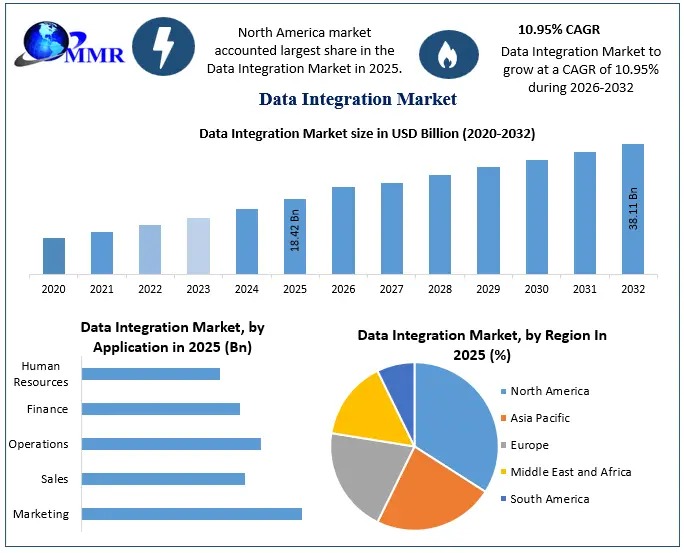
- Data Integration Market valued at USD 18.42 Billion in 2025.
- Expected to reach USD 38.11 Billion by 2032.
- Forecast CAGR of 10.95% between 2026 and 2032.
- Services represent the fastest-growing component segment.
- BFSI and Government emerge as the fastest-growing industry verticals.
- North America maintains a strong regional position through technology investments and enterprise modernization.
Why This Matters Now
Artificial intelligence has shifted from experimentation to enterprise execution. Organizations now compete on how quickly they can transform fragmented data into actionable intelligence rather than simply collecting more information.
That shift makes data integration a boardroom priority. Every cloud migration, AI deployment, customer analytics initiative, cybersecurity program, and automation strategy depends on reliable movement of data across increasingly complex IT environments. Companies unable to integrate data at scale risk delaying AI deployment, reducing operational visibility, and increasing compliance complexity.
Market Overview
The Data Integration Market is entering a new phase of enterprise technology investment. The market was valued at USD 18.42 Billion in 2025 and is projected to reach USD 38.11 Billion by 2032, expanding at a CAGR of 10.95%. That pace signals sustained enterprise spending on platforms capable of connecting diverse applications, cloud environments, databases, and business processes. Every percentage point of market expansion translates into broader enterprise investment in digital infrastructure and AI-ready data ecosystems.
The industry’s evolution is no longer driven solely by traditional ETL workloads. Enterprises increasingly require continuous synchronization across hybrid cloud environments, SaaS platforms, operational technology, IoT deployments, and enterprise applications. Data integration has become the operational layer that enables analytics, automation, compliance, and AI models to operate on trusted information.
Key Trends Driving Growth
AI adoption is fundamentally changing enterprise integration priorities. Organizations increasingly require high-quality, unified datasets before deploying generative AI, machine learning, predictive analytics, and intelligent automation. Clean, governed, and accessible data has become a competitive asset rather than an IT function.
Cloud migration continues to redefine purchasing decisions. Enterprises moving workloads across public, private, and hybrid cloud environments require integration platforms capable of maintaining consistent governance while supporting real-time analytics and application interoperability. This increases demand for scalable cloud-native integration services.
Enterprise automation is also expanding integration requirements. Finance, manufacturing, healthcare, retail, telecommunications, and government agencies increasingly automate workflows that depend on seamless data movement across legacy applications and modern SaaS platforms.
Cybersecurity and regulatory compliance are influencing technology architecture as well. Organizations require centralized visibility into enterprise data movement to strengthen governance, improve audit readiness, and reduce operational risk across distributed IT environments.
Another defining trend is API-driven digital ecosystems. Modern enterprises increasingly expose services through APIs, requiring integration platforms capable of orchestrating data across customers, suppliers, partners, and cloud ecosystems without disrupting business continuity.
Get a free sample:https://www.maximizemarketresearch.com/request-sample/34124/
Segment Insights
- Dominant Segment: The report identifies component-based segmentation, with strong enterprise demand across integration solutions supporting modern digital environments.
- Fastest-Growing Component: Services, driven by increasing requirements to integrate heterogeneous enterprise data sources alongside expanding cloud computing adoption.
- Fastest-Growing Industry Vertical: Banking, Financial Services & Insurance (BFSI) together with Government, as organizations modernize manual processes, improve customer experience, and streamline document-intensive operations through integrated digital platforms.
Regional Growth Story
North America continues to strengthen its position through sustained investment in enterprise software, cloud infrastructure, research and development, and digital modernization. The United States and Canada remain early adopters of AI-enabled enterprise platforms, helping organizations accelerate data-driven decision making and operational automation. These investments reinforce regional technology leadership while encouraging broader adoption across regulated industries.
Across Asia-Pacific, countries including India, China, Japan, and South Korea continue expanding digital infrastructure, enterprise cloud adoption, and AI deployment. Government-led digital transformation initiatives, expanding software ecosystems, and growing enterprise modernization programs are increasing demand for advanced integration capabilities.
Europe remains focused on data governance, digital sovereignty, cybersecurity resilience, and enterprise modernization. Germany and the United Kingdom continue investing in industrial digitalization, cloud transformation, and secure enterprise connectivity, creating long-term opportunities for integration platform providers.
Competitive Landscape
Competition increasingly revolves around platform ecosystems rather than standalone integration tools. Technology vendors are embedding AI capabilities, automation, governance, API management, and cloud orchestration into broader enterprise software portfolios to strengthen customer retention and expand recurring SaaS revenue.
Platform expansion also signals a shift toward end-to-end enterprise data management. Vendors investing in intelligent automation, cloud-native integration, hybrid cloud capabilities, and AI-enabled governance position themselves as strategic transformation partners rather than infrastructure suppliers.
For enterprise buyers, this changes procurement priorities. CIOs increasingly evaluate vendors based on ecosystem compatibility, AI readiness, cybersecurity resilience, scalability, and long-term platform economics instead of isolated integration functionality. Vendors capable of combining integration, governance, automation, and analytics within unified platforms are likely to strengthen competitive positioning as enterprise modernization accelerates.
Recent Developments
- Growing enterprise investment in AI-ready data integration capabilities.
- Increasing adoption of cloud-based integration services across hybrid IT environments.
- Rising implementation within BFSI and government sectors to improve operational efficiency and customer experience.
- Continued enterprise investment in digital transformation, automation, and cloud modernization initiatives.
- North America maintains strong momentum through sustained R&D investments and enterprise technology adoption.
Strategic Implications
Technology leaders increasingly recognize that successful AI programs begin with integrated, trusted, and governed enterprise data. Organizations investing early in modern integration architectures can accelerate automation, improve customer experience, reduce operational complexity, and strengthen regulatory compliance simultaneously.
For software vendors, the opportunity extends beyond integration software itself. Demand increasingly favors intelligent platforms capable of supporting AI deployment, hybrid cloud operations, API ecosystems, real-time analytics, and enterprise-wide automation from a unified technology stack.
Investors should view this market as an enabling technology rather than an isolated software category. Growth in AI, cloud computing, digital transformation, and enterprise modernization directly expands demand for advanced integration capabilities.
Future Outlook
The next stage of enterprise competition will be defined less by who collects the most data and more by who can operationalize it fastest across AI models, cloud platforms, enterprise applications, and digital ecosystems. Organizations building integrated, intelligent, and automated data foundations today will define tomorrow’s digital leaders, while those delaying modernization risk falling permanently behind in the AI-driven platform economy.
Analyst Perspective
“Data integration is becoming the operational backbone of enterprise AI, cloud transformation, and digital modernization. Organizations investing in intelligent integration capabilities today are building the data foundations required for future competitiveness.” — Yash Ghosalkar
About Maximize Market Research
Maximize Market Research Pvt. Ltd. (MMR) is a global market research and consulting company that provides reliable, data-focused, and practical business insights. The firm serves a wide range of industries, including healthcare, pharmaceuticals, technology, automotive, electronics, chemicals, personal care, and consumer goods. Through market forecasts, competitive analysis, strategic consulting, and industry impact assessments, MMR helps organizations understand changing market conditions, identify growth opportunities, and make informed business decisions for long-term success.
2nd Floor, Navale IT Park Phase 3
Pune Banglore Highway, Narhe
Pune, Maharashtra 411041, India
+91 9607365656
sales@maximizemarketresearch.com
