Key Highlights
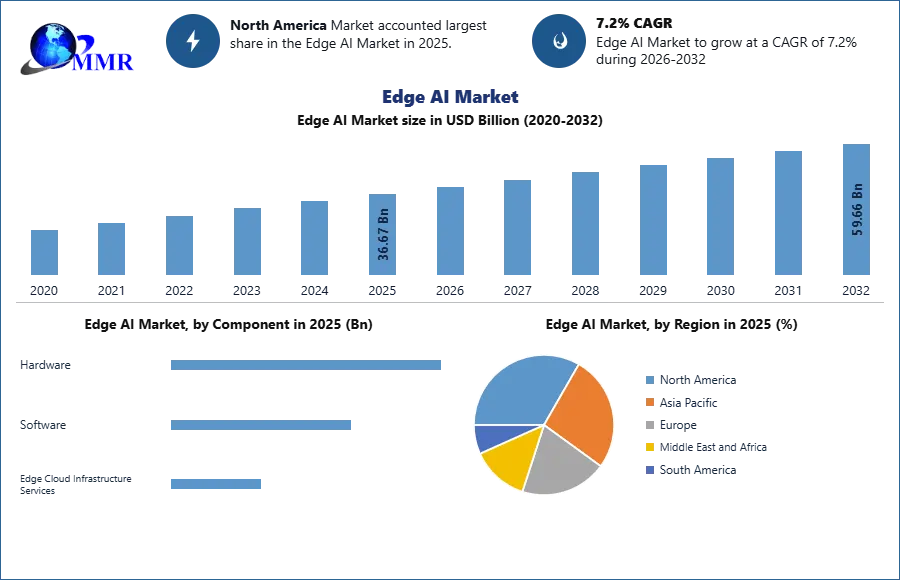
- Edge AI Market was valued at USD 36.67 Billion in 2025.
- Market revenue is expected to reach USD 59.66 Billion by 2032.
- Forecast CAGR stands at 7.2% during 2026–2032.
- Enterprises are moving AI workloads from centralized clouds to intelligent edge infrastructure.
- Manufacturing, healthcare, automotive, retail, and telecommunications continue expanding edge AI deployments.
- 5G networks and distributed computing are accelerating real-time AI adoption.
- AI-enabled cybersecurity and privacy requirements are increasing investment in localized intelligence.
Why This Matters Now
Artificial intelligence is entering a new competitive phase. The race is no longer limited to building larger cloud models; it is increasingly about delivering intelligence exactly where decisions are made. For CIOs, telecom operators, cloud providers, and enterprise technology leaders, Edge AI is becoming a strategic infrastructure investment rather than a technology experiment.
The Edge AI Market, valued at USD 36.67 Billion in 2025 and projected to reach USD 59.66 Billion by 2032 at a CAGR of 7.2%, signals a broader transition toward decentralized computing. That expansion means organizations are investing in distributed AI architectures that reduce latency, strengthen data privacy, improve operational resilience, and enable autonomous decision-making across connected environments.
Market Overview
The next wave of enterprise AI is being built outside traditional data centers. Organizations increasingly require AI inference to occur close to devices generating information, whether inside manufacturing plants, hospitals, connected vehicles, telecom networks, or smart cities. This shift reduces dependence on centralized cloud processing while supporting real-time operational decisions.
Edge AI combines artificial intelligence with edge computing infrastructure to process data locally rather than continuously transmitting information to remote cloud platforms. The result is faster response times, reduced bandwidth consumption, stronger regulatory compliance, and improved cybersecurity posture.
Technology vendors are responding by redesigning hardware, software platforms, AI accelerators, orchestration tools, and edge-native applications. Instead of replacing cloud computing, Edge AI complements hybrid cloud strategies, enabling enterprises to distribute workloads according to latency, security, and business requirements.
Key Trends Driving Growth
Enterprise digital transformation has moved beyond automation toward intelligent operations. Organizations increasingly expect AI systems to monitor equipment, analyze video streams, optimize logistics, detect cybersecurity threats, and automate customer interactions without relying exclusively on cloud connectivity.
Generative AI has also accelerated demand for localized inference. Enterprises want sensitive information processed closer to users while minimizing network congestion and protecting proprietary data. This trend is encouraging investment in edge servers, AI-enabled processors, and intelligent gateways.
Telecommunications operators are integrating Edge AI into network modernization programs. The combination of private 5G, network virtualization, and intelligent edge infrastructure enables telecom providers to offer new enterprise services while improving network efficiency.
Cloud providers are evolving their strategies as well. Rather than competing with edge deployments, hyperscale cloud companies are expanding hybrid architectures that extend AI capabilities from centralized clouds to distributed edge locations.
Cybersecurity remains another powerful catalyst. Processing information locally reduces exposure associated with transmitting large volumes of sensitive data across public networks while supporting compliance with evolving privacy regulations.
Industrial automation is becoming one of the strongest commercial use cases. Manufacturers increasingly deploy computer vision, predictive maintenance, robotics, and quality inspection systems powered by Edge AI to improve productivity while reducing operational downtime.
Get a free sample:https://www.maximizemarketresearch.com/request-sample/190417/
Segment Insights
- Dominant Segment: Information not explicitly specified in the supplied report.
- Fastest-Growing Segment: Information not explicitly specified in the supplied report.
- Edge AI adoption continues expanding across manufacturing, automotive, healthcare, telecommunications, retail, and smart infrastructure applications.
- AI-enabled hardware, software platforms, and intelligent edge infrastructure remain central investment priorities.
- Enterprise demand increasingly favors low-latency AI inference, distributed computing, and privacy-focused deployments.
Regional Growth Story
North America continues strengthening its leadership through advanced AI research, mature cloud ecosystems, semiconductor innovation, and early enterprise adoption. Large-scale investments from hyperscale cloud providers and technology companies continue expanding intelligent edge infrastructure while supporting next-generation enterprise applications.
Asia-Pacific is becoming a major deployment engine. China, Japan, South Korea, and India continue investing in smart manufacturing, industrial automation, digital infrastructure, and connected mobility. Expanding 5G coverage is accelerating commercial adoption of edge-enabled AI services across multiple industries.
Europe is emphasizing trustworthy AI, industrial modernization, and digital sovereignty. Germany and the United Kingdom continue investing in Industry 4.0 initiatives, secure digital infrastructure, and advanced manufacturing technologies that increasingly rely on intelligent edge computing.
Emerging markets are also gaining momentum as governments expand digital infrastructure, modernize telecommunications networks, and encourage AI-driven economic development.
Competitive Landscape
Competition is moving beyond standalone AI models toward complete technology ecosystems. Success increasingly depends on integrating semiconductors, edge hardware, cloud orchestration, AI software, networking, cybersecurity, and developer platforms into unified enterprise solutions.
Technology leaders are investing in specialized AI processors that deliver higher inference performance with lower power consumption. This signals an industry shift toward application-specific intelligence rather than general-purpose computing.
Cloud providers are strengthening hybrid cloud portfolios to maintain relevance as AI workloads become increasingly distributed. Their competitive advantage now depends on seamless orchestration between centralized infrastructure and intelligent edge environments.
Telecommunications operators are repositioning themselves as digital platform providers by integrating Edge AI into 5G services, private networks, and enterprise connectivity offerings. This creates opportunities for recurring software and managed-service revenues beyond traditional connectivity.
Software vendors are expanding AI lifecycle management, model deployment, and automation capabilities, enabling enterprises to scale Edge AI across geographically distributed operations. The competitive battleground is therefore shifting from individual products toward comprehensive AI ecosystems that simplify deployment and maximize business outcomes.
Recent Developments
- AI deployment strategies increasingly combine cloud computing with distributed edge intelligence.
- Enterprise investments continue expanding across intelligent automation, industrial AI, and real-time analytics.
- Telecommunications providers are integrating Edge AI with 5G-enabled enterprise services.
- Organizations are prioritizing localized AI processing to strengthen cybersecurity and regulatory compliance.
- Technology vendors continue advancing specialized AI hardware and software designed for edge inference.
Strategic Implications
Technology leaders should view Edge AI as a foundational digital capability rather than an isolated infrastructure upgrade. Competitive advantage will increasingly depend on the ability to process information closer to operational environments while maintaining centralized governance across hybrid cloud architectures.
Investors should monitor companies capable of integrating AI hardware, networking, cloud platforms, cybersecurity, and enterprise software into scalable ecosystems. Platform economics increasingly favor vendors offering end-to-end deployment rather than standalone components.
For enterprise buyers, procurement priorities are shifting toward interoperability, AI lifecycle management, security-by-design, and operational scalability. Organizations that align Edge AI investments with business workflows are more likely to achieve measurable returns than those pursuing isolated pilot projects.
Future Outlook
The next phase of enterprise AI will be defined less by model size and more by deployment intelligence. Organizations that successfully combine Edge AI, hybrid cloud, automation, cybersecurity, and next-generation connectivity will create faster decision cycles, stronger operational resilience, and differentiated customer experiences. Those that delay modernization risk becoming dependent on slower, centralized architectures while digital leaders build autonomous enterprises powered by intelligence at the edge.
Analyst Perspective
“Edge AI is evolving from a specialized computing model into a strategic enterprise capability. Organizations that integrate intelligent edge infrastructure with cloud platforms, automation, and secure connectivity will be positioned to unlock the next generation of AI-driven business value.” — Yash Ghosalkar, Analyst
About Maximize Market Research
Maximize Market Research Pvt. Ltd. (MMR) is a global market research and consulting company that provides reliable, data-focused, and practical business insights. The firm serves a wide range of industries, including healthcare, pharmaceuticals, technology, automotive, electronics, chemicals, personal care, and consumer goods. Through market forecasts, competitive analysis, strategic consulting, and industry impact assessments, MMR helps organizations understand changing market conditions, identify growth opportunities, and make informed business decisions for long-term success.
2nd Floor, Navale IT Park Phase 3
Pune Banglore Highway, Narhe
Pune, Maharashtra 411041, India
+91 9607365656
sales@maximizemarketresearch.com
