Key Highlights
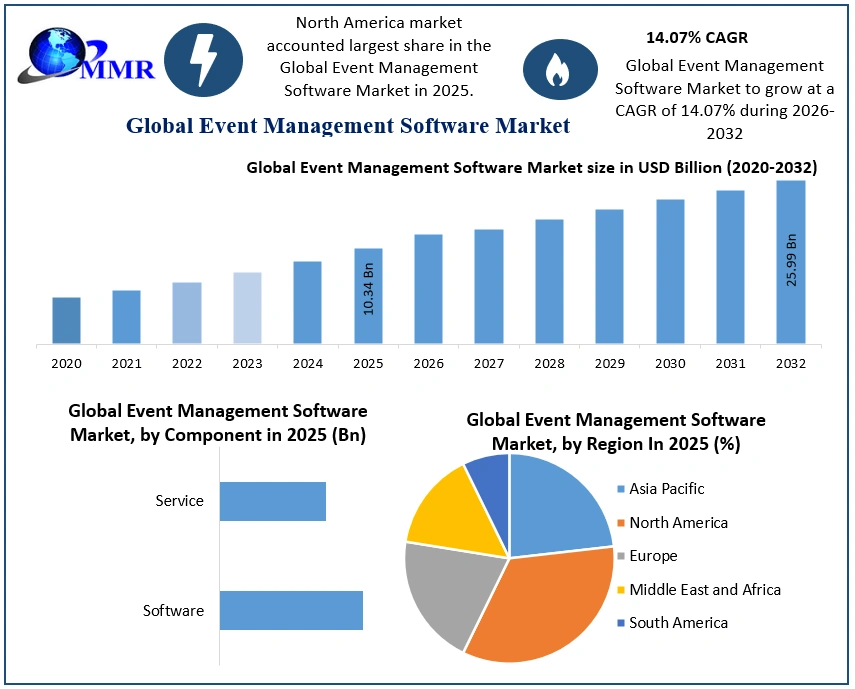
- Market valued at USD 10.34 Billion in 2025, signaling rapid enterprise adoption of digital event infrastructure.
- Expected to reach USD 25.99 Billion by 2032, reflecting strong enterprise shift toward automated engagement platforms.
- CAGR of 14.07% highlights sustained demand for cloud-native and AI-enabled event orchestration systems.
- Growth anchored in hybrid work models, virtual conferencing scale, and enterprise experience transformation.
- Expansion closely tied to SaaS penetration and digital experience platform consolidation.
Why This Matters Now
Enterprise communication has shifted from physical coordination to real-time, data-driven engagement systems. Event platforms are no longer administrative tools; they are becoming intelligence layers for customer experience, workforce collaboration, and marketing automation.
The acceleration toward hybrid work and distributed enterprise ecosystems has forced organizations to replace fragmented event workflows with integrated software stacks. This transition is reshaping how companies engage customers, partners, and employees at scale.
Market Overview
The Event Management Software Market is evolving into a core component of enterprise digital infrastructure. Platforms now integrate registration automation, attendee analytics, virtual conferencing, and AI-driven personalization into unified ecosystems.
The market size reached USD 10.34 Billion in 2025, reflecting enterprise investment in scalable digital engagement tools. This growth signals a structural shift in how organizations manage conferences, webinars, product launches, and internal corporate events. The projected expansion to USD 25.99 Billion by 2032 at a CAGR of 14.07% highlights sustained demand for cloud-based orchestration systems that replace legacy manual processes.
AI integration is reshaping platform capabilities. Predictive attendance modeling, real-time engagement scoring, and automated content recommendations are becoming standard features. For enterprises, this reduces operational complexity while increasing measurable ROI from events.
Key Trends Driving Growth
AI-driven automation is redefining event lifecycle management. Vendors are embedding machine learning into scheduling, attendee targeting, and post-event analytics to improve engagement efficiency.
Cloud migration is accelerating platform scalability. Enterprises are shifting from on-premise tools to SaaS-based event systems to support global hybrid audiences and reduce infrastructure overhead.
Hybrid event infrastructure is becoming standard. Organizations now demand seamless integration between physical venues and digital platforms, creating demand for unified orchestration layers.
Data-driven marketing integration is expanding. Event platforms are increasingly linked with CRM and marketing automation systems, allowing enterprises to convert engagement data into revenue pipelines.
Cybersecurity and data governance are gaining priority as events handle large volumes of personal and enterprise data across distributed networks.
Get a free sample:https://www.maximizemarketresearch.com/request-sample/14484/
Segment Insights
- Dominant Segment: Not explicitly disclosed in the supplied report source. However, enterprise adoption trends indicate strong concentration in cloud-based deployment models and large-scale corporate use cases.
- Fastest-Growing Segment: Not specified in the source data; growth is broadly observed in AI-enabled and hybrid event management solutions driven by automation demand.
The absence of granular segmentation data highlights a broader industry transition: value is shifting from standalone event tools toward integrated enterprise experience platforms.
Regional Growth Story
North America remains a leading adopter due to high enterprise SaaS penetration and mature digital marketing ecosystems. Organizations in this region prioritize automation, analytics integration, and AI-powered engagement tools.
Europe is advancing through regulatory-driven digital transformation and increased demand for secure, compliant event platforms. Enterprises are aligning software procurement with data governance frameworks.
Asia-Pacific is emerging as a high-growth region, driven by rapid enterprise digitization, expanding IT services ecosystems, and increasing adoption of hybrid event models across corporate and government sectors.
Across all regions, cloud-first deployment strategies and remote collaboration trends are converging to standardize event software as a core enterprise utility rather than a supporting tool.
Competitive Landscape
Competition in the Event Management Software Market is intensifying as vendors move beyond feature-based offerings toward platform ecosystems. The shift signals consolidation around integrated SaaS suites combining CRM, analytics, marketing automation, and virtual event infrastructure.
AI capability has become a primary differentiation axis. Vendors investing in generative AI for content creation, attendee personalization, and predictive engagement are positioning themselves as enterprise workflow platforms rather than niche tools.
Strategic partnerships between software providers and cloud infrastructure companies are reshaping scalability and global delivery models. These alliances indicate a transition toward hyperscaler-dependent event ecosystems where compute, data, and engagement layers are tightly integrated.
Pricing power is increasingly tied to platform breadth. Vendors offering end-to-end digital experience stacks are capturing higher enterprise contract values compared to point-solution providers.
The competitive direction signals a structural shift: event management software is converging with customer experience platforms, reducing fragmentation across enterprise software landscapes.
Recent Developments
- Expansion of AI-driven automation capabilities in event lifecycle management platforms.
- Increased integration of event software with CRM and enterprise marketing ecosystems.
- Accelerated adoption of cloud-native architectures for global scalability and hybrid events.
- Growing emphasis on data security features and compliance-focused platform design.
- Rising investment in real-time analytics and attendee behavior tracking systems.
Strategic Implications
Enterprises are redefining event platforms as revenue-linked intelligence systems rather than administrative tools. This shift elevates event software into the enterprise data stack alongside CRM and marketing automation systems.
Cloud providers benefit from increasing dependency on scalable infrastructure to support global hybrid events. SaaS vendors gain recurring revenue advantages through platform lock-in and integrated workflow ecosystems.
For telecom operators and network providers, rising hybrid event traffic reinforces demand for low-latency connectivity and edge computing capabilities. This creates indirect alignment between event software performance and network modernization strategies.
AI integration is emerging as the primary competitive lever. Vendors that fail to embed intelligence across event workflows risk commoditization as enterprises consolidate software vendors.
Future Outlook
The market’s trajectory toward USD 25.99 Billion by 2032 reflects more than software expansion; it signals the redefinition of enterprise engagement architecture. The next phase will be defined by AI-native event ecosystems that autonomously manage audience targeting, engagement optimization, and post-event monetization.
Digital leaders will operate unified, intelligent engagement platforms. Laggards will remain trapped in fragmented tools that cannot scale across hybrid enterprise environments.
Analyst Perspective
“Event management software is no longer a coordination layer. It is becoming an intelligence engine for enterprise engagement, where AI, cloud scalability, and real-time data determine competitive advantage,” said Yash Ghosalkar, Analyst at Maximize Market Research.
About Maximize Market Research
Maximize Market Research Pvt. Ltd. (MMR) is a global market research and consulting company that provides reliable, data-focused, and practical business insights. The firm serves a wide range of industries, including healthcare, pharmaceuticals, technology, automotive, electronics, chemicals, personal care, and consumer goods. Through market forecasts, competitive analysis, strategic consulting, and industry impact assessments, MMR helps organizations understand changing market conditions, identify growth opportunities, and make informed business decisions for long-term success.
2nd Floor, Navale IT Park Phase 3
Pune Banglore Highway, Narhe
Pune, Maharashtra 411041, India
+91 9607365656
sales@maximizemarketresearch.com
