Key Highlights
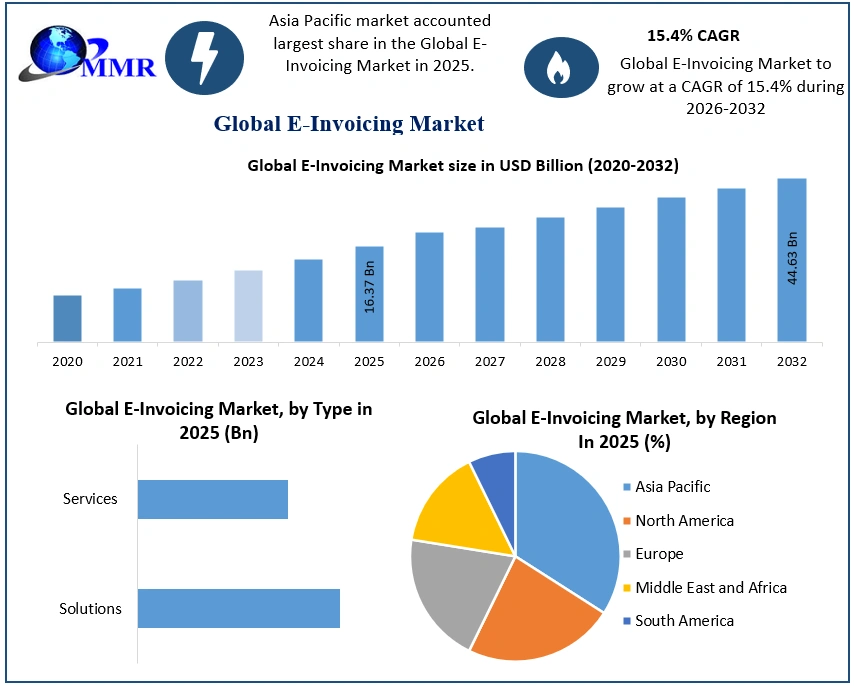
- Market valued at USD 16.37 Billion in 2025, signaling rapid enterprise digitization of financial workflows
- Expected to reach USD 44.63 Billion by 2032, driven by automation and regulatory compliance mandates
- CAGR of 15.4% reflects sustained enterprise and government push toward paperless finance ecosystems
- Cloud-native invoicing platforms are becoming the backbone of modern ERP and accounting systems
- AI-driven invoice validation and fraud detection are reshaping enterprise finance operations
Why This Matters Now
Finance systems are becoming real-time digital control towers for enterprises under pressure from regulators, auditors, and global supply chains. E-invoicing is no longer a back-office upgrade; it is a compliance-critical infrastructure layer embedded into enterprise ERP, taxation systems, and cross-border trade workflows.
The acceleration to USD 44.63 Billion by 2032 signals a structural shift in how enterprises process transactions, enforce tax compliance, and integrate with government digital infrastructure. For CIOs and CFOs, delayed adoption increases operational risk, audit exposure, and integration debt across fragmented legacy billing systems.
Market Overview
The E-Invoicing Market is evolving into a foundational pillar of enterprise digital transformation. At USD 16.37 Billion in 2025, the market reflects strong institutional adoption of structured digital invoicing systems across public and private sectors. Governments are mandating electronic invoice submissions to improve tax transparency, reduce fraud, and increase fiscal efficiency.
This transition is not limited to compliance. Enterprises are embedding invoicing platforms into broader ERP ecosystems, enabling real-time reconciliation, automated tax calculations, and seamless integration with procurement and supply chain platforms. As a result, invoicing is shifting from static documentation to dynamic financial data exchange.
The projected growth to USD 44.63 Billion by 2032 highlights how financial digitization is converging with cloud computing, API-first architectures, and AI-powered automation. Enterprises that fail to modernize invoicing infrastructure risk fragmentation across financial operations and regulatory non-compliance.
Key Trends Driving Growth
Cloud migration remains the primary enabler of e-invoicing adoption as enterprises move away from on-premise accounting systems toward SaaS-based financial platforms. This shift allows real-time invoice validation, centralized data governance, and seamless regulatory updates across jurisdictions.
Artificial intelligence is increasingly embedded in invoicing workflows. AI models are being used to detect anomalies, flag fraudulent transactions, and automate invoice classification. Machine learning systems improve accuracy in tax calculation and reduce manual intervention across finance teams.
Governments across major economies are tightening digital tax reporting requirements. Mandatory e-invoicing frameworks in markets such as Europe, India, and parts of Asia are accelerating adoption among SMEs and large enterprises. This regulatory push is forcing rapid standardization of invoice formats and transmission protocols.
API-driven integration is another critical driver. Enterprises are prioritizing interoperable invoicing systems that connect seamlessly with ERP, procurement, and banking platforms. This is enabling end-to-end automation of procure-to-pay cycles.
Get a free sample:https://www.maximizemarketresearch.com/request-sample/31243/
Segment Insights
- Dominant Segment: Enterprise-grade invoicing solutions integrated with ERP systems dominate adoption due to high transaction volumes, regulatory complexity, and global compliance requirements across multinational corporations
- Fastest-Growing Segment: Cloud-based e-invoicing platforms are expanding rapidly as SMEs and mid-market enterprises adopt subscription-based financial software models to reduce infrastructure costs and improve scalability
Regional Growth Story
North America leads adoption through advanced enterprise SaaS ecosystems and strong integration of invoicing platforms with cloud ERP systems. The United States is witnessing rapid deployment of AI-enabled financial automation tools across large enterprises.
Europe remains structurally significant due to stringent VAT reporting regulations and mandatory e-invoicing frameworks across multiple countries. Digital tax compliance policies continue to push enterprises toward standardized electronic invoice systems.
Asia-Pacific is emerging as the fastest-expanding adoption zone, driven by large-scale digital tax reforms and government-led e-invoicing mandates. India is accelerating adoption through GST-linked invoicing infrastructure, while China and Southeast Asia are strengthening digital trade documentation frameworks.
Competitive Landscape
The competitive environment is defined by platform convergence rather than standalone invoicing vendors. Global ERP providers and cloud platforms are integrating e-invoicing capabilities directly into enterprise ecosystems, reducing reliance on fragmented third-party tools.
Major enterprise software providers are strengthening their positions through deep ERP-invoicing integration, API marketplaces, and AI-driven financial automation modules. This shift signals a consolidation trend where invoicing becomes a native capability within broader enterprise cloud platforms.
The strategic implication is clear: competition is no longer about invoice processing alone but about controlling enterprise financial data flow. Vendors that control invoicing infrastructure gain leverage across taxation, analytics, procurement, and treasury workflows.
This consolidation is also reshaping pricing power. Platform-led ecosystems are locking enterprises into integrated financial stacks, increasing switching costs and reinforcing long-term vendor dominance in enterprise finance digitization.
Recent Developments
- Expansion of cloud-based ERP ecosystems embedding native e-invoicing modules
- Increased deployment of AI-driven fraud detection in financial transaction workflows
- Government-led mandates accelerating structured invoice adoption in emerging economies
- Rising API-based integration between invoicing systems and banking networks
- Growing enterprise investments in automated tax compliance infrastructure
Strategic Implications
For enterprises, e-invoicing is now a strategic compliance and efficiency layer rather than a transactional tool. Finance leaders must align invoicing modernization with broader ERP transformation and cloud migration strategies.
For technology vendors, differentiation is shifting toward AI-enabled automation, interoperability, and regulatory adaptability across jurisdictions. The ability to dynamically update compliance frameworks across geographies is becoming a core competitive advantage.
For governments, digital invoicing systems are evolving into real-time fiscal intelligence tools, improving tax collection efficiency and reducing economic leakage.
For investors, the market represents a long-cycle infrastructure opportunity tied to enterprise digitization, SaaS expansion, and regulatory modernization.
Future Outlook
The E-Invoicing Market will evolve into a fully automated, AI-orchestrated financial transaction layer embedded within global digital commerce ecosystems. Enterprises that treat invoicing as a strategic data infrastructure layer will achieve faster financial closure, lower compliance risk, and higher operational agility, while laggards remain constrained by fragmented, manual finance systems.
Analyst Perspective
“The e-invoicing ecosystem is moving beyond compliance into intelligent financial automation. Enterprises are redesigning their finance architecture around real-time data exchange, AI validation, and cloud-native integration,” said Yash Ghosalkar, Analyst, Maximize Market Research.
About Maximize Market Research
Maximize Market Research Pvt. Ltd. (MMR) is a global market research and consulting company that provides reliable, data-focused, and practical business insights. The firm serves a wide range of industries, including healthcare, pharmaceuticals, technology, automotive, electronics, chemicals, personal care, and consumer goods. Through market forecasts, competitive analysis, strategic consulting, and industry impact assessments, MMR helps organizations understand changing market conditions, identify growth opportunities, and make informed business decisions for long-term success.
2nd Floor, Navale IT Park Phase 3
Pune Banglore Highway, Narhe
Pune, Maharashtra 411041, India
+91 9607365656
sales@maximizemarketresearch.com
