Key Highlights
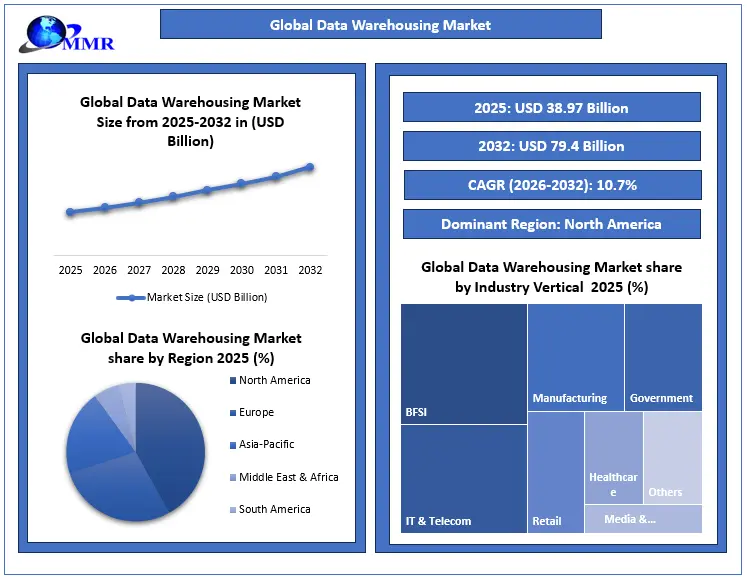
- Market valued at USD 38.97 billion in 2025, projected to reach USD 78.1 billion by 2032
- Expanding at a CAGR of 10.7% during the forecast period
- Growth driven by cloud adoption, enterprise analytics expansion, and AI-driven insights
- Increasing enterprise shift toward centralized and scalable data infrastructure
- Rising demand for real-time analytics and unified data platforms across industries
Why This Matters Now
Enterprises are no longer treating data warehousing as a back-office function. It has become a strategic control layer for AI deployment, digital operations, and enterprise decision intelligence. The surge from USD 38.97 billion to USD 78.1 billion signals a structural shift where data architecture is directly tied to competitive advantage.
Cloud-first modernization, AI integration, and data-driven automation are forcing CIOs and CTOs to rethink legacy systems. The pressure is immediate: organizations that fail to modernize their warehousing layers risk slower analytics cycles, fragmented data visibility, and weaker AI model performance.
Market Overview
The Data Warehousing Market is evolving into a foundational pillar of enterprise digital infrastructure. Organizations are consolidating structured and semi-structured data into scalable environments designed to support analytics, business intelligence, and AI workloads.
According to the MMR report, the market is valued at USD 38.97 billion in 2025 and is expected to reach USD 78.1 billion by 2032, expanding at a CAGR of 10.7% during the forecast period. This growth reflects sustained enterprise investment in cloud-based analytics ecosystems and AI-enabled data processing frameworks.
The market’s expansion is closely linked to enterprise digitization programs, where data warehousing acts as the backbone for operational intelligence, customer analytics, and predictive modeling. Businesses are prioritizing faster query performance, unified data access, and scalable architectures to support real-time decision-making.
Key Trends Driving Growth
A defining trend reshaping the market is the acceleration of cloud adoption. Enterprises are migrating from on-premise systems to cloud-based data warehousing environments to improve scalability, reduce infrastructure overheads, and enable elastic compute for analytics workloads.
AI-driven insights are another structural driver. Organizations are embedding machine learning models directly into data warehouses to reduce latency between data ingestion and insight generation. This shift is turning warehouses into active intelligence systems rather than static repositories.
Digital transformation initiatives across banking, retail, telecom, and healthcare are further accelerating demand. Enterprises require unified data platforms that support omnichannel analytics, customer behavior modeling, and operational optimization.
Cybersecurity and data governance pressures are also influencing architecture decisions. As data volumes grow, enterprises are investing in stronger access control, encryption layers, and compliance-driven data management frameworks.
Get a free sample:https://www.maximizemarketresearch.com/request-sample/52612/
Segment Insights
- Dominant Segment: Not specified in the provided MMR report data
- Fastest-Growing Segment: Not specified in the provided MMR report data
Despite limited segmentation disclosure in the source, enterprise demand patterns indicate a broader shift toward cloud-integrated and AI-compatible warehousing environments. The market is increasingly shaped by platforms that can unify analytics, machine learning, and real-time data processing in a single architecture.
The absence of clearly defined segment leadership in public data highlights an important industry signal: differentiation is no longer based on static segmentation but on platform adaptability and ecosystem integration.
Regional Growth Story
Global adoption of data warehousing technologies is expanding across major digital economies including the United States, China, India, Germany, Japan, South Korea, and the United Kingdom.
North America continues to lead enterprise adoption due to high cloud penetration and mature analytics ecosystems. Large-scale investments by technology firms and cloud service providers are reinforcing regional leadership in AI-driven data infrastructure.
Asia-Pacific is emerging as a high-growth region, supported by rapid digital transformation in India and China. Enterprises in these markets are investing heavily in cloud migration, telecom modernization, and large-scale data platform deployment.
Europe is advancing through regulatory-driven modernization, where data sovereignty requirements are shaping hybrid and localized warehousing strategies. Enterprises are balancing compliance with scalability, leading to increased adoption of hybrid cloud architectures.
Competitive Landscape
The competitive environment is defined by platform consolidation and cloud ecosystem expansion rather than isolated product innovation. Technology providers are increasingly competing on integrated data platforms that combine warehousing, analytics, and AI capabilities.
Cloud hyperscalers are strengthening their positions by embedding advanced analytics engines into their ecosystems. This shift signals a transition from infrastructure-based competition to platform-based dominance, where vendor lock-in is replaced by ecosystem dependency.
Specialized data management providers are responding by focusing on interoperability, real-time analytics performance, and hybrid deployment flexibility. Their strategic positioning reflects growing enterprise demand for multi-cloud compatibility and workload portability.
The broader competitive signal is clear: leadership in the Data Warehousing Market is shifting toward companies that can unify AI, analytics, and cloud infrastructure into a single operational layer. This is reshaping pricing power, enterprise adoption cycles, and long-term platform control.
Recent Developments
- Expansion of cloud-native data warehousing deployments across enterprise sectors
- Increased integration of AI and machine learning capabilities into analytics platforms
- Rising enterprise investment in hybrid and multi-cloud data architectures
- Strengthening focus on real-time data processing and streaming analytics systems
- Growing emphasis on data governance, security, and regulatory compliance frameworks
Strategic Implications
For enterprises, data warehousing is becoming a central decision infrastructure rather than a storage function. CIOs are prioritizing platforms that reduce data latency and improve AI readiness across business units.
For cloud providers, the market signals intensified competition around integrated analytics ecosystems. Control over data pipelines increasingly translates into control over enterprise AI workloads.
For telecom and digital infrastructure providers, rising data volumes are driving demand for low-latency connectivity, edge-enabled analytics, and distributed data processing frameworks.
For investors, the structural CAGR of 10.7% indicates sustained multi-year expansion tied directly to AI adoption cycles and cloud transformation budgets.
Future Outlook
The next phase of the Data Warehousing Market will be defined by the convergence of AI-native analytics, autonomous data pipelines, and fully cloud-orchestrated enterprise intelligence systems. Organizations that treat data warehousing as a dynamic intelligence engine will widen the gap over firms still operating legacy architectures.
Analyst Perspective
“The Data Warehousing Market is transitioning from infrastructure modernization to intelligence orchestration. Enterprises are no longer buying storage—they are buying real-time decision velocity powered by AI and cloud ecosystems,” said Yash Ghosalkar, Analyst at Maximize Market Research.
About Maximize Market Research
Maximize Market Research Pvt. Ltd. (MMR) is a global market research and consulting company that provides reliable, data-focused, and practical business insights. The firm serves a wide range of industries, including healthcare, pharmaceuticals, technology, automotive, electronics, chemicals, personal care, and consumer goods. Through market forecasts, competitive analysis, strategic consulting, and industry impact assessments, MMR helps organizations understand changing market conditions, identify growth opportunities, and make informed business decisions for long-term success.
2nd Floor, Navale IT Park Phase 3
Pune Banglore Highway, Narhe
Pune, Maharashtra 411041, India
+91 9607365656
sales@maximizemarketresearch.com
