Key Highlights
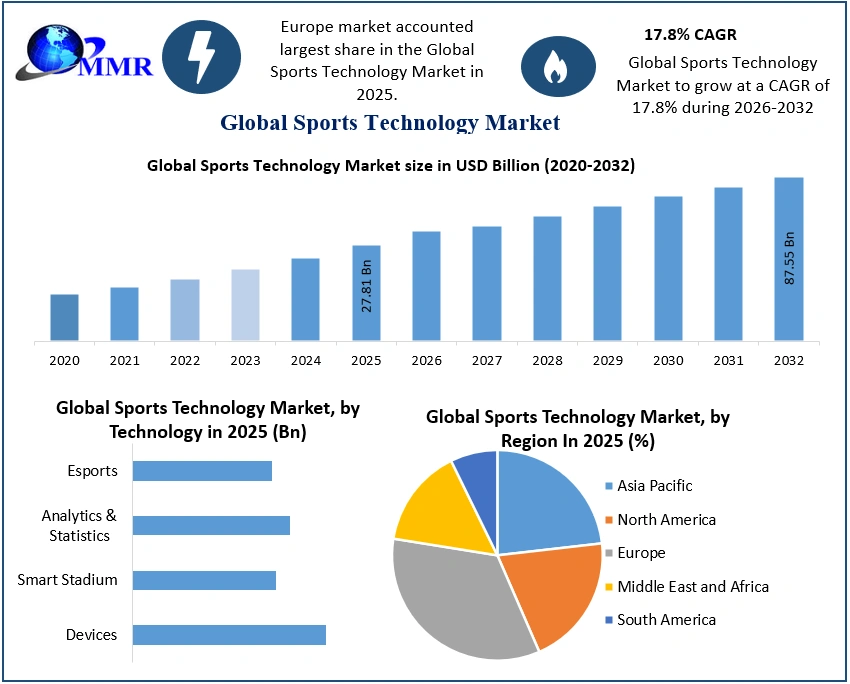
- Market size: USD 27.81 Billion in 2025
- Forecast value: USD 87.55 Billion by 2032
- CAGR: 17.8% (2026–2032)
- Rapid integration of AI-driven performance analytics across sports ecosystems
- Expansion of cloud-based sports platforms and real-time data processing
- Growing convergence of broadcasting, analytics, and fan engagement technologies
- Digital infrastructure modernization across professional sports organizations
Why This Matters Now
Sports organizations are no longer competing only on the field. They are competing on data infrastructure, latency, and AI-driven decision intelligence. The acceleration toward connected stadiums, cloud-based analytics, and real-time performance monitoring is redefining competitive advantage in global sports.
The Sports Technology Market expansion to USD 87.55 Billion signals a structural shift. Sports enterprises, broadcasters, and leagues are adopting enterprise-grade digital systems to monetize engagement, optimize athlete performance, and scale global fan ecosystems. Technology stacks are becoming as critical as coaching strategies.
Market Overview
The Sports Technology Market is transitioning from peripheral digital tools to core operational infrastructure for global sports enterprises. Valued at USD 27.81 Billion in 2025, the market is projected to reach USD 87.55 Billion by 2032, growing at a CAGR of 17.8% during 2026–2032, according to Maximize Market Research.
This growth reflects a broader transformation in how sports ecosystems operate. AI, cloud computing, and connected devices are now embedded into training, broadcasting, ticketing, and fan engagement systems. Sports organizations are adopting integrated digital platforms that unify performance analytics, content distribution, and audience monetization.
The shift is no longer experimental. It is structural. Sports institutions are evolving into data-driven enterprises where competitive advantage depends on computational speed, predictive modeling, and real-time insights.
Key Trends Driving Growth
Artificial intelligence is becoming the central intelligence layer in sports technology ecosystems. AI models are increasingly used for player tracking, injury prediction, tactical optimization, and automated video analysis. This shift is reducing reliance on manual scouting and traditional performance assessment methods.
Cloud computing adoption is accelerating across sports organizations. Cloud-native platforms enable real-time data ingestion from wearables, cameras, and IoT-enabled stadium systems. This supports scalable analytics and remote collaboration across teams, broadcasters, and analysts.
Digital transformation initiatives are also reshaping fan engagement models. Sports franchises are deploying mobile-first platforms, immersive content systems, and personalized streaming experiences. This is increasing monetization opportunities beyond traditional ticketing and broadcasting revenue.
Cybersecurity has become a critical investment area as sports organizations digitize operations. Sensitive athlete data, proprietary analytics models, and fan engagement platforms require enterprise-grade protection against cyber threats and data breaches.
Edge computing adoption is increasing in smart stadium environments. Real-time processing at venue level reduces latency in live analytics, automated replays, and in-stadium digital experiences, improving both operational efficiency and fan engagement.
Get a free sample:https://www.maximizemarketresearch.com/request-sample/29807/
Segment Insights
- Dominant Segment: Not explicitly specified in the provided Maximize Market Research dataset
- Fastest-Growing Segment: Not explicitly specified in the provided Maximize Market Research dataset
The report indicates broad-based adoption across multiple sports technology categories rather than isolating a single dominant or fastest-growing segment. Growth is distributed across analytics platforms, smart infrastructure, wearable technologies, and digital engagement solutions.
Enterprise demand patterns suggest increasing convergence between performance analytics and fan engagement systems, driven by unified data infrastructure requirements.
Regional Growth Story
Growth in the Sports Technology Market is concentrated across advanced digital economies and rapidly digitizing sports ecosystems.
In the United States, sports leagues and broadcasters are driving large-scale adoption of AI-powered analytics and cloud-based content delivery platforms. Investment is focused on enhancing viewer engagement and optimizing performance analytics.
The China market is expanding through state-supported sports modernization programs and digital infrastructure upgrades, particularly in smart stadium development and athlete monitoring systems.
In India, rapid growth in digital sports consumption and mobile-first engagement platforms is accelerating adoption of cloud-based sports streaming and analytics solutions.
European markets including Germany and the United Kingdom are prioritizing data governance, sports analytics integration, and AI-enabled performance optimization across professional leagues.
Japan and South Korea are advancing high-density digital sports ecosystems supported by strong telecommunications infrastructure and early adoption of immersive fan engagement technologies.
Competitive Landscape
The competitive environment in the Sports Technology Market is defined by platform convergence rather than isolated product competition. The market is increasingly shaped by integrated ecosystems combining analytics software, cloud infrastructure, and real-time data platforms.
Technology providers are moving toward end-to-end sports intelligence stacks that unify athlete performance data, broadcasting workflows, and fan engagement systems. This signals a shift from point solutions to platform dominance.
Cloud providers and AI platform developers are strengthening their position as backbone infrastructure providers for sports ecosystems. Their role is expanding from hosting services to strategic enablers of predictive analytics and immersive digital experiences.
For sports organizations, competitive advantage is increasingly tied to vendor lock-in within integrated ecosystems. The ability to control data pipelines, analytics layers, and content distribution channels is becoming a primary differentiator.
Recent Developments
- Expansion of AI-driven sports analytics platforms across professional leagues globally
- Increased deployment of cloud-native sports data infrastructure for real-time performance tracking
- Growth in smart stadium technologies integrating IoT sensors and edge computing systems
- Rising adoption of digital fan engagement platforms supporting personalized content delivery
- Accelerated investment in cybersecurity frameworks for sports data protection
Strategic Implications
The Sports Technology Market is shifting decision-making power from traditional sports management structures to data-driven digital ecosystems. Organizations that integrate AI, cloud, and real-time analytics will control performance optimization and fan monetization layers.
Telecom operators and cloud providers are becoming strategic partners in sports infrastructure development, particularly in latency-sensitive applications such as live streaming and in-stadium experiences.
Investors are increasingly evaluating sports technology firms not as niche vendors but as enterprise software and data infrastructure players. Valuation models are shifting toward recurring revenue, platform scalability, and ecosystem integration.
Future Outlook
The next phase of sports competition will be defined less by physical performance alone and more by which organizations build the most intelligent, low-latency, AI-driven digital sports ecosystems at scale.
Analyst Perspective
“Sports technology is evolving into a real-time intelligence layer for global sports ecosystems. The shift from traditional analytics to AI-driven, cloud-native platforms is fundamentally redefining how performance, engagement, and monetization are engineered across the industry.”
— Yash Ghosalkar, Analyst, Maximize Market Research
About Maximize Market Research
Maximize Market Research Pvt. Ltd. (MMR) is a global market research and consulting company that provides reliable, data-focused, and practical business insights. The firm serves a wide range of industries, including healthcare, pharmaceuticals, technology, automotive, electronics, chemicals, personal care, and consumer goods. Through market forecasts, competitive analysis, strategic consulting, and industry impact assessments, MMR helps organizations understand changing market conditions, identify growth opportunities, and make informed business decisions for long-term success.
2nd Floor, Navale IT Park Phase 3
Pune Banglore Highway, Narhe
Pune, Maharashtra 411041, India
+91 9607365656
sales@maximizemarketresearch.com
