Key Highlights
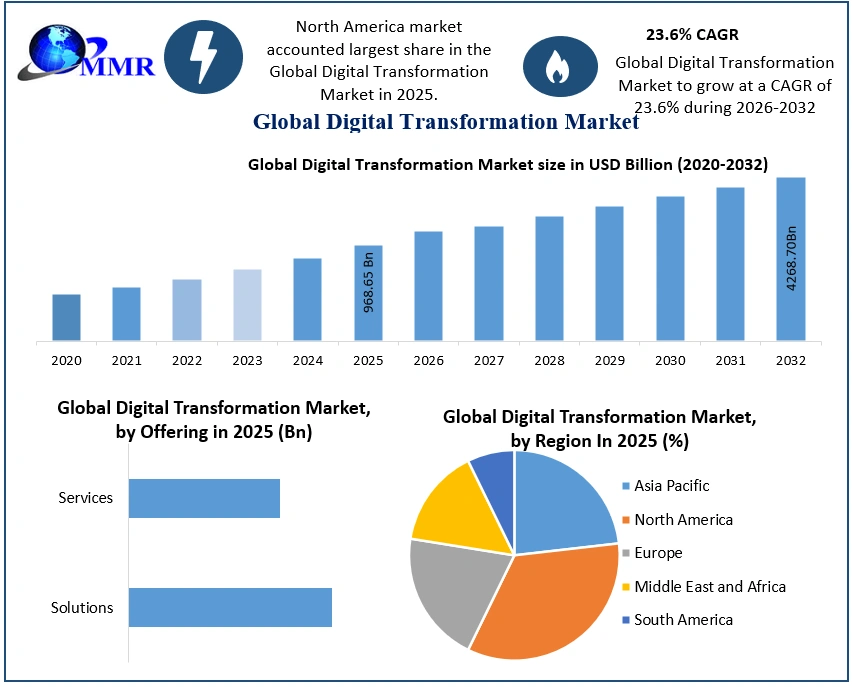
- Market size: USD 968.65 Billion (2025)
- Forecast value: USD 4268.70 Billion by 2032
- CAGR: 23.6% during 2025–2032
- Driven by AI-led enterprise modernization and cloud-first strategies
- Telecom operators accelerating 5G, edge, and software-defined networks
Why This Matters Now
Enterprises are moving from incremental IT upgrades to full-stack digital reinvention. AI workloads, cloud-native applications, and real-time analytics are forcing CIOs to rebuild core infrastructure rather than optimize legacy systems.
The Digital Transformation Market reflects this structural shift. At USD 968.65 Billion in 2025, growth signals capital reallocation from traditional IT spending to intelligent automation platforms, cybersecurity frameworks, and hybrid cloud ecosystems. The projected rise to USD 4268.70 Billion by 2032 highlights how digital capability is becoming a core determinant of enterprise competitiveness.
Telecom operators, cloud providers, and software vendors are converging into integrated platforms, reshaping competitive boundaries across IT and telecommunications.
Market Overview
The Digital Transformation Market is no longer a software upgrade cycle. It is a restructuring of enterprise architecture across cloud, data, applications, and connectivity layers.
At its core, the market represents investments in AI-driven decision systems, hybrid cloud environments, cybersecurity resilience, and automated workflows. The USD 968.65 Billion valuation in 2025 signals widespread enterprise migration away from siloed IT systems toward unified digital ecosystems.
Growth to USD 4268.70 Billion by 2032 reflects enterprise demand for scalable infrastructure capable of supporting generative AI, edge computing, and real-time digital services. Cloud hyperscalers such as Microsoft and Amazon Web Services are central to this transition, enabling platform consolidation and enterprise-wide modernization.
Key Trends Driving Growth
AI integration is the primary catalyst reshaping enterprise workflows. Generative AI is being embedded into customer service, software development, cybersecurity monitoring, and supply chain analytics. This shift is increasing demand for high-performance cloud infrastructure and GPU-intensive data centers.
Cloud migration remains foundational. Enterprises are adopting hybrid and multi-cloud models to balance scalability with regulatory compliance. This is driving expansion of distributed infrastructure and API-driven ecosystems.
Cybersecurity is evolving from perimeter defense to zero-trust architectures. Enterprises are embedding security into every layer of digital operations, driven by rising threat complexity and regulatory pressure.
Telecom networks are undergoing virtualization. 5G deployment and edge computing adoption are enabling ultra-low latency applications across manufacturing, healthcare, and autonomous systems.
Data center investments are rising globally as AI workloads require high-density compute environments. This is accelerating partnerships between telecom operators, cloud providers, and infrastructure developers.
Get a free sample:https://www.maximizemarketresearch.com/request-sample/2813/
Segment Insights
- Dominant Segment: Not disclosed in the provided report data
- Fastest-Growing Segment: Not disclosed in the provided report data
Despite the absence of explicit segmentation data, enterprise software, cloud services, and managed IT services remain structurally central to digital transformation spending patterns across global industries.
Regional Growth Story
North America leads adoption due to advanced cloud ecosystems, AI-first enterprise strategies, and strong hyperscaler presence. The United States remains the epicenter of platform innovation, with aggressive investments in AI infrastructure and enterprise SaaS expansion.
Asia-Pacific is emerging as the fastest-scaling region, driven by India, China, Japan, and South Korea. India’s enterprise digitization, China’s industrial AI deployment, and Japan’s robotics integration are reshaping regional demand patterns.
Europe is prioritizing digital sovereignty and regulated cloud frameworks. Germany and the United Kingdom are investing in secure cloud infrastructure and industrial automation to strengthen manufacturing competitiveness.
Middle East markets are accelerating smart city programs and telecom modernization, while Latin America is expanding cloud adoption through fintech and digital banking ecosystems.
Competitive Landscape
Competition is shifting from product-based differentiation to ecosystem control. Cloud providers, telecom operators, and enterprise software vendors are converging into integrated platforms.
Microsoft is expanding AI copilots across enterprise applications, signaling a transition toward embedded intelligence in productivity ecosystems. This strengthens lock-in across enterprise workflows.
Amazon Web Services continues to scale infrastructure dominance through global data center expansion and AI-optimized compute offerings, reinforcing its role as backbone provider for enterprise cloud workloads.
Telecom operators are repositioning as digital service providers, investing in 5G slicing, edge computing, and private networks. This signals a shift from connectivity revenue to platform-based monetization.
Software vendors are consolidating through acquisitions and platform integration strategies, targeting end-to-end digital transformation stacks. The competitive direction is clear: control over data pipelines, AI infrastructure, and enterprise workflows will define market leadership.
Recent Developments
- Expansion of AI-driven enterprise copilots across productivity ecosystems
- Global acceleration of hyperscale data center investments
- Telecom operators scaling 5G standalone and edge deployments
- Rising enterprise adoption of zero-trust cybersecurity frameworks
- Increased integration of generative AI into SaaS platforms
Strategic Implications
Digital transformation is becoming a capital allocation decision rather than an IT upgrade cycle. Enterprises that delay cloud migration risk operational fragmentation and reduced AI readiness.
Telecom operators face pressure to evolve into software-defined infrastructure providers. Revenue models are shifting toward managed services, edge computing, and private network solutions.
For enterprises, the convergence of AI, cloud, and cybersecurity defines competitive survival. Organizations with unified data architectures and automation-first operations will outperform legacy IT-driven competitors.
Investors are prioritizing platform scalability, recurring revenue models, and AI infrastructure exposure. The market is rewarding ecosystem integration over standalone product innovation.
Future Outlook
The market’s trajectory toward USD 4268.70 Billion by 2032 signals a structural shift where digital capability becomes equivalent to operational capability. AI-native enterprises will separate decisively from legacy digital adopters unable to integrate real-time intelligence into core systems.
Analyst Perspective
“Digital transformation is shifting from infrastructure modernization to intelligence orchestration across enterprise systems. The next phase of growth will be defined by AI-native operations, not incremental digital upgrades,” says Yash Ghosalkar, Analyst at Maximize Market Research.
About Maximize Market Research
Maximize Market Research Pvt. Ltd. (MMR) is a global market research and consulting company that provides reliable, data-focused, and practical business insights. The firm serves a wide range of industries, including healthcare, pharmaceuticals, technology, automotive, electronics, chemicals, personal care, and consumer goods. Through market forecasts, competitive analysis, strategic consulting, and industry impact assessments, MMR helps organizations understand changing market conditions, identify growth opportunities, and make informed business decisions for long-term success.
2nd Floor, Navale IT Park Phase 3
Pune Banglore Highway, Narhe
Pune, Maharashtra 411041, India
+91 9607365656
sales@maximizemarketresearch.com
