Key Highlights
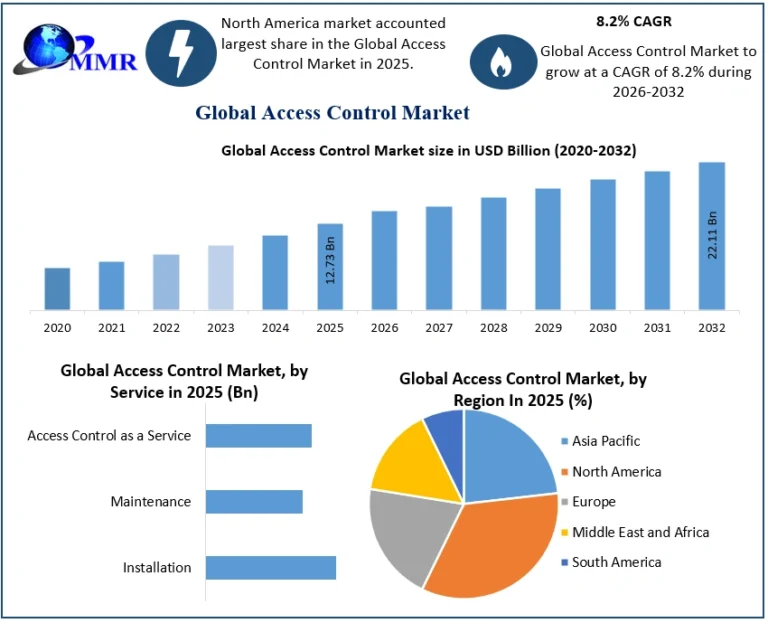
- Access Control Market valued at USD 12.73 Billion in 2025
- Expected to reach USD 22.11 Billion by 2032
- Forecast CAGR of 8.2%
- North America remains the leading regional market
- AI-enabled authentication and biometric technologies are reshaping enterprise security
- Cloud-based Access Control as a Service (ACaaS) is expanding deployment flexibility
- Smart infrastructure and digital transformation continue driving enterprise investments
Why This Matters Now
Enterprise security has shifted from protecting doors to protecting digital ecosystems. As organizations modernize workplaces, expand hybrid operations, migrate workloads to the cloud, and strengthen cybersecurity resilience, access control has become a strategic technology investment rather than a facilities management decision.
The Access Control Market reflects this transition. Organizations increasingly require intelligent identity verification, centralized security management, cloud-native platforms, and AI-assisted threat detection that support both physical and digital infrastructure. For CIOs, CTOs, telecom operators, cloud providers, and investors, access control now sits at the center of enterprise risk management and digital transformation.
Market Overview
The Access Control Market Size was valued at USD 12.73 Billion in 2025 and is projected to reach USD 22.11 Billion by 2032, growing at a CAGR of 8.2%.
Every percentage point of market expansion signals rising enterprise investment in integrated security platforms capable of managing increasingly complex workforces, distributed facilities, connected devices, and critical digital assets.
Organizations are replacing isolated security products with unified platforms that combine biometric authentication, electronic locking systems, intelligent software, and managed services. This evolution supports compliance requirements, operational efficiency, and stronger cyber-physical security across commercial buildings, government facilities, manufacturing plants, healthcare institutions, educational campuses, and transportation infrastructure.
Rather than functioning as standalone security hardware, access control solutions are becoming integral components of broader enterprise technology ecosystems.
Key Trends Driving Growth
Artificial intelligence is changing how organizations authenticate users, identify suspicious behavior, and automate security decisions. AI-assisted analytics enable faster threat recognition while reducing operational complexity for security teams.
Cloud migration is accelerating demand for Access Control as a Service (ACaaS). Organizations increasingly prefer centralized management, remote administration, simplified software updates, and scalable deployment models over traditional on-premise systems.
Digital transformation initiatives are also driving convergence between physical security and cybersecurity. Identity management platforms increasingly integrate with enterprise software, surveillance systems, building automation, workforce management, and compliance applications.
Biometric authentication continues expanding as enterprises seek stronger identity verification while reducing dependence on traditional credentials. Fingerprint recognition, facial authentication, and advanced biometric readers improve both convenience and security.
Automation remains another defining trend. Intelligent software platforms simplify credential provisioning, visitor management, policy enforcement, and access monitoring, allowing enterprises to operate larger security environments without proportional increases in staffing.
Download a Sample Report Covering Market Size and Forecast
Segment Insights
- Dominant Segment: Hardware remains the leading component category, supported by continued deployment of card-based readers, biometric readers, electronic locks, controllers, and integrated security infrastructure.
- Fastest-Growing Segment: Access Control as a Service (ACaaS) is emerging as the fastest-growing service segment as enterprises accelerate cloud adoption and seek subscription-based security management.
- Commercial organizations continue representing a major vertical due to continuous investments in workplace modernization and integrated building security.
- Government, military & defense, healthcare, manufacturing, transportation, education, and residential sectors continue expanding deployment as regulatory requirements and security expectations increase.
Regional Growth Story
North America maintains its leadership position due to mature digital infrastructure, strong enterprise technology spending, advanced cybersecurity initiatives, and widespread deployment of integrated physical security systems.
The United States continues investing heavily in intelligent buildings, enterprise software modernization, cloud infrastructure, and identity management solutions. These investments reinforce demand for scalable access control technologies capable of supporting hybrid workforces and distributed facilities.
Asia-Pacific represents one of the most dynamic growth environments. China, India, Japan, and South Korea continue investing in smart cities, digital infrastructure, manufacturing automation, and intelligent transportation systems. These initiatives expand opportunities for biometric authentication, AI-powered access management, and cloud-based security platforms.
European markets, particularly Germany and the United Kingdom, continue emphasizing regulatory compliance, digital sovereignty, industrial automation, and enterprise cybersecurity. Organizations increasingly prioritize integrated security architectures capable of protecting both physical and digital assets.
Across emerging economies, rapid urbanization, commercial construction, transportation modernization, and digital government initiatives continue creating new opportunities for advanced access control deployments.
Competitive Landscape
Competition is increasingly defined by platform capability rather than individual hardware products.
Leading companies including Assa Abloy AB, Dormakaba Holding AG, Allegion PLC, Johnson Controls International PLC, Honeywell Security Group, Identiv Inc., Nedap N.V., Suprema HQ Inc., Bosch Security Systems Inc., Axis Communications AB, NEC Corporation, Gallagher Group Limited, Brivo Inc., Salto Systems S.L., IDEMIA, Thales Group, HID Global Corporation, and others continue expanding integrated security portfolios.
The competitive direction signals several important industry shifts. Vendors are strengthening software ecosystems alongside hardware portfolios, enabling recurring revenue through cloud services and subscription-based platforms. Integration with enterprise identity management, analytics, AI-enabled monitoring, and building automation is becoming a primary competitive differentiator.
Platform interoperability is also emerging as a strategic advantage. Organizations increasingly favor vendors capable of connecting access control with surveillance, cybersecurity, workforce management, and operational technology environments. This ecosystem approach strengthens customer retention while increasing long-term platform value.
Recent Developments
- AI capabilities continue expanding within authentication and security monitoring platforms.
- Cloud-based Access Control as a Service offerings are gaining broader enterprise adoption.
- Biometric authentication technologies continue replacing conventional credential systems.
- Enterprises increasingly integrate physical security with cybersecurity and identity management platforms.
- Smart building initiatives continue accelerating deployment of intelligent access management solutions.
- Organizations are modernizing legacy infrastructure through software-driven security platforms.
Strategic Implications
Technology leaders increasingly view access control as foundational digital infrastructure rather than physical security equipment.
For CIOs, integrated access management improves governance, compliance, workforce mobility, and cybersecurity resilience. CTOs benefit from API-enabled architectures that simplify integration across enterprise applications.
Cloud providers gain opportunities as organizations migrate security management toward subscription-based platforms. Telecom operators benefit from growing demand for secure connectivity supporting distributed campuses, edge environments, and intelligent infrastructure.
Investors should also recognize the industry’s transition toward recurring software revenue, AI-enabled services, and platform economics that extend well beyond traditional hardware replacement cycles.
Future Outlook
The next phase of the Access Control Market will be defined by AI-assisted authentication, cloud-native security platforms, enterprise automation, biometric innovation, and increasingly connected digital infrastructure.
As enterprises continue modernizing workplaces, expanding hybrid operations, and strengthening cyber resilience, intelligent access management will become a core element of enterprise technology strategy rather than a standalone security investment. Organizations that build integrated, AI-enabled identity ecosystems will establish stronger operational resilience, while those relying on fragmented legacy security architectures risk falling behind in an increasingly software-defined economy.
Analyst Perspective
“The evolution of access control is moving beyond physical entry management toward intelligent, connected security ecosystems. Organizations investing in AI-enabled authentication, cloud-based management, and integrated security platforms will be better positioned to support digital transformation while strengthening operational resilience.” — Yash Ghosalkar, Analyst
About Maximize Market Research
Maximize Market Research Pvt. Ltd. (MMR) is a global market research and consulting company that provides reliable, data-focused, and practical business insights. The firm serves a wide range of industries, including healthcare, pharmaceuticals, technology, automotive, electronics, chemicals, personal care, and consumer goods. Through market forecasts, competitive analysis, strategic consulting, and industry impact assessments, MMR helps organizations understand changing market conditions, identify growth opportunities, and make informed business decisions for long-term success.
Contact Us
2nd Floor, Navale IT Park Phase 3
Pune Banglore Highway, Narhe
Pune, Maharashtra 411041, India
+91 9607365656
sales@maximizemarketresearch.com
