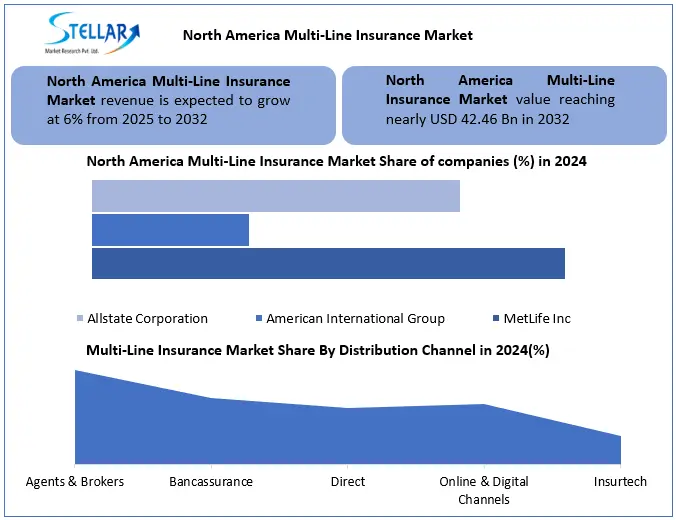
The North America Multi-Line Insurance Market Size was valued at over USD 26.64 Bn in 2024 and is expected to grow to USD 42.46 Bn in 2032 at a CAGR of 6%.
The North America Multi-Line Insurance Market is undergoing a significant transformation driven by digital innovation, regulatory evolution, and increasing demand for comprehensive insurance solutions. Businesses and individual policyholders are increasingly seeking insurance providers that can offer multiple coverage options—including property, casualty, health, life, automobile, liability, and commercial insurance—under a single platform.
As economic uncertainty, climate-related risks, cyber threats, and evolving customer expectations reshape the insurance landscape, multi-line insurers are investing heavily in artificial intelligence (AI), predictive analytics, cloud computing, and digital distribution channels to enhance customer experience and improve underwriting accuracy.
Rising Demand for Comprehensive Insurance Solutions
Consumers and businesses are increasingly looking for integrated insurance packages that simplify policy management while providing broader financial protection. Multi-line insurance products enable customers to bundle various insurance policies under one provider, offering convenience, competitive pricing, and streamlined claims processing.
For businesses, bundled commercial insurance policies covering property damage, workers’ compensation, cyber liability, professional liability, and business interruption have become increasingly important as organizations seek comprehensive risk management strategies.
The growing adoption of bundled insurance products is helping insurers strengthen customer retention while expanding cross-selling opportunities across multiple business segments.
𝐃𝐨𝐰𝐧𝐥𝐨𝐚𝐝 𝐅𝐫𝐞𝐞 𝐏𝐃𝐅 𝐁𝐫𝐨𝐜𝐡𝐮𝐫𝐞: https://www.stellarmr.com/report/req_sample/north-america-multi-line-insurance-market/2889
Digital Transformation Is Revolutionizing Insurance Operations
Technology has become one of the strongest growth drivers for the North America Multi-Line Insurance Market. Insurance companies are leveraging AI, machine learning, robotic process automation (RPA), and big data analytics to automate underwriting, accelerate claims settlement, and improve fraud detection.
Cloud-based insurance platforms provide insurers with greater operational flexibility while enabling real-time customer engagement through mobile applications, self-service portals, and digital policy management systems.
Telematics, IoT-connected devices, and predictive analytics further enable insurers to assess risks more accurately, personalize premiums, and proactively prevent losses.
Climate Risks and Cybersecurity Drive Product Innovation
Increasing climate-related disasters, cyberattacks, and business interruptions are encouraging insurers to expand specialized coverage offerings. Businesses now require integrated insurance products that address emerging risks alongside traditional property and casualty protection.
Cyber insurance has become one of the fastest-growing product categories as organizations strengthen digital infrastructure and comply with evolving cybersecurity regulations. Similarly, climate resilience and catastrophe risk management are becoming central to underwriting strategies across North America.
Insurers are increasingly utilizing catastrophe modeling, satellite data, and geospatial analytics to improve risk assessment and optimize pricing models.
Regulatory Compliance Encourages Market Modernization
Insurance regulators across the United States and Canada continue modernizing compliance frameworks to improve transparency, consumer protection, and operational resilience. Companies are investing in digital governance, automated compliance monitoring, and secure data management systems to meet evolving regulatory requirements.
The increasing adoption of ESG (Environmental, Social, and Governance) principles is also influencing underwriting decisions, investment portfolios, and corporate sustainability strategies within the insurance sector.
Technology Trends Shaping the Market
The North America Multi-Line Insurance Market is rapidly adopting advanced technologies, including:
Artificial Intelligence for underwriting and claims automation
Machine Learning for predictive risk assessment
Cloud-native insurance platforms
Blockchain for secure policy administration
Internet of Things (IoT) for real-time risk monitoring
Predictive analytics for fraud detection
Digital customer portals and mobile applications
Robotic Process Automation (RPA) for operational efficiency
These technologies are improving customer experience while helping insurers reduce operating costs and enhance decision-making.
𝐃𝐨𝐰𝐧𝐥𝐨𝐚𝐝 𝐅𝐫𝐞𝐞 𝐏𝐃𝐅 𝐁𝐫𝐨𝐜𝐡𝐮𝐫𝐞: https://www.stellarmr.com/report/req_sample/north-america-multi-line-insurance-market/2889
Regional Market Insights
United States
The United States dominates the North America Multi-Line Insurance Market due to its mature insurance industry, high insurance penetration, advanced digital infrastructure, and strong regulatory framework. Large commercial enterprises, growing cyber risks, and increasing adoption of AI-driven insurance platforms continue to support market expansion.
Canada
Canada is witnessing healthy market growth as insurers expand digital capabilities, introduce personalized insurance products, and strengthen climate risk management initiatives. Government support for financial sector innovation and increasing consumer demand for digital insurance services are accelerating modernization efforts.
Cross-border insurance operations between the U.S. and Canada continue to encourage product standardization, technology adoption, and collaborative risk management.
Competitive Landscape
The North America Multi-Line Insurance Market is highly competitive, with established insurers, digital insurance providers, InsurTech companies, and financial institutions investing in customer-centric innovation, AI-powered underwriting, and digital distribution strategies.
Leading companies are expanding through mergers and acquisitions, strategic partnerships, cloud transformation, embedded insurance solutions, and omnichannel customer engagement. Investments in advanced analytics, cybersecurity, and personalized insurance products continue strengthening competitive positioning.
Emerging Opportunities
Several trends are expected to create long-term opportunities within the market:
Expansion of embedded insurance solutions
Growth of cyber insurance and digital risk protection
AI-driven personalized policy pricing
ESG-focused insurance products
Increased adoption of usage-based insurance
Digital claims management
Small business insurance innovation
Climate resilience and catastrophe insurance
These developments are expected to reshape how insurers design products and interact with policyholders.
Future Outlook
The outlook for the North America Multi-Line Insurance Market remains highly positive as insurers continue investing in digital transformation, operational efficiency, and customer-centric business models. Artificial intelligence, predictive analytics, cloud computing, and automation will continue transforming underwriting, policy administration, and claims management.
Growing demand for comprehensive insurance coverage, increasing cyber threats, climate-related risks, and evolving regulatory standards will encourage insurers to diversify product portfolios while strengthening risk management capabilities.
Organizations that successfully combine advanced technology, personalized customer experiences, sustainable business practices, and innovative insurance products will be well positioned to capture future market growth and maintain long-term competitiveness in North America’s evolving insurance landscape.
Conclusion
The North America Multi-Line Insurance Market is entering a new phase of growth characterized by digital innovation, integrated risk management, and customer-focused insurance solutions. As technology continues transforming every stage of the insurance value chain, companies that prioritize AI, automation, data analytics, and comprehensive coverage offerings will shape the future of the regional insurance industry.
With continued investments in digital ecosystems, cybersecurity, ESG initiatives, and personalized insurance services, the market is expected to remain one of the most dynamic segments within North America’s financial services sector throughout the coming decade.
