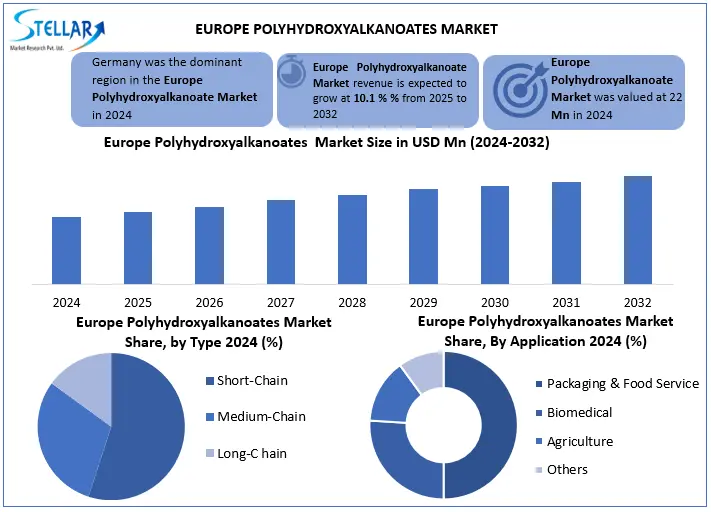
Europe Polyhydroxyalkanoates Market size was valued at USD 22 million in 2024, and the total Europe Polyhydroxyalkanoates Market size is expected to grow at a CAGR of 10.1% from 2025 to 2032, reaching nearly USD 47.50 million by 2032.
The Europe Polyhydroxyalkanoates Market is experiencing robust growth as industries transition toward sustainable materials that reduce environmental impact while supporting circular economy objectives. Polyhydroxyalkanoates (PHAs), a family of biodegradable and bio-based polymers produced through microbial fermentation, are gaining significant attention as an alternative to conventional petroleum-based plastics.
Across Europe, governments, manufacturers, and consumers are increasingly embracing biodegradable plastics to address plastic waste challenges, reduce carbon emissions, and comply with stringent environmental regulations. As a result, PHAs are finding expanding applications in packaging, agriculture, healthcare, consumer goods, and industrial products.
Circular Economy Policies Drive Market Expansion
Europe has positioned itself as a global leader in sustainable materials through ambitious environmental legislation and circular economy initiatives. Regulations aimed at reducing single-use plastics and promoting recyclable and compostable materials are encouraging manufacturers to adopt bio-based polymers such as PHAs.
The region’s focus on achieving climate neutrality and improving resource efficiency is accelerating investments in biodegradable polymer production, advanced recycling technologies, and sustainable packaging solutions.
Government incentives supporting bio-based industries are further encouraging innovation and commercialization across the PHA value chain.
𝐃𝐨𝐰𝐧𝐥𝐨𝐚𝐝 𝐅𝐫𝐞𝐞 𝐏𝐃𝐅 𝐁𝐫𝐨𝐜𝐡𝐮𝐫𝐞: https://www.stellarmr.com/report/req_sample/europe-polyhydroxyalkanoate-market/2890
Sustainable Packaging Emerges as the Largest Application
Packaging remains the dominant application segment within the Europe Polyhydroxyalkanoates Market. Food and beverage companies, retailers, and consumer goods manufacturers are increasingly replacing conventional plastics with biodegradable packaging materials to meet sustainability commitments and changing consumer preferences.
PHA materials offer several advantages, including:
Industrial and home compostability
Renewable biological origin
Excellent biodegradability in marine and soil environments
Reduced greenhouse gas emissions
Compatibility with food-contact applications
Improved environmental performance throughout the product lifecycle
As brands strengthen ESG commitments, demand for biodegradable flexible packaging, food containers, disposable cutlery, and shopping bags continues to increase.
Biotechnology Innovation Improves Commercial Viability
Technological advancements in microbial fermentation, synthetic biology, metabolic engineering, and bioprocess optimization are making PHA production increasingly cost-effective.
Researchers and manufacturers are developing high-yield bacterial strains, alternative feedstocks, and continuous fermentation processes that improve production efficiency while lowering manufacturing costs.
Artificial intelligence and digital process monitoring are also helping optimize fermentation performance, enhance product consistency, and reduce resource consumption throughout manufacturing operations.
Expanding Applications Beyond Packaging
Although packaging remains the leading application, the Europe Polyhydroxyalkanoates Market is rapidly diversifying into several high-value sectors.
Healthcare
Biocompatibility and biodegradability make PHAs suitable for medical sutures, tissue engineering, drug delivery systems, wound care products, and implantable medical devices.
Agriculture
Biodegradable mulch films, controlled-release fertilizers, seed coatings, and agricultural packaging are supporting sustainable farming practices while reducing plastic waste.
Consumer Goods
Manufacturers are increasingly incorporating PHAs into cosmetics packaging, household products, disposable personal care items, and eco-friendly consumer products.
3D Printing and Industrial Applications
Growing interest in sustainable additive manufacturing materials is creating new opportunities for PHA-based filaments and specialized engineering applications.
𝐃𝐨𝐰𝐧𝐥𝐨𝐚𝐝 𝐅𝐫𝐞𝐞 𝐏𝐃𝐅 𝐁𝐫𝐨𝐜𝐡𝐮𝐫𝐞: https://www.stellarmr.com/report/req_sample/europe-polyhydroxyalkanoate-market/2890
Sustainability Remains the Core Growth Driver
Environmental responsibility continues to shape purchasing decisions across Europe. Consumers increasingly prefer products manufactured using renewable raw materials that can biodegrade naturally without contributing to long-term plastic pollution.
Manufacturers are responding through:
Renewable feedstock utilization
Low-carbon production processes
Waste biomass valorization
Industrial compostability certification
Circular product design
Sustainable supply chain management
These initiatives align with corporate ESG objectives while supporting broader European sustainability targets.
Regional Market Highlights
Germany
Germany remains one of Europe’s largest markets due to its advanced biotechnology sector, strong industrial base, and significant investments in sustainable manufacturing.
France
France continues expanding bio-based materials through supportive environmental policies, packaging innovation, and circular economy investments.
Italy
Italian manufacturers are increasing adoption of biodegradable polymers across food packaging, agriculture, and consumer goods industries.
Netherlands
The Netherlands serves as a major innovation hub for biotechnology, bioplastics research, and sustainable materials commercialization.
Nordic Countries
Sweden, Denmark, and Finland continue investing heavily in bioeconomy initiatives, renewable feedstocks, and environmentally responsible manufacturing technologies.
Competitive Landscape
The Europe Polyhydroxyalkanoates Market is becoming increasingly competitive as biotechnology companies, specialty chemical manufacturers, packaging suppliers, and research organizations invest in production expansion and product innovation.
Leading market participants are focusing on:
Capacity expansion
Advanced fermentation technologies
Strategic partnerships
Sustainable feedstock development
New biodegradable polymer formulations
R&D collaboration with universities
Commercial-scale production facilities
Companies are also strengthening relationships with food manufacturers, consumer goods companies, healthcare organizations, and packaging converters to accelerate market adoption.
Emerging Market Opportunities
Several long-term trends are expected to support continued market growth:
Expansion of biodegradable food packaging
Medical-grade biodegradable polymers
Marine biodegradable plastics
Sustainable agricultural films
Bio-based consumer products
Carbon-neutral manufacturing
Precision fermentation technologies
Circular bioeconomy investments
These opportunities are expected to significantly broaden the commercial potential of PHA materials across Europe.
Future Outlook
The Europe Polyhydroxyalkanoates Market is expected to witness sustained expansion as regulatory support, biotechnology innovation, and consumer demand for sustainable materials continue to strengthen.
Improvements in fermentation efficiency, feedstock diversification, production scalability, and cost competitiveness will accelerate commercial adoption across multiple industries.
Companies investing in advanced biotechnology, sustainable manufacturing, circular economy partnerships, and high-performance biodegradable materials will be well positioned to capitalize on the growing demand for environmentally responsible alternatives to conventional plastics.
Conclusion
The Europe Polyhydroxyalkanoates Market represents one of the most promising segments within the global bioplastics industry. Driven by supportive regulations, technological innovation, and increasing environmental awareness, PHAs are emerging as a preferred solution for sustainable packaging and advanced industrial applications.
As Europe continues leading the global transition toward a circular economy, the adoption of biodegradable polymers is expected to accelerate, creating significant opportunities for manufacturers, investors, technology developers, and end-user industries over the coming decade.
