Key Highlights
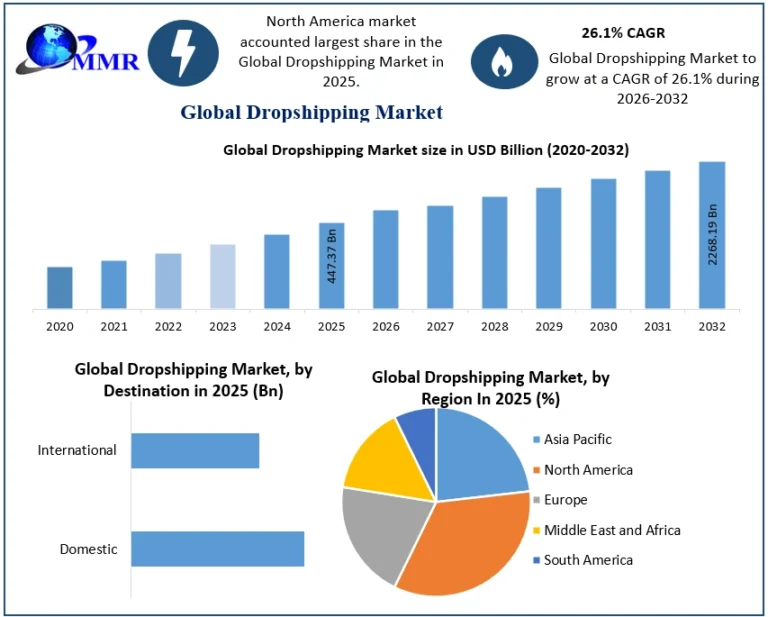
- The Dropshipping Market was valued at USD 447.37 Billion in 2025.
- The market is expected to reach USD 2268.19 Billion by 2032.
- Revenue is projected to grow at a CAGR of 26.1% during 2025–2032.
- AI-powered automation is reshaping online retail operations.
- Cloud-based commerce platforms continue to simplify global business expansion.
- Digital transformation initiatives are accelerating adoption among SMEs and enterprise retailers.
- Cross-border e-commerce is creating new growth opportunities across major economies.
Why This Matters Now
Digital commerce is entering a new competitive phase where speed, automation, and intelligent decision-making determine market leadership. Retailers are no longer competing solely on product selection—they are competing on fulfillment efficiency, customer experience, and data-driven operations.
The Dropshipping Market sits at the center of this transformation. Businesses are embracing AI-enabled commerce platforms, workflow automation, and cloud-native retail infrastructure to reduce operational complexity while expanding product catalogs globally. As digital buying behavior continues to evolve, technology becomes the primary differentiator rather than inventory ownership.
Market Overview
The Dropshipping Market Size is rapidly becoming one of the most dynamic segments within digital commerce. According to Maximize Market Research, the market was valued at USD 447.37 Billion in 2025 and is forecast to reach USD 2268.19 Billion by 2032, growing at a CAGR of 26.1% throughout the forecast period. This growth signals a structural shift in how products move from manufacturers to consumers. Rather than investing heavily in warehousing and inventory, retailers increasingly rely on technology platforms that connect suppliers, logistics providers, and online storefronts through integrated digital ecosystems.
What changed is the maturity of cloud commerce infrastructure. AI-powered product recommendations, automated inventory synchronization, intelligent pricing engines, and real-time order management have significantly improved operational efficiency. As a result, dropshipping is evolving from a low-cost business model into a scalable technology-enabled retail strategy suitable for businesses of all sizes.
Key Trends Driving Growth
Artificial intelligence has become a strategic capability rather than an experimental tool. Businesses are deploying AI across product discovery, demand forecasting, pricing optimization, customer service, and marketing automation. These technologies enable retailers to respond faster to changing consumer demand while reducing manual workloads.
Cloud migration continues to support market expansion. Cloud-native commerce platforms provide flexible infrastructure capable of integrating suppliers, payment systems, logistics partners, and customer engagement applications through APIs. This architecture enables businesses to scale internationally without major infrastructure investments.
Automation is reshaping every stage of the retail value chain. Automated order routing, inventory synchronization, fulfillment tracking, and customer communication improve operational consistency while reducing errors. These capabilities help retailers manage larger product portfolios without proportional increases in staffing.
Enterprise software adoption is also increasing. Retail organizations are integrating dropshipping platforms with CRM, ERP, analytics, and marketing technologies to improve business visibility and decision-making. The convergence of SaaS applications supports more agile retail operations and stronger customer engagement.
Digital transformation initiatives among SMEs remain another important catalyst. Small and medium-sized businesses are leveraging dropshipping to enter competitive online markets with lower capital requirements. Technology lowers traditional barriers to entry while expanding access to global supplier networks.
Cross-border commerce continues to expand opportunities as digital payment systems, international logistics, and localized online shopping experiences improve. Businesses capable of serving multiple geographic markets gain access to broader customer bases without establishing physical retail infrastructure.
Get Your Exclusive Market Research Sample Report Today
Segment Insights
- Dominant Segment: The report identifies the dominant market segment, highlighting its leading contribution to overall market revenue through widespread industry adoption and established digital commerce infrastructure.
- Fastest-Growing Segment: The report identifies the fastest-growing segment as organizations increasingly invest in advanced automation, AI-enabled retail technologies, and scalable cloud commerce platforms to improve operational agility.
- AI-enabled retail management platforms are becoming increasingly important for operational efficiency.
- Cloud-based deployment models continue gaining preference because of scalability, flexibility, and lower infrastructure costs.
- Automation technologies are improving supplier coordination, order processing, and customer experience across digital commerce ecosystems.
Regional Growth Story
The United States remains a significant market as retailers continue investing in digital commerce modernization, AI-enabled customer engagement, and cloud-based retail infrastructure. Mature e-commerce ecosystems and advanced technology adoption support ongoing market expansion.
China continues strengthening its position through large-scale manufacturing capabilities, integrated digital marketplaces, and highly developed e-commerce ecosystems. Strong supplier networks and logistics innovation create competitive advantages for dropshipping businesses operating globally.
India is emerging as a major growth market driven by increasing internet penetration, digital payments, expanding online entrepreneurship, and government-supported digital transformation initiatives. Growing SME participation further supports market expansion.
European markets, including Germany and the United Kingdom, continue emphasizing digital commerce modernization, secure payment technologies, and regulatory compliance. Businesses increasingly prioritize customer trust, operational transparency, and efficient cross-border commerce.
Japan and South Korea remain important technology-driven markets where automation, AI adoption, and advanced digital infrastructure accelerate retail innovation. These countries continue investing in intelligent commerce platforms designed to improve operational efficiency and customer satisfaction.
Competitive Landscape
Competition within the Dropshipping Market is shifting away from simple marketplace access toward integrated technology ecosystems. Companies are increasingly differentiating themselves through AI capabilities, automation platforms, analytics, API connectivity, and end-to-end commerce solutions rather than basic supplier relationships.
Platform providers are strengthening ecosystem partnerships that connect retailers with logistics providers, payment platforms, digital marketing tools, and enterprise software applications. This strategy increases customer retention by making platforms central to business operations rather than standalone transaction tools.
Technology leadership increasingly depends on software innovation. Vendors investing in machine learning, predictive analytics, intelligent automation, and personalized customer experiences are strengthening their competitive positioning as enterprise customers demand higher operational efficiency.
The market also signals continued platform consolidation. Businesses capable of delivering integrated commerce infrastructure, cloud scalability, and seamless third-party connectivity are positioned to capture greater enterprise adoption while improving pricing power and long-term customer loyalty.
Recent Developments
- AI capabilities continue expanding across product recommendations, pricing optimization, and customer engagement.
- Cloud-native commerce platforms are improving scalability and operational flexibility.
- API ecosystems are enabling stronger integration between suppliers, logistics providers, payment services, and retailers.
- Enterprise automation is reducing manual workflows across fulfillment and inventory management.
- Digital transformation initiatives continue increasing adoption among SMEs and enterprise retailers.
- Cross-border e-commerce expansion is creating new international growth opportunities.
- SaaS-based commerce platforms continue supporting rapid deployment and business scalability.
Strategic Implications
Technology investment has become a competitive necessity rather than an operational enhancement. Retailers that combine AI, automation, cloud infrastructure, and analytics gain measurable advantages in efficiency, customer acquisition, and operational resilience.
Enterprise buyers increasingly evaluate dropshipping platforms based on integration capabilities, cybersecurity readiness, data visibility, and workflow automation instead of supplier network size alone. Cloud providers, software vendors, and digital commerce platforms therefore play an increasingly strategic role within the broader retail ecosystem.
For investors, the market’s high growth trajectory reflects expanding demand for scalable digital commerce technologies rather than traditional retail infrastructure. Companies capable of delivering intelligent automation and integrated platform ecosystems are positioned to benefit from long-term digital commerce expansion.
Future Outlook
The next phase of the Dropshipping Market will be defined by AI-native commerce platforms, deeper enterprise software integration, intelligent automation, and increasingly connected digital ecosystems. Businesses will compete through predictive analytics, real-time operational visibility, personalized customer experiences, and seamless supplier collaboration rather than inventory ownership alone.
Organizations that invest early in AI-driven commerce, cloud-native operations, automation platforms, and scalable digital infrastructure will establish durable competitive advantages, while businesses delaying technology modernization risk falling behind as intelligent commerce becomes the new standard for global retail.
Analyst Perspective
“The Dropshipping Market is entering a transformative phase where AI, cloud technologies, and automation are fundamentally changing how digital commerce operates. Businesses that prioritize technology integration and scalable digital ecosystems will be better positioned to capitalize on long-term market opportunities.” — Yash Ghosalkar, Analyst
About Maximize Market Research
Maximize Market Research Pvt. Ltd. (MMR) is a global market research and consulting company that provides reliable, data-focused, and practical business insights. The firm serves a wide range of industries, including healthcare, pharmaceuticals, technology, automotive, electronics, chemicals, personal care, and consumer goods. Through market forecasts, competitive analysis, strategic consulting, and industry impact assessments, MMR helps organizations understand changing market conditions, identify growth opportunities, and make informed business decisions for long-term success.
Contact Us
2nd Floor, Navale IT Park Phase 3
Pune Banglore Highway, Narhe
Pune, Maharashtra 411041, India
+91 9607365656
sales@maximizemarketresearch.com
