Key Highlights
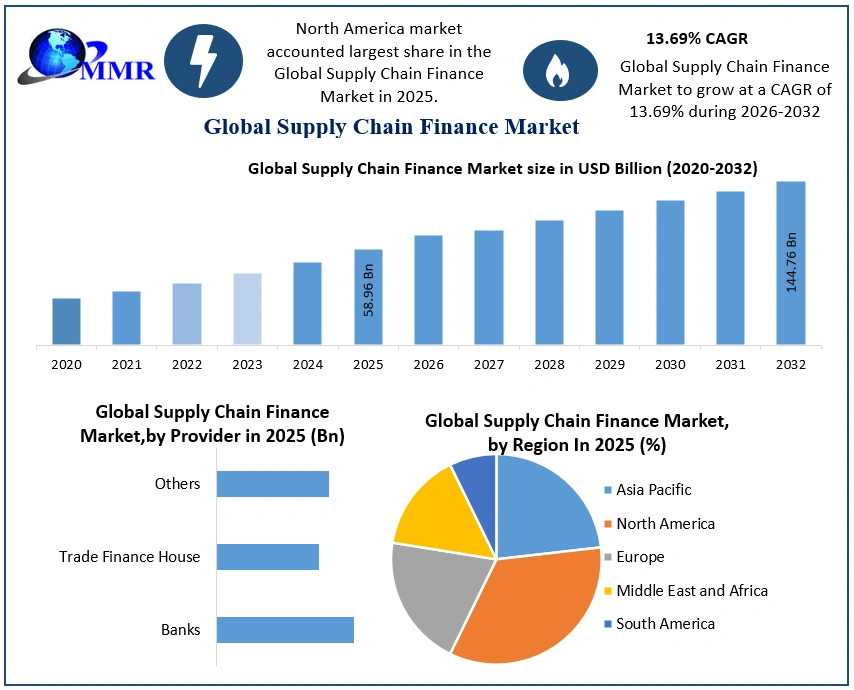
- Supply Chain Finance Market valued at USD 58.96 Billion in 2025.
- Market projected to reach USD 144.76 Billion by 2032.
- Expected CAGR of 13.69% during 2025–2032.
- AI-powered automation is accelerating financing decisions.
- Cloud-native finance platforms continue to replace legacy systems.
- Enterprise digital transformation is increasing demand for integrated working capital solutions.
- Financial institutions and technology providers are expanding ecosystem-based platforms.
- Automation and real-time analytics are improving supplier payment efficiency.
Why This Matters Now
Working capital has become a strategic priority rather than simply a financial metric. Enterprises are operating in an environment shaped by volatile supply chains, higher financing costs, and increasing pressure to strengthen supplier relationships. These conditions are driving organizations toward digital supply chain finance platforms that improve liquidity while reducing operational complexity.
Artificial intelligence, cloud computing, and enterprise automation have shifted supply chain finance from a traditional banking product into a technology-driven business platform. CIOs, CFOs, financial institutions, cloud providers, and enterprise software vendors increasingly view supply chain finance as a digital transformation initiative capable of delivering measurable operational advantages.
Market Overview
The Supply Chain Finance Market Size was valued at USD 58.96 Billion in 2025 and is projected to reach USD 144.76 Billion by 2032, expanding at a CAGR of 13.69%.
This growth signals more than expanding financing volumes. It reflects the rapid modernization of enterprise finance operations as organizations digitize procurement, automate invoice processing, and integrate financing directly into supply chain workflows. Instead of treating liquidity as a back-office function, businesses are embedding financial intelligence throughout procurement and supplier management processes.
The market is evolving alongside broader enterprise technology investments, where finance platforms increasingly connect with ERP systems, cloud infrastructure, analytics engines, and AI-driven decision support tools.
Key Trends Driving Growth
Artificial intelligence is becoming central to modern supply chain finance. Machine learning models improve credit assessments, detect transaction anomalies, automate approval workflows, and accelerate financing decisions. These capabilities reduce manual intervention while improving risk visibility for lenders and enterprises alike.
Cloud migration is another defining trend. Organizations increasingly favor SaaS-based supply chain finance platforms because they simplify deployment, improve scalability, and enable seamless integration with enterprise software ecosystems. Cloud infrastructure also supports real-time collaboration among buyers, suppliers, financial institutions, and fintech providers.
Enterprise automation continues to reshape financial operations. Digital invoice processing, automated compliance checks, API-enabled integrations, and intelligent workflow management reduce processing times while enhancing operational efficiency.
Digital transformation initiatives across industries are expanding adoption beyond multinational corporations. Mid-sized enterprises are increasingly implementing technology-enabled financing platforms to strengthen supplier resilience and optimize cash flow without increasing operational complexity.
Cybersecurity has also become a strategic consideration. As financial transactions move to digital platforms, organizations are investing in stronger authentication, secure API frameworks, encrypted payment systems, and comprehensive governance models to protect sensitive financial information.
Platform ecosystems represent another major shift. Financial institutions increasingly collaborate with fintech providers, ERP vendors, and cloud technology companies to deliver integrated solutions that extend beyond financing into procurement analytics, supplier management, and financial planning.
Access a Detailed Sample Report with Industry Analysis
Segment Insights
- Dominant Segment: The report identifies the leading market segment based on its current revenue contribution, reflecting broad enterprise adoption and strong commercial demand.
- Fastest-Growing Segment: The report highlights the fastest-growing segment as organizations accelerate digital finance transformation and adopt more technology-enabled financing models.
- AI-driven automation is improving transaction accuracy and reducing financing cycle times.
- Cloud-based deployment models continue to gain enterprise preference because of scalability, flexibility, and lower infrastructure requirements.
- Integrated enterprise software solutions are enabling finance, procurement, and supply chain teams to operate through connected digital platforms.
Regional Growth Story
The United States remains an important market as enterprises accelerate digital finance modernization and financial institutions invest in advanced technology platforms. Demand is supported by mature cloud adoption, enterprise software integration, and continuous investment in AI-enabled financial services.
China continues expanding digital financial ecosystems through large-scale enterprise digitization and sophisticated supply chain networks. Technology adoption and industrial modernization are strengthening opportunities for digital financing platforms.
India represents a rapidly developing opportunity as enterprises adopt cloud technologies, digital payments, and financial automation to support growing manufacturing and export activity. Digital transformation initiatives across public and private sectors are encouraging broader adoption of technology-enabled finance solutions.
Germany and the United Kingdom continue emphasizing enterprise automation, digital manufacturing, and financial technology innovation. Organizations increasingly integrate supply chain finance into broader Industry 4.0 and digital business strategies.
Japan and South Korea remain technology-intensive markets where advanced enterprise software adoption, automation, and digital infrastructure investments support continued modernization of financial operations.
Across major economies, regulatory modernization, digital infrastructure investments, and enterprise cloud migration continue expanding the addressable market for intelligent supply chain finance platforms.
Competitive Landscape
Competition increasingly centers on technology leadership rather than financing capacity alone. Financial institutions are transforming into digital platform providers capable of delivering intelligent financing services through cloud-native architectures and API-driven ecosystems.
Platform competition is encouraging stronger integration between enterprise software vendors, fintech innovators, banking institutions, and cloud providers. This shift creates more comprehensive ecosystems where financing becomes embedded directly within procurement, ERP, and supplier management applications.
Artificial intelligence is becoming an important competitive differentiator. Organizations capable of delivering automated risk analysis, predictive insights, intelligent workflow management, and real-time financing decisions are strengthening their market positions while improving customer experience.
Cloud-based business models are also reshaping pricing strategies. Subscription-based SaaS platforms provide greater scalability and recurring revenue opportunities while enabling faster innovation cycles compared with traditional financial software deployments.
The competitive landscape increasingly rewards organizations that combine financial expertise with digital platform capabilities, automation, cybersecurity resilience, and enterprise integration.
Recent Developments
- Growing adoption of AI-enabled financial automation across enterprise finance operations.
- Expansion of cloud-native supply chain finance platforms supporting digital transformation.
- Increased integration with enterprise ERP and procurement software.
- Greater use of API ecosystems to improve interoperability across financial platforms.
- Stronger investment in cybersecurity capabilities protecting digital financial transactions.
- Continued enterprise focus on working capital optimization through intelligent finance platforms.
Strategic Implications
Technology investment is becoming a competitive necessity rather than an operational enhancement. Organizations implementing intelligent supply chain finance platforms gain faster access to liquidity, improved supplier collaboration, stronger financial visibility, and more resilient supply networks.
For financial institutions, the opportunity extends beyond lending. Platform-based service delivery creates new recurring revenue models while strengthening customer relationships through integrated digital ecosystems.
Cloud providers, enterprise software companies, fintech firms, and AI technology vendors are positioned to benefit as enterprises increasingly seek unified platforms instead of disconnected financial applications.
Investors are likely to view companies with scalable digital finance capabilities, automation expertise, and AI integration as better positioned to capture long-term enterprise modernization spending.
Future Outlook
The next phase of the Supply Chain Finance Market will be defined by intelligent automation, embedded finance, AI-driven decision engines, and cloud-native financial ecosystems. Organizations that successfully integrate financing into enterprise digital workflows will achieve stronger liquidity management, greater operational agility, and more resilient supplier networks. Those that delay platform modernization risk falling behind as digital finance becomes a core competitive capability separating future industry leaders from laggards.
Analyst Perspective
“The Supply Chain Finance Market is entering a period where digital technologies are transforming working capital management into a strategic business advantage. AI, cloud computing, automation, and integrated enterprise platforms are redefining how organizations manage supplier relationships, improve liquidity, and strengthen financial resilience across increasingly complex global supply chains.” — Yash Ghosalkar, Analyst
About Maximize Market Research
Maximize Market Research Pvt. Ltd. (MMR) is a global market research and consulting company that provides reliable, data-focused, and practical business insights. The firm serves a wide range of industries, including healthcare, pharmaceuticals, technology, automotive, electronics, chemicals, personal care, and consumer goods. Through market forecasts, competitive analysis, strategic consulting, and industry impact assessments, MMR helps organizations understand changing market conditions, identify growth opportunities, and make informed business decisions for long-term success.
Contact Us
2nd Floor, Navale IT Park Phase 3
Pune Banglore Highway, Narhe
Pune, Maharashtra 411041, India
+91 9607365656
sales@maximizemarketresearch.com
