Key Highlights
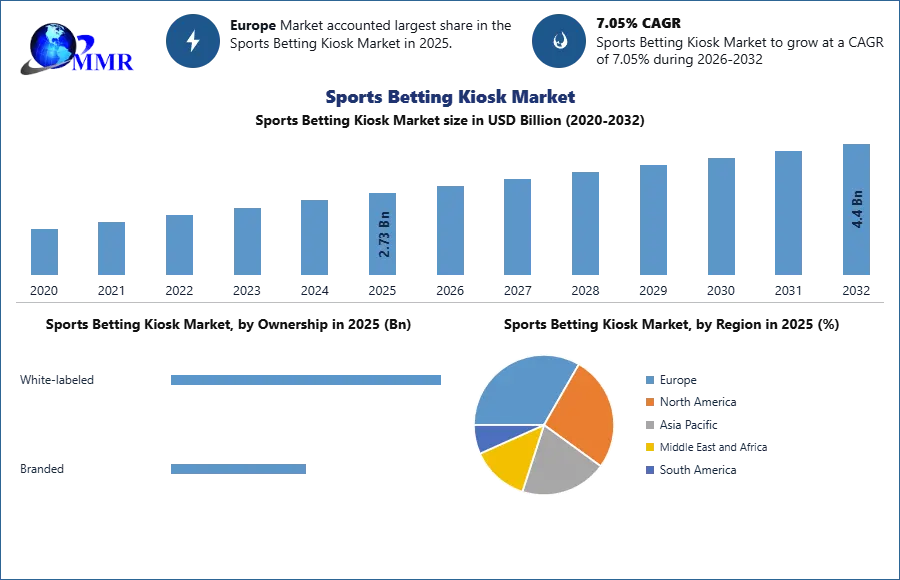
Sports Betting Kiosk Market is expected to grow at a 7.05% CAGR during the forecast period and reach USD 4.4 billion by 2032. Every percentage point of sustained expansion signals continued investment opportunities for gaming technology vendors and kiosk manufacturers.
Betting shops and gambling clubs represented the largest end-user segment in 2025, reinforcing their position as the primary deployment environment for self-service betting technologies.
Customer experience enhancement, automation, and expanding acceptance of feature-rich kiosks continue to accelerate market adoption.
Cybersecurity remains the principal market restraint, increasing demand for secure digital transaction platforms.
Regulatory liberalization across multiple markets is creating new opportunities for operators and technology suppliers.
Why This Matters Now
Sportsbooks are redesigning the retail betting experience as consumers expect the speed and convenience associated with digital platforms. Self-service kiosks have become strategic infrastructure rather than simple payment terminals, allowing operators to expand betting capacity without proportionally increasing staffing requirements.
For technology vendors, this shift creates demand for integrated software, secure payment processing, customer engagement capabilities, and connected gaming ecosystems. The next competitive advantage increasingly depends on combining physical betting locations with digital operational efficiency.
Market Overview
The Sports Betting Kiosk Market is entering a phase where automation is reshaping physical sportsbooks. According to Maximize Market Research, the market is projected to reach USD 4.4 billion by 2032, expanding at a 7.05% CAGR during the forecast period. That growth signals continuing investments by sportsbook operators seeking scalable customer-service models while reducing operational friction.
Sports betting kiosks enable customers to place legal wagers independently while accessing sports information, handicapping services, promotions, and betting services throughout extended operating hours. Their ability to deliver nearly continuous betting access strengthens customer engagement and improves venue utilization.
Rather than replacing digital sportsbooks, kiosks increasingly complement omnichannel betting strategies by connecting physical retail locations with automated customer interactions. Operators benefit from greater transaction efficiency while consumers gain faster service and greater convenience.
Key Trends Driving Growth
Regulatory change remains one of the strongest catalysts for market expansion. The report identifies reduced legal restrictions across multiple regions as an important driver encouraging sportsbook operators to expand kiosk deployments. As additional jurisdictions formalize sports betting frameworks, technology suppliers gain larger addressable markets.
Technology innovation is equally important. Vendors continue enhancing kiosk capabilities through richer customer interfaces, expanded betting functionality, promotional integration, and reward programs. These improvements strengthen customer retention while helping operators differentiate increasingly competitive sportsbook offerings.
Automation also changes venue economics. Stadiums, sports clubs, casinos, hotels, and retail environments can process customer transactions within smaller physical footprints while improving operational efficiency. That combination supports higher transaction volumes during peak sporting events without proportionally increasing staffing requirements.
Cybersecurity, however, has become a defining strategic issue. As betting transactions become increasingly digital, operators must invest in secure payment systems and resilient infrastructure to protect customer information and maintain regulatory compliance. Security investment is therefore evolving from a compliance requirement into a competitive differentiator.
Although artificial intelligence, cloud migration, edge computing, 5G deployment, enterprise software modernization, and data center investments are important themes across digital infrastructure, the supplied report does not provide specific findings regarding these technologies for this market.
Request a Free Sample Copy or View Report Summary: https://www.maximizemarketresearch.com/request-sample/39718/
Segment Insights
Dominant Segment: Betting Shops & Gambling Clubs held the largest end-user market share in 2025 and are expected to remain the leading deployment environment throughout the forecast period. Their continued leadership demonstrates sustained demand for automated customer service, digital advertising, self-directed payments, and integrated sportsbook experiences.
Fastest-Growing Segment: The supplied report does not specify the fastest-growing segment.
Betting kiosks support additional customer services including digital signage, sports screening, parking ticketing, parking management, and customer interaction capabilities, expanding their role beyond wagering terminals.
Regional Growth Story
North America remains strategically significant as regulated sports betting continues expanding across the United States, Canada, and Mexico. Increasing legalization supports broader deployment opportunities for sportsbook technology providers and gaming infrastructure vendors.
Europe continues to represent an established sportsbook ecosystem, while Asia-Pacific—including China, India, Japan, South Korea, Australia, and ASEAN economies—offers long-term expansion opportunities supported by digital adoption and evolving regulatory environments where applicable.
The report also evaluates developments across South America and the Middle East & Africa, highlighting the industry’s increasingly global competitive landscape.
Competitive Landscape
Competition increasingly centers on platform capability rather than hardware alone. Vendors that combine reliable kiosk hardware with sophisticated sportsbook software, customer engagement tools, secure transaction processing, and integrated retail experiences are positioned to strengthen long-term customer relationships.
The competitive landscape includes DB Solutions, International Game Technology PLC, KIOSK Information Systems, Olea Kiosks, SG Gaming, NOVOMATIC Sports Betting Solutions, SBTech Malta Limited, JCM Global, Kambi Group PLC, Scientific Games Corporation, Playtech PLC, Sportech PLC, Inspired Entertainment, Genius Sports Limited, BetMGM, DraftKings, Flutter Entertainment PLC, Sportradar AG, and Internet Sports International. Their continued investments signal increasing competition around integrated betting ecosystems, customer experience, and technology differentiation rather than standalone kiosk deployments.
Recent Developments
Growing deployment of self-service betting technologies to improve customer experience.
Continued investment in kiosks featuring multiple betting functions and promotional capabilities.
Expansion of automated betting infrastructure across sports venues and retail betting environments.
Ongoing emphasis on cybersecurity as digital betting transactions increase.
Strategic Implications
Technology providers increasingly compete on software integration, security, customer engagement, and operational scalability instead of hardware specifications alone. Operators that deploy connected betting ecosystems can improve throughput while creating richer customer experiences across physical venues.
Investors should monitor regulatory developments alongside cybersecurity capabilities because both factors increasingly influence long-term competitive positioning. Meanwhile, enterprise technology suppliers have opportunities to support sportsbook modernization through payment technologies, customer analytics, automation platforms, and integrated digital infrastructure.
Future Outlook
The Sports Betting Kiosk Market is evolving from standalone betting terminals toward digitally connected customer engagement platforms. Regulatory expansion, self-service automation, and secure transaction technologies are expected to remain the principal growth drivers identified in the report.
The next competitive divide will not be determined simply by installing more kiosks—it will belong to operators that transform retail betting into secure, automated, technology-driven digital ecosystems while competitors remain limited to conventional sportsbook operations.
Related Reports
Hypervisor Market https://www.maximizemarketresearch.com/market-report/global-hypervisor-market/79909/
India Gaming Market https://www.maximizemarketresearch.com/market-report/india-gaming-market/44686/
India Accounting Software Market https://www.maximizemarketresearch.com/market-report/india-accounting-software-market/44134/
Analyst Perspective
“The Sports Betting Kiosk Market continues to expand as operators prioritize customer experience, automation, and wider deployment of self-service betting solutions. Regulatory developments and technological innovation are expected to remain central growth drivers, while cybersecurity will continue shaping long-term market competitiveness.” — Yash Ghosalkar
About Maximize Market Research
Maximize Market Research Pvt. Ltd. (MMR) is a global market research and consulting company that provides reliable, data-focused, and practical business insights. The firm serves a wide range of industries, including healthcare, pharmaceuticals, technology, automotive, electronics, chemicals, personal care, and consumer goods. Through market forecasts, competitive analysis, strategic consulting, and industry impact assessments, MMR helps organizations understand changing market conditions, identify growth opportunities, and make informed business decisions for long-term success.
2nd Floor, Navale IT Park Phase 3
Pune Banglore Highway, Narhe
Pune, Maharashtra 411041, India
+91 9607365656
sales@maximizemarketresearch.com
