https://www.stellarmr.com/report/req_sample/Global-Coffee-Market/55The global Coffee Market is experiencing a dynamic transformation as shifting consumer preferences, sustainability concerns, and premium product demand redefine industry growth. Once considered a staple commodity, coffee has evolved into a lifestyle-driven product category, influenced by innovation, branding, and changing consumption patterns.
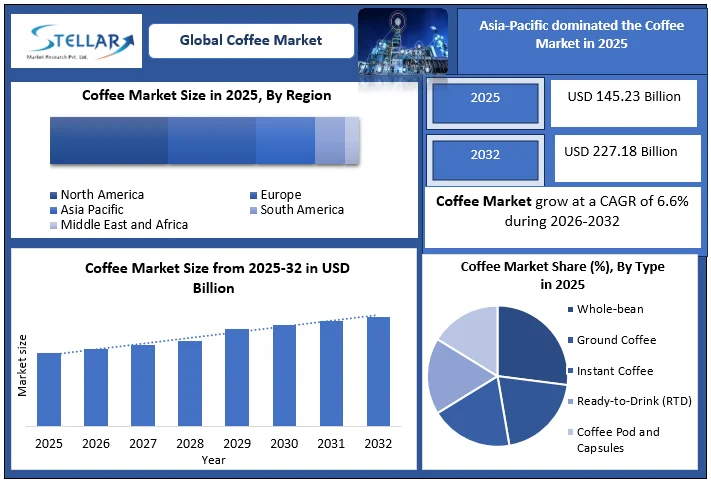
Coffee Market size was valued at US$ 145.23 Bn. in 2025 with a CAGR of 6.6% reaching nearly 227.18 Bn. by 2032 while navigating a volatile supply environment shaped by climate disruption, inventory drawdowns, and shifting consumption patterns, with Robusta gaining share and Asia-Pacific emerging as the primary growth engine.
From specialty brews and single-origin beans to ready-to-drink (RTD) coffee and café culture expansion, the market is witnessing robust diversification. With rising urbanization and increasing disposable incomes, particularly in emerging economies, coffee consumption is expanding beyond traditional strongholds into new, high-growth regions.
The Rise of Premium and Specialty Coffee
One of the most significant trends shaping the coffee market is the growing demand for premium and specialty coffee products. Consumers are increasingly seeking high-quality beans, unique flavor profiles, and ethically sourced coffee.
Specialty coffee shops and artisanal brands are capitalizing on this trend by offering curated experiences, including single-origin beans, organic blends, and customized brewing methods. This shift is not only boosting average selling prices but also enhancing brand loyalty.
Additionally, the popularity of third-wave coffee culture—focused on craftsmanship, sustainability, and transparency—is redefining consumer expectations and pushing companies to innovate.
Key Market Insights
- The global coffee market is witnessing steady growth driven by increasing consumption across both developed and emerging economies.
- Arabica coffee dominates the market due to its superior flavor and premium positioning.
- Ready-to-drink (RTD) coffee is among the fastest-growing segments, driven by convenience and on-the-go consumption.
- Asia-Pacific is emerging as a high-growth region, supported by rising café culture and urbanization.
- Sustainability and ethical sourcing are becoming key differentiators for brands.
- Digital platforms and e-commerce are playing a significant role in expanding market reach.
- Increasing investment in coffee processing and supply chain optimization is improving product quality and availability.
𝐃𝐨𝐰𝐧𝐥𝐨𝐚𝐝 𝐅𝐫𝐞𝐞 𝐏𝐃𝐅 𝐁𝐫𝐨𝐜𝐡𝐮𝐫𝐞: https://www.stellarmr.com/report/req_sample/Global-Coffee-Market/55
Market Drivers Accelerating Growth
1. Expanding Café Culture and Urbanization
The rapid expansion of coffee chains and independent cafés is fueling demand, particularly in urban centers. Consumers are increasingly viewing coffee shops as social and professional spaces.
2. Rising Demand for Convenience Products
Busy lifestyles are driving the popularity of instant coffee and ready-to-drink beverages. These formats offer quick consumption without compromising on taste.
3. Growing Awareness of Coffee Varieties
Consumers are becoming more knowledgeable about coffee origins, roasting techniques, and brewing methods, leading to higher demand for premium offerings.
Market Challenges and Restraints
1. Price Volatility of Raw Coffee Beans
Fluctuations in coffee bean prices due to climate change, supply disruptions, and geopolitical factors can impact profit margins.
2. Environmental Concerns in Coffee Production
Deforestation, water usage, and carbon emissions associated with coffee farming are raising sustainability challenges for producers.
Technology and Sustainability Trends
Technology is playing a transformative role in the coffee market. From precision agriculture and AI-based crop monitoring to automated brewing systems, innovation is improving both production efficiency and product consistency.
Sustainability is at the forefront of industry priorities. Companies are adopting fair trade practices, eco-friendly packaging, and carbon-neutral operations to align with consumer expectations and regulatory requirements.
Additionally, blockchain technology is being explored to enhance supply chain transparency, allowing consumers to trace the origin of their coffee.
𝐃𝐨𝐰𝐧𝐥𝐨𝐚𝐝 𝐅𝐫𝐞𝐞 𝐏𝐃𝐅 𝐁𝐫𝐨𝐜𝐡𝐮𝐫𝐞: https://www.stellarmr.com/report/req_sample/Global-Coffee-Market/55
Regional Outlook: Mature Markets vs Emerging Opportunities
North America and Europe remain mature markets with high per capita coffee consumption. These regions are characterized by strong demand for premium and specialty coffee products.
However, the most exciting growth opportunities lie in Asia-Pacific and Latin America. Countries such as China and India are witnessing a surge in coffee consumption, driven by urbanization, changing lifestyles, and the influence of global café chains.
Meanwhile, Latin America continues to play a crucial role as a leading coffee-producing region, with countries like Brazil and Colombia dominating global supply.
Recent Industry Developments
- A major global coffee chain introduced plant-based coffee beverages to cater to vegan and health-conscious consumers, expanding its product portfolio.
- Leading beverage companies are investing in ready-to-drink coffee production facilities to meet growing demand.
- Several coffee brands have launched sustainable packaging solutions, reducing plastic usage and environmental impact.
- Strategic partnerships between coffee producers and retailers are enhancing supply chain efficiency and product availability.
- Governments in key producing countries are implementing policies to support sustainable coffee farming and improve farmer incomes.
Competitive Landscape
The coffee market is highly competitive, with a mix of multinational corporations, regional players, and specialty brands. Companies are focusing on product innovation, sustainability initiatives, and brand differentiation to gain market share.
Key strategies include expanding product portfolios, entering new geographic markets, and leveraging digital channels for direct-to-consumer sales. Collaborations with local farmers and investment in ethical sourcing are also becoming essential for maintaining brand credibility.
Analyst Perspective
A senior market analyst notes:
“The coffee market is transitioning from a volume-driven industry to a value-driven one. Premiumization, sustainability, and digital engagement are no longer optional—they are critical for long-term success.”
Future Outlook
The future of the coffee market looks promising, with continued growth expected across multiple segments. The rise of specialty coffee, increasing demand for sustainable products, and expansion into emerging markets will drive the next phase of industry evolution.
Technological advancements and innovation in product formats will further enhance consumer experience, while regulatory support for sustainable practices will shape industry standards.
As consumer expectations continue to evolve, companies that prioritize quality, transparency, and innovation will be best positioned to succeed in the global coffee market.
