The Asia Pacific Bike Sharing Market is emerging as one of the fastest-growing segments in the global mobility ecosystem, driven by rapid urbanization, increasing traffic congestion, and strong government support for sustainable transportation. As cities across the region grapple with pollution and infrastructure challenges, bike-sharing systems are becoming an essential component of modern urban mobility strategies.
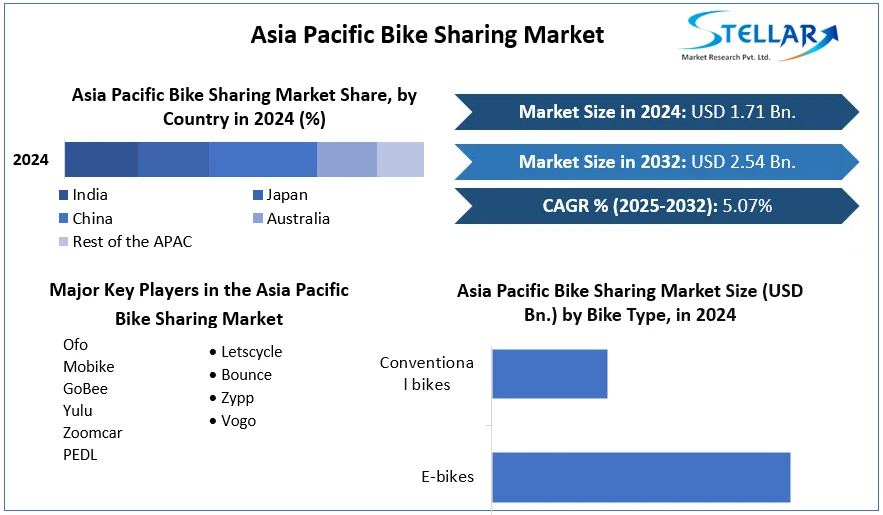
Asia Pacific Bike Sharing Market size was valued at US$ 1.71 Billion in 2024 and the total Asia Pacific Bike Sharing Market revenue is expected to grow at 5.07% through 2025 to 2032, reaching nearly US$ 2.54 Billion.
According to insights from industry research, the Asia Pacific region is witnessing a surge in demand for flexible, cost-effective, and eco-friendly transportation solutions. From densely populated megacities to rapidly developing urban centers, bike-sharing services are transforming how people commute.
Urban Mobility Transformation Across Asia Pacific
The most significant shift in the Asia Pacific bike sharing market is the transition toward dockless and app-based systems. Countries such as China and India have been at the forefront of adopting large-scale bike-sharing networks, supported by smartphone penetration and digital payment ecosystems.
Dockless models offer greater convenience, allowing users to pick up and drop off bikes anywhere within designated zones. This flexibility has significantly improved adoption rates, particularly among young urban commuters.
Additionally, the rise of electric bikes (e-bikes) is reshaping the market by enabling longer-distance travel and reducing physical effort, making cycling more accessible to a broader population.
Key Market Insights
- Asia Pacific is one of the fastest-growing regions in the global bike-sharing market.
- Dockless bike-sharing systems dominate due to their scalability and user convenience.
- Electric bikes represent the fastest-growing segment, driven by demand for efficient commuting.
- China remains the largest market, supported by extensive bike-sharing infrastructure.
- India and Southeast Asia are emerging as high-growth markets due to urban expansion.
- Integration with mobile apps and digital payments is boosting user adoption.
- Government investments in cycling infrastructure are accelerating market development.
𝐃𝐨𝐰𝐧𝐥𝐨𝐚𝐝 𝐅𝐫𝐞𝐞 𝐏𝐃𝐅 𝐁𝐫𝐨𝐜𝐡𝐮𝐫𝐞: https://www.stellarmr.com/report/req_sample/Asia-Pacific-Bike-Sharing-Market/62
Market Drivers Accelerating Growth
1. Rapid Urbanization and Traffic Congestion
Urban population growth in Asia Pacific is creating significant pressure on transportation systems. Bike sharing offers a practical solution for short-distance travel and last-mile connectivity.
2. Government Support for Sustainable Transport
Governments across the region are promoting cycling through infrastructure development, subsidies, and policy initiatives aimed at reducing carbon emissions.
3. Digital Ecosystem and Smartphone Penetration
High smartphone usage and digital payment adoption are enabling seamless access to bike-sharing services, enhancing user convenience.
Market Challenges and Restraints
1. Operational Challenges and Fleet Management
Managing large fleets of bikes, including maintenance and redistribution, remains a key challenge for operators.
2. Regulatory Uncertainty
In some countries, evolving regulations around parking, safety, and operations can create barriers for market expansion.
Technology and Sustainability Trends
Technology is at the heart of the Asia Pacific bike sharing market. Companies are leveraging IoT, GPS tracking, and AI-based analytics to optimize fleet management, reduce operational costs, and improve user experience.
Sustainability is another major focus area. Bike-sharing systems contribute to reducing carbon emissions and promoting greener cities. Many operators are also adopting electric bikes and renewable energy solutions to enhance their environmental impact.
Additionally, integration with smart city initiatives is enabling better coordination between bike-sharing systems and other modes of transportation.
𝐃𝐨𝐰𝐧𝐥𝐨𝐚𝐝 𝐅𝐫𝐞𝐞 𝐏𝐃𝐅 𝐁𝐫𝐨𝐜𝐡𝐮𝐫𝐞: https://www.stellarmr.com/report/req_sample/Asia-Pacific-Bike-Sharing-Market/62
Regional Insights: China Leads, India and Southeast Asia Rise
China dominates the Asia Pacific bike sharing market, with large-scale deployments and high user adoption rates. The country’s advanced digital ecosystem and urban density have enabled rapid growth of bike-sharing platforms.
India is emerging as a key growth market, driven by increasing urbanization, government initiatives, and rising awareness of sustainable mobility. Cities are investing in cycling infrastructure and launching public bike-sharing programs.
Southeast Asian countries, including Indonesia, Vietnam, and Thailand, are also witnessing growing adoption, supported by expanding urban populations and improving infrastructure.
Recent Industry Developments
- Meituan (2025): Expanded its bike-sharing services across major Chinese cities, enhancing fleet size and operational efficiency.
- Ofo (2024): Restructured its operations and re-entered select markets with improved business models.
- Yulu (2025): Partnered with municipal authorities in India to expand electric bike-sharing services in urban areas.
- Grab (2024): Integrated bike-sharing services into its super app, improving accessibility and user engagement.
- Government of India (2025): Launched initiatives to promote non-motorized transport, including bike-sharing infrastructure development.
Competitive Landscape
The Asia Pacific bike sharing market is highly competitive, with a mix of regional and global players. Companies are focusing on technology integration, fleet expansion, and strategic partnerships to strengthen their market presence.
Innovation in electric bikes, app-based platforms, and data analytics is enabling companies to differentiate themselves in a crowded market. Collaborations with governments and urban planners are also critical for long-term success.
Analyst Perspective
A senior market analyst notes:
“The Asia Pacific bike sharing market is at the forefront of global mobility transformation. The combination of urbanization, digital innovation, and sustainability goals is creating a highly dynamic and competitive landscape.”
Future Outlook
The future of the Asia Pacific bike sharing market looks highly promising, with strong growth expected over the coming years. Increasing investments in smart city projects, advancements in electric mobility, and supportive government policies will continue to drive demand.
The market is also expected to witness greater integration with multimodal transportation systems, enabling seamless urban mobility experiences. As competition intensifies, companies will need to focus on operational efficiency, innovation, and sustainability to maintain their edge.
Overall, the Asia Pacific Bike Sharing Market is set to play a critical role in shaping the future of urban transportation, offering scalable, efficient, and environmentally friendly mobility solutions.
