Indonesia Automotive Engine Oil Market: Rising Vehicle Ownership and Premium Lubricants Fuel Industry Growth
Indonesia’s automotive sector continues to expand as rising household incomes, rapid urbanization, and increasing mobility needs drive vehicle ownership across the country. This growth is creating sustained demand for automotive engine oils, making lubricants a critical component of vehicle maintenance and performance. As consumers increasingly prioritize fuel efficiency, engine protection, and longer service intervals, the market is witnessing a gradual shift from conventional mineral oils to premium synthetic and semi-synthetic formulations.
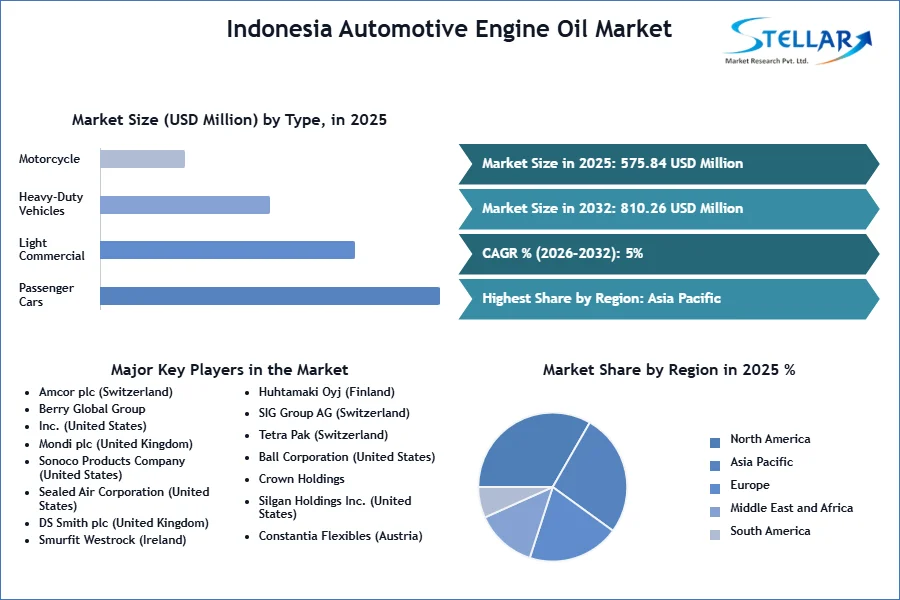
According to the latest Indonesia Automotive Engine Oil Market Report by Stellar Market Research, the market was valued at USD 575.84 million in 2025 and is projected to reach nearly USD 810.26 million by 2032, registering a CAGR of 4.70% during 2026–2032. The market is primarily driven by Indonesia’s growing vehicle fleet, increasing consumer awareness regarding preventive maintenance, and continuous advancements in lubricant technology.
Indonesia’s Expanding Vehicle Fleet Drives Lubricant Demand
Indonesia remains one of Southeast Asia’s largest automotive markets, with millions of passenger cars, motorcycles, and commercial vehicles operating across the country. Every additional vehicle entering the market contributes to recurring demand for engine oil through routine servicing and preventive maintenance.
Motorcycles continue to dominate Indonesia’s transportation landscape, while passenger vehicle ownership is steadily increasing as disposable incomes improve. This expanding vehicle parc creates consistent aftermarket demand for high-quality engine lubricants that improve engine durability, reduce wear, and enhance fuel economy. Industry participants are therefore investing in broader distribution networks and product portfolios tailored to different vehicle categories.
Premium Lubricants Gain Market Share
Consumer preferences are gradually shifting toward synthetic and semi-synthetic engine oils that offer superior performance compared with traditional mineral-based lubricants. Premium lubricants provide better thermal stability, reduced engine deposits, improved oxidation resistance, and extended oil-drain intervals.
As modern engines become more technologically advanced and manufacturers recommend lower-viscosity lubricants, demand for high-performance engine oils continues to increase. Vehicle owners are increasingly recognizing that premium lubricants can reduce long-term maintenance costs by improving engine efficiency and extending component life.
𝐃𝐨𝐰𝐧𝐥𝐨𝐚𝐝 𝐅𝐫𝐞𝐞 𝐏𝐃𝐅 𝐁𝐫𝐨𝐜𝐡𝐮𝐫𝐞: https://www.stellarmr.com/report/req_sample/Indonesia-Automotive-Engine-Oil-Market/1755
Gasoline Engines Continue to Lead Market Demand
Based on engine type, the gasoline segment accounted for approximately 52% of the Indonesia Automotive Engine Oil Market in 2025, supported by the country’s large passenger car and motorcycle population. Gasoline-powered vehicles require regular oil replacement to maintain engine efficiency and comply with manufacturer maintenance schedules.
By product grade, the market comprises mineral, semi-synthetic, and fully synthetic engine oils, serving diverse customer preferences and vehicle requirements. Vehicle segmentation includes passenger cars, motorcycles, light commercial vehicles, and heavy-duty vehicles, each requiring specialized lubricant formulations for optimal performance.
Technology Is Transforming Lubricant Performance
Engine oil manufacturers are investing heavily in research and development to produce lubricants capable of supporting modern engine technologies. Advanced additive packages improve wear protection, reduce friction, minimize sludge formation, and enhance fuel economy.
The adoption of turbocharged engines, stricter emission standards, and extended maintenance intervals is encouraging lubricant suppliers to develop formulations that perform effectively under higher operating temperatures and challenging driving conditions.
Digital service platforms, predictive maintenance solutions, and connected vehicle technologies are also influencing lubricant purchasing behavior by helping vehicle owners schedule maintenance more efficiently.
Market Challenges
Despite positive long-term prospects, the industry faces several challenges.
Fluctuations in crude oil prices and base oil costs can affect production expenses and profit margins. Manufacturers must also comply with evolving environmental regulations while investing in cleaner lubricant technologies.
Another challenge is the gradual adoption of electric vehicles, which may reduce long-term demand for conventional engine oils. However, Indonesia’s internal combustion engine fleet is expected to remain dominant throughout the forecast period, sustaining significant lubricant demand. Counterfeit lubricants and inconsistent product quality in some distribution channels also remain concerns for manufacturers and consumers alike.
Competitive Landscape
The Indonesia Automotive Engine Oil Market features strong competition among both international and domestic lubricant manufacturers. Major participants include BP (Castrol), ExxonMobil, PT Pertamina, PT Wiraswasta Gemilang Indonesia (Evalube), Shell, TotalEnergies, and Chevron.
Companies continue to compete through product innovation, expanded service networks, strategic partnerships with automotive manufacturers and workshops, and investments in premium synthetic lubricant portfolios. Brand reputation, distribution reach, technical support, and pricing strategies remain key competitive differentiators within Indonesia’s dynamic lubricant industry.
𝐃𝐨𝐰𝐧𝐥𝐨𝐚𝐝 𝐅𝐫𝐞𝐞 𝐏𝐃𝐅 𝐁𝐫𝐨𝐜𝐡𝐮𝐫𝐞: https://www.stellarmr.com/report/req_sample/Indonesia-Automotive-Engine-Oil-Market/1755
Future Outlook
Indonesia’s automotive engine oil market is expected to maintain steady growth through 2032 as vehicle ownership continues to increase and consumers place greater emphasis on preventive maintenance and engine performance.
Future growth opportunities will be supported by rising demand for premium synthetic lubricants, improvements in lubricant formulation technologies, expansion of automotive service networks, and increasing awareness of fuel-efficient maintenance practices. Manufacturers that invest in innovation, sustainable lubricant solutions, and nationwide distribution capabilities will be well positioned to capitalize on Indonesia’s expanding automotive aftermarket.
With a projected market value of USD 810.26 million by 2032, the Indonesia Automotive Engine Oil Market is expected to remain an attractive opportunity for lubricant manufacturers, distributors, automotive service providers, and investors seeking long-term growth within Southeast Asia’s automotive ecosystem.
