Electric Vehicle Traction Motor Market: High-Efficiency Motor Technologies Accelerate the Global EV Revolution
The rapid electrification of the automotive industry is transforming the global mobility landscape, with electric vehicle (EV) traction motors emerging as one of the most critical components of modern electric powertrains. As governments strengthen emission regulations and automakers expand their electric vehicle portfolios, demand for high-performance traction motors continues to surge. Advances in motor efficiency, power density, and thermal management are enabling EVs to deliver longer driving ranges, improved acceleration, and enhanced energy efficiency.
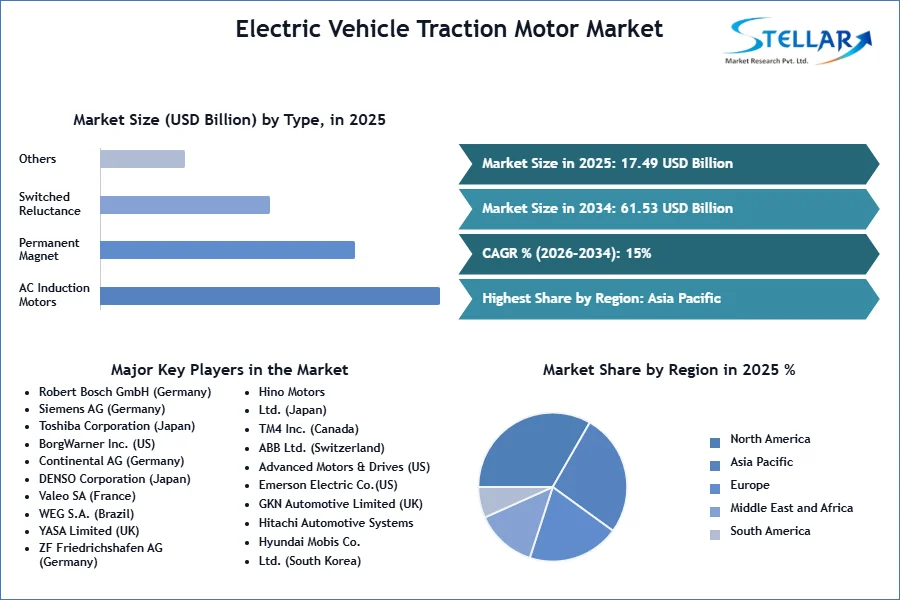
According to the latest Electric Vehicle Traction Motor Market Report by Stellar Market Research, the market is expected to witness robust growth throughout the forecast period, driven by rising EV production, supportive government policies, and continuous innovation in electric propulsion technologies.
Why Traction Motors Are the Heart of Electric Mobility
Traction motors convert electrical energy from the battery into mechanical power, making them the core propulsion system of battery electric vehicles (BEVs) and plug-in hybrid electric vehicles (PHEVs). Unlike conventional internal combustion engines, electric traction motors provide instant torque, smoother acceleration, and significantly higher energy efficiency.
Automakers are increasingly focusing on lightweight, compact, and high-efficiency motor designs that improve vehicle performance while reducing energy consumption. Permanent Magnet Synchronous Motors (PMSMs), induction motors, and emerging axial-flux motor technologies are becoming key differentiators for next-generation EV platforms. Market demand is rising alongside the global expansion of electric vehicle manufacturing and sales.
Rising Electric Vehicle Adoption Fuels Market Expansion
The accelerating adoption of electric vehicles remains the primary growth engine for the traction motor market. Governments worldwide continue to introduce financial incentives, stricter carbon emission standards, and investments in charging infrastructure to encourage EV adoption.
Battery Electric Vehicles (BEVs) account for the largest share of traction motor demand due to their fully electric powertrain architecture, while Plug-in Hybrid Electric Vehicles (PHEVs) are expected to witness strong growth as consumers seek greater driving flexibility. Increasing investments by automotive manufacturers in dedicated EV production facilities are further supporting long-term market expansion.
𝐃𝐨𝐰𝐧𝐥𝐨𝐚𝐝 𝐅𝐫𝐞𝐞 𝐏𝐃𝐅 𝐁𝐫𝐨𝐜𝐡𝐮𝐫𝐞: https://www.stellarmr.com/report/req_sample/Electric-Vehicle-Traction-Motor-Market/1762
Technological Innovation Is Reshaping Motor Performance
Motor manufacturers are investing heavily in advanced engineering solutions to improve efficiency, reliability, and sustainability.
Key technology trends include:
Development of high-efficiency Permanent Magnet Synchronous Motors (PMSMs)
Integration of silicon carbide (SiC)-based power electronics
Adoption of rare-earth optimized and rare-earth-free motor technologies
Improved thermal management systems for higher power density
Lightweight motor designs to extend vehicle driving range
AI-assisted motor control systems for energy optimization
These innovations enable electric vehicles to achieve better acceleration, reduced energy losses, and lower overall operating costs while improving vehicle reliability under varying driving conditions.
Asia-Pacific Leads Global Production
Asia-Pacific continues to dominate the Electric Vehicle Traction Motor Market due to its strong EV manufacturing ecosystem, established battery supply chains, and supportive government policies.
China remains the largest producer and consumer of electric vehicles globally, supported by extensive investments in domestic EV manufacturing and component production. Japan and South Korea contribute through advanced motor technologies and automotive innovation, while India is rapidly expanding its electric mobility ecosystem through incentive programs and local manufacturing initiatives.
Europe is witnessing strong market growth driven by ambitious decarbonization goals, increasing EV adoption, and investments from leading automotive manufacturers. North America is also expanding rapidly as automakers increase investments in domestic EV production and supply chain localization.
Market Challenges
Despite impressive growth prospects, the industry faces several challenges.
The availability and pricing of rare-earth materials used in permanent magnet motors remain major concerns for manufacturers. Supply chain disruptions and geopolitical uncertainties can affect production costs and procurement strategies.
In addition, manufacturers must balance performance improvements with affordability while complying with evolving efficiency and sustainability regulations. The industry is responding through material innovation, recycling initiatives, and the development of alternative motor architectures that reduce dependence on critical minerals.
Competitive Landscape
The Electric Vehicle Traction Motor Market is characterized by continuous innovation and strategic investments from global automotive suppliers and technology companies.
Leading participants include Robert Bosch GmbH, ZF Friedrichshafen AG, Nidec Corporation, Valeo, ABB, Hitachi, Parker Hannifin, YASA, and Continental Engineering Services. These companies are expanding production capacity, strengthening partnerships with electric vehicle manufacturers, and investing in next-generation motor technologies to improve efficiency, reduce weight, and enhance power output.
𝐃𝐨𝐰𝐧𝐥𝐨𝐚𝐝 𝐅𝐫𝐞𝐞 𝐏𝐃𝐅 𝐁𝐫𝐨𝐜𝐡𝐮𝐫𝐞: https://www.stellarmr.com/report/req_sample/Electric-Vehicle-Traction-Motor-Market/1762
Future Outlook
The future of the Electric Vehicle Traction Motor Market will be shaped by continued electrification, advances in motor design, and increasing investments in sustainable transportation. As battery technologies improve and EV production scales globally, demand for compact, high-efficiency traction motors is expected to grow significantly.
Emerging technologies such as axial-flux motors, integrated e-axles, and rare-earth-free propulsion systems are likely to redefine the competitive landscape over the coming years. Combined with supportive government policies, expanding charging infrastructure, and increasing consumer acceptance of electric mobility, these innovations will create substantial opportunities for motor manufacturers, automotive OEMs, and investors.
As the global automotive industry accelerates toward zero-emission transportation, traction motors will remain a foundational technology enabling higher efficiency, improved vehicle performance, and sustainable mobility solutions for the future.
