Skateboard Market: Youth Culture, Urban Sports, and Innovation Drive Global Industry Growth
Skateboarding has evolved from a niche recreational activity into a global lifestyle movement fueled by youth culture, competitive sports, and urban mobility trends. The sport’s inclusion in international competitions, growing popularity on social media, and increasing investments in skate parks have significantly expanded its appeal across all age groups. As manufacturers introduce innovative board designs and premium materials, the global skateboard market is experiencing steady growth supported by both recreational riders and professional athletes.
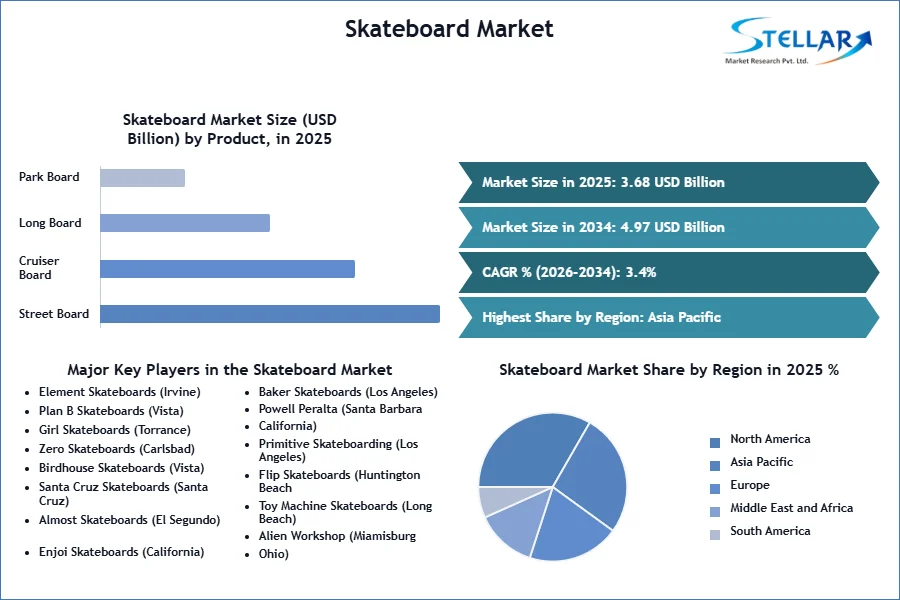
According to the latest Skateboard Market Report by Stellar Market Research, the global market was valued at USD 3.68 billion in 2025 and is projected to reach USD 4.97 billion by 2034, growing at a CAGR of 3.4% during the forecast period (2026–2034). The market is benefiting from rising participation in action sports, expanding e-commerce channels, and increasing demand for high-performance skateboards.
Skateboarding Continues to Gain Mainstream Popularity
Over the past decade, skateboarding has become one of the fastest-growing action sports worldwide. Greater visibility through international sporting events, online content creators, and lifestyle branding has attracted new participants while strengthening consumer demand for premium skateboards and accessories.
Manufacturers are responding by developing boards that offer improved durability, lightweight construction, and enhanced maneuverability. Product innovation, coupled with growing consumer interest in outdoor recreation, is creating new opportunities across recreational, competitive, and commuter segments. The increasing popularity of direct-to-consumer sales and digital retail platforms has also improved product accessibility for consumers worldwide.
Street Boards Dominate Product Demand
Among product categories, street boards accounted for the largest market share in 2024–2025. Their popularity stems from widespread use in urban environments, skate parks, and competitive street skating.
Modern street boards feature reinforced deck construction, precision trucks, and optimized wheel designs that improve control and performance during tricks and technical maneuvers. Their strong association with youth culture and street fashion has further strengthened demand across global markets. Manufacturers continue collaborating with professional skateboarders and lifestyle brands to launch limited-edition products and performance-focused designs.
𝐃𝐨𝐰𝐧𝐥𝐨𝐚𝐝 𝐅𝐫𝐞𝐞 𝐏𝐃𝐅 𝐁𝐫𝐨𝐜𝐡𝐮𝐫𝐞: https://www.stellarmr.com/report/req_sample/Skateboard-Market/1814
Asia-Pacific Leads Global Production and Consumption
The Asia-Pacific region dominates the global skateboard market due to its well-established manufacturing ecosystem, competitive production costs, and growing consumer base.
Countries including China and Taiwan serve as major manufacturing hubs, supplying skateboards to international brands while supporting continuous product innovation. Rising participation in outdoor sports, increasing disposable incomes, and expanding urban youth populations continue to stimulate regional demand.
Meanwhile, North America remains a mature market supported by a strong skateboarding culture, extensive retail networks, and continued investment in recreational infrastructure. Europe is also witnessing healthy growth as governments promote active lifestyles and outdoor sports participation.
Product Innovation Is Expanding Market Opportunities
Continuous innovation is reshaping the skateboard industry. Manufacturers are investing in advanced deck materials, improved wheel compounds, and lightweight construction techniques that enhance rider performance and durability.
The emergence of electric skateboards represents one of the industry’s most promising growth opportunities. Equipped with rechargeable batteries, electric motors, and smart control systems, these products appeal to consumers seeking sustainable short-distance transportation alongside recreational use.
At the same time, demand for eco-friendly skateboards made from responsibly sourced wood, bamboo, and recycled materials is increasing as consumers become more environmentally conscious. Premium customization options and direct-to-consumer business models are also helping brands strengthen customer engagement.
Market Challenges
Despite positive growth prospects, several factors continue to influence market expansion.
Safety concerns remain one of the primary challenges, particularly among beginners and younger riders. The need for helmets, pads, and other protective equipment can increase the overall cost of participation. Additionally, fluctuations in raw material prices and intense competition among established brands require manufacturers to continuously innovate while maintaining competitive pricing.
However, growing awareness of skateboarding as both a recreational activity and an organized sport is expected to offset these challenges over the long term.
Competitive Landscape
The skateboard market is characterized by strong competition among established global brands and specialized manufacturers. Leading companies focus on product innovation, athlete sponsorships, digital marketing, and collaborations with fashion and lifestyle brands to strengthen their market presence.
Key industry participants include Boardriders, Krown Skateboards, Skate One, Alien Workshop, Almost Skateboards, Zero Skateboards, Absolute Board Co., CONTROL SKATEBOARDS INC., and Razor USA LLC. Companies are expanding their online sales channels while investing in premium product portfolios to address changing consumer preferences and growing international demand.
𝐃𝐨𝐰𝐧𝐥𝐨𝐚𝐝 𝐅𝐫𝐞𝐞 𝐏𝐃𝐅 𝐁𝐫𝐨𝐜𝐡𝐮𝐫𝐞: https://www.stellarmr.com/report/req_sample/Skateboard-Market/1814
Future Outlook
The global skateboard market is expected to maintain steady growth through 2034 as participation in action sports continues to increase worldwide. Rising investments in recreational infrastructure, expanding youth engagement, and the growing influence of social media are expected to sustain long-term demand.
Future opportunities will likely emerge from premium skateboard products, electric skateboards, sustainable materials, and personalized designs that appeal to both recreational users and professional athletes. Manufacturers that successfully combine innovation, quality, sustainability, and strong community engagement will be well positioned to capitalize on the evolving global skateboard industry.
With the market projected to approach USD 5 billion by 2034, skateboarding is expected to remain an important segment within the global sporting goods and outdoor recreation industry, offering attractive opportunities for manufacturers, retailers, investors, and lifestyle brands alike.
