The Middle East and Africa Bike Sharing Market is gradually gaining momentum as governments and urban planners focus on sustainable mobility solutions, smart city initiatives, and reducing carbon emissions. While still in a developing phase compared to Europe and Asia Pacific, the region presents significant untapped potential driven by urbanization, tourism growth, and infrastructure investments.
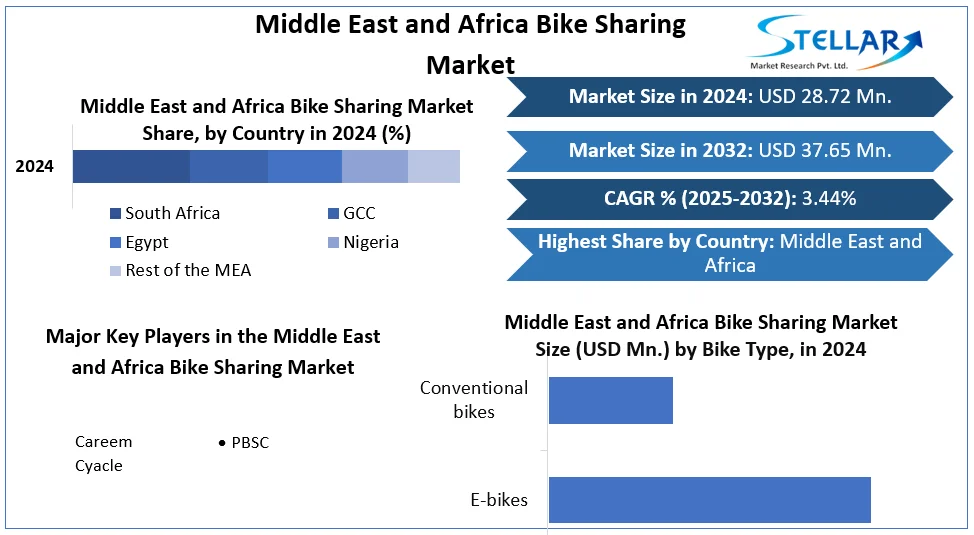
Middle East and Africa Bike Sharing Market size was valued at US$ 28.72 Million in 2024 and the total Middle East and Africa Bike Sharing Market revenue is expected to grow at 3.44% through 2025 to 2032, reaching nearly US$ 37.65 Million.
With rising awareness around environmental sustainability and increasing traffic congestion in major cities, bike-sharing systems are emerging as a viable solution for last-mile connectivity and short-distance commuting. The market is evolving as both public and private stakeholders invest in modern transportation ecosystems.
A Shift Toward Smart and Sustainable Urban Mobility
One of the most notable transformations in the Middle East and Africa bike sharing market is the adoption of smart, app-based bike-sharing systems. Cities are integrating these systems with public transportation networks to create seamless and efficient mobility solutions.
In the Middle East, countries such as the UAE and Saudi Arabia are leveraging bike-sharing as part of broader smart city initiatives. Meanwhile, in Africa, pilot projects and partnerships are helping introduce bike-sharing services in urban centers.
Electric bikes (e-bikes) are also gaining traction, particularly in regions where high temperatures and long commuting distances present challenges for traditional cycling.
Key Market Insights
- The Middle East and Africa bike sharing market is in an early growth stage with strong long-term potential.
- Dockless and hybrid models are gaining popularity due to flexibility and scalability.
- Electric bikes are emerging as a key growth segment, improving accessibility and user adoption.
- The Middle East leads the market, supported by smart city investments and infrastructure development.
- Africa is an emerging region with increasing pilot projects and urban mobility initiatives.
- Tourism-driven demand is contributing to bike-sharing adoption in key cities.
- Government support and public-private partnerships are critical for market expansion.
𝐃𝐨𝐰𝐧𝐥𝐨𝐚𝐝 𝐅𝐫𝐞𝐞 𝐏𝐃𝐅 𝐁𝐫𝐨𝐜𝐡𝐮𝐫𝐞: https://www.stellarmr.com/report/req_sample/Middle-East-and-Africa-Bike-Sharing-Market/67
Market Drivers Accelerating Growth
1. Smart City Initiatives and Urban Development
Governments in the Middle East are investing heavily in smart city projects, integrating bike-sharing systems into broader urban mobility frameworks.
2. Rising Traffic Congestion and Urbanization
Rapid urbanization is increasing pressure on transportation systems, creating demand for efficient and flexible mobility solutions.
3. Tourism and Recreational Demand
Bike-sharing services are gaining popularity in tourist destinations, offering convenient and eco-friendly transportation options.
Market Challenges and Restraints
1. Climate and Environmental Conditions
High temperatures in many Middle Eastern and African regions can limit the usability of traditional bike-sharing systems.
2. Limited Infrastructure in Some Regions
In parts of Africa, inadequate cycling infrastructure and urban planning constraints pose challenges for market growth.
Technology and Sustainability Trends
Technology is playing a crucial role in shaping the Middle East and Africa bike sharing market. Operators are adopting IoT-enabled tracking systems, mobile applications, and AI-driven analytics to improve operational efficiency and user experience.
Sustainability is a key focus area, with governments promoting eco-friendly transportation solutions to reduce carbon emissions. Bike-sharing systems are being integrated into green mobility strategies, particularly in cities aiming to achieve sustainability targets.
Additionally, solar-powered docking stations and energy-efficient e-bike fleets are emerging as innovative solutions in the region.
𝐃𝐨𝐰𝐧𝐥𝐨𝐚𝐝 𝐅𝐫𝐞𝐞 𝐏𝐃𝐅 𝐁𝐫𝐨𝐜𝐡𝐮𝐫𝐞: https://www.stellarmr.com/report/req_sample/Middle-East-and-Africa-Bike-Sharing-Market/67
Regional Insights: Middle East Leads, Africa Emerges
The Middle East dominates the regional bike-sharing market, with countries like the UAE and Saudi Arabia leading adoption. Cities such as Dubai and Riyadh are investing in cycling infrastructure and launching bike-sharing programs as part of smart city initiatives.
Africa, on the other hand, is an emerging market with significant growth potential. Countries such as South Africa, Kenya, and Nigeria are exploring bike-sharing solutions through pilot projects and partnerships with private operators.
The growing focus on urban mobility and sustainability is expected to drive adoption across both regions.
Recent Industry Developments
- Careem (2025): Expanded its bike-sharing services in select Middle Eastern cities, enhancing last-mile connectivity.
- Tier Mobility (2024): Entered partnerships to explore micro-mobility solutions in Middle Eastern markets.
- Dubai Roads and Transport Authority (2025): Expanded cycling infrastructure and bike-sharing initiatives across the city.
- Bolt (2024): Introduced micro-mobility services in select African cities, including bike-sharing options.
- Saudi Vision 2030 (2025): Continued to promote sustainable transport solutions, including bike-sharing systems.
Competitive Landscape
The Middle East and Africa bike sharing market is moderately fragmented, with a mix of international mobility companies and regional players. Companies are focusing on strategic partnerships, pilot projects, and technology integration to establish their presence.
Public-private partnerships are particularly important in this region, as governments play a key role in infrastructure development and policy support. Companies that can adapt to local conditions and offer innovative solutions are likely to gain a competitive advantage.
Analyst Perspective
A senior market analyst notes:
“The Middle East and Africa bike sharing market is at a pivotal stage, where early investments in infrastructure and technology will determine long-term growth trajectories. The region’s focus on smart cities and sustainability creates strong opportunities for market expansion.”
Future Outlook
The Middle East and Africa bike sharing market is expected to witness steady growth over the coming years, driven by increasing urbanization, government initiatives, and rising awareness of sustainable mobility.
The adoption of electric bikes, expansion of smart city projects, and integration with public transportation systems will play a crucial role in shaping the market’s future. As infrastructure improves and consumer awareness grows, the region is likely to emerge as a significant player in the global bike-sharing ecosystem.
Overall, the Middle East and Africa Bike Sharing Market represents a promising opportunity for investors and mobility providers looking to tap into emerging urban transportation trends.
