The United States Bike Sharing Market is undergoing rapid transformation as cities prioritize sustainable transportation, reduce congestion, and invest in smart mobility infrastructure. Once limited to a few metropolitan areas, bike-sharing systems have now become a mainstream urban mobility solution across major U.S. cities.
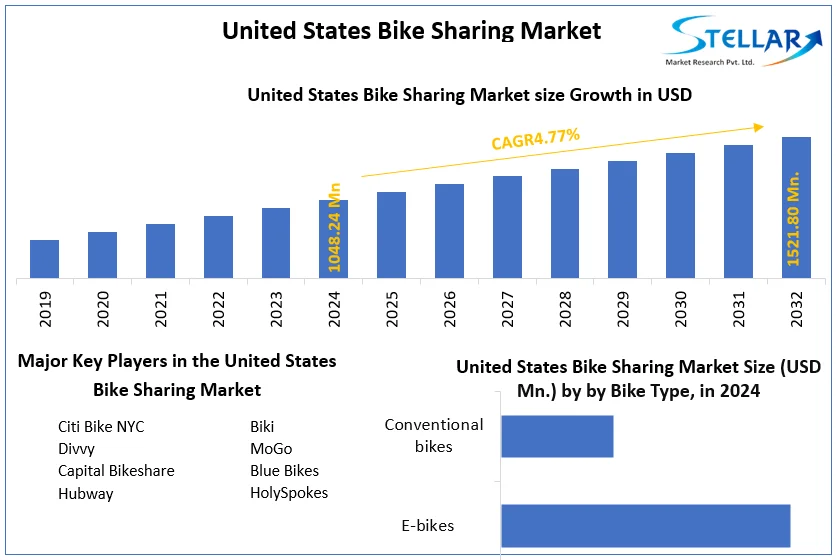
United States Bike Sharing Market size was valued at US$ 1048.24 Million in 2024 and the total United States Bike Sharing Market revenue is expected to grow at 4.77% through 2025 to 2032, reaching nearly US$ 1521.80 Million.
Driven by increasing environmental awareness, rising fuel costs, and changing commuter preferences, the market is expanding with a strong focus on electric bikes (e-bikes), app-based platforms, and multimodal transport integration. As a result, bike sharing is evolving from a niche service into a critical component of the urban transportation ecosystem.
A Shift Toward E-Bikes and Multimodal Mobility
A defining trend in the United States bike sharing market is the rapid adoption of electric bikes, which are transforming user behavior. E-bikes offer greater convenience, reduced physical effort, and the ability to travel longer distances, making them particularly attractive in sprawling urban environments.
Additionally, cities are increasingly integrating bike-sharing systems with public transit networks, enabling seamless multimodal journeys. This integration supports last-mile connectivity and reduces dependence on private vehicles.
Dockless and hybrid bike-sharing models are also gaining traction, offering flexibility and scalability compared to traditional docked systems.
Key Market Insights
- The United States is one of the largest bike-sharing markets in North America.
- Electric bikes represent the fastest-growing segment, driving user adoption.
- Dockless and hybrid systems are expanding rapidly across urban areas.
- Major cities such as New York, San Francisco, and Washington, D.C. lead the market.
- Integration with mobile apps and digital payment systems enhances user experience.
- Government initiatives and funding support infrastructure development.
- Public-private partnerships are critical for market expansion.
𝐃𝐨𝐰𝐧𝐥𝐨𝐚𝐝 𝐅𝐫𝐞𝐞 𝐏𝐃𝐅 𝐁𝐫𝐨𝐜𝐡𝐮𝐫𝐞: https://www.stellarmr.com/report/req_sample/United-States-Bike-Sharing-Market/75
Market Drivers Accelerating Growth
1. Strong Government Support and Urban Policies
Federal and municipal governments are investing in cycling infrastructure and promoting sustainable transportation to meet climate goals.
2. Rising Environmental Awareness
Consumers are increasingly adopting eco-friendly commuting options, driving demand for bike-sharing services.
3. Growth of Smart City Initiatives
Smart city projects are integrating bike-sharing systems into broader mobility frameworks, improving accessibility and efficiency.
Market Challenges and Restraints
1. Infrastructure Gaps in Some Cities
While major cities have well-developed cycling infrastructure, smaller cities may face challenges in supporting bike-sharing systems.
2. Operational and Maintenance Costs
Managing large fleets, ensuring maintenance, and preventing theft or vandalism can impact profitability.
Technology and Sustainability Trends
Technology is at the core of the United States bike sharing market. Operators are leveraging IoT-enabled tracking, GPS systems, and AI-driven analytics to optimize fleet management and improve user experience.
Mobile applications play a crucial role, allowing users to locate, unlock, and pay for bikes seamlessly. Data analytics is also being used to predict demand patterns and improve operational efficiency.
Sustainability remains a key focus, with bike-sharing systems contributing to reduced carbon emissions and improved urban air quality. The increasing adoption of electric bikes further enhances environmental benefits.
𝐃𝐨𝐰𝐧𝐥𝐨𝐚𝐝 𝐅𝐫𝐞𝐞 𝐏𝐃𝐅 𝐁𝐫𝐨𝐜𝐡𝐮𝐫𝐞: https://www.stellarmr.com/report/req_sample/United-States-Bike-Sharing-Market/75
Regional Insights: Major Cities Lead Adoption
New York City, San Francisco, and Washington, D.C. are leading the adoption of bike-sharing systems in the United States. These cities have well-established programs, strong infrastructure, and high user adoption rates.
Other cities, including Chicago, Los Angeles, and Seattle, are also expanding their bike-sharing networks, creating new growth opportunities.
The regional diversity highlights both mature markets and emerging opportunities across the country.
Recent Industry Developments
- Lyft (2025): Expanded its bike-sharing services through its Citi Bike program, increasing fleet size and e-bike availability.
- Uber (2024): Strengthened its micromobility offerings, including bike-sharing and e-bike services, across U.S. cities.
- Lime (2025): Increased investment in electric bikes, enhancing user experience and operational efficiency.
- U.S. Department of Transportation (2024): Announced funding for sustainable transportation projects, including cycling infrastructure.
- City of New York (2025): Expanded bike lanes and bike-sharing infrastructure to support urban mobility goals.
Competitive Landscape
The United States bike sharing market is highly competitive, with a mix of global mobility companies, local operators, and public bike-sharing systems. Companies are focusing on technology integration, fleet expansion, and strategic partnerships to strengthen their market position.
Public-private partnerships are particularly important, enabling infrastructure development and operational support. Companies that can offer reliable, user-friendly, and sustainable solutions are likely to gain a competitive edge.
Analyst Perspective
A senior market analyst notes:
“The U.S. bike sharing market is evolving rapidly as cities embrace sustainable mobility and digital transformation. The rise of e-bikes and integration with public transit will be key drivers of long-term growth.”
Future Outlook
The United States Bike Sharing Market is expected to witness strong growth in the coming years, driven by increasing investments in sustainable transportation and smart city initiatives. The adoption of electric bikes and expansion of bike-sharing networks will continue to enhance market potential.
The market is also likely to see greater integration with multimodal transport systems, enabling seamless travel experiences. As infrastructure improves and consumer awareness grows, bike-sharing will become an integral part of urban transportation in the United States.
Overall, the United States bike sharing market represents a significant opportunity for mobility providers, investors, and policymakers seeking to build efficient, eco-friendly, and scalable urban transport solutions.
