Packaging Material Market: Sustainability Mandates and E-Commerce Boom Drive Global Expansion
The global packaging material market is undergoing a major transformation driven by rising environmental regulations, rapid e-commerce expansion, and increasing demand for sustainable packaging solutions. Packaging materials—ranging from plastics, paper and paperboard, glass, and metals—play a critical role in protecting, preserving, and presenting products across industries such as food and beverages, pharmaceuticals, personal care, and consumer goods.
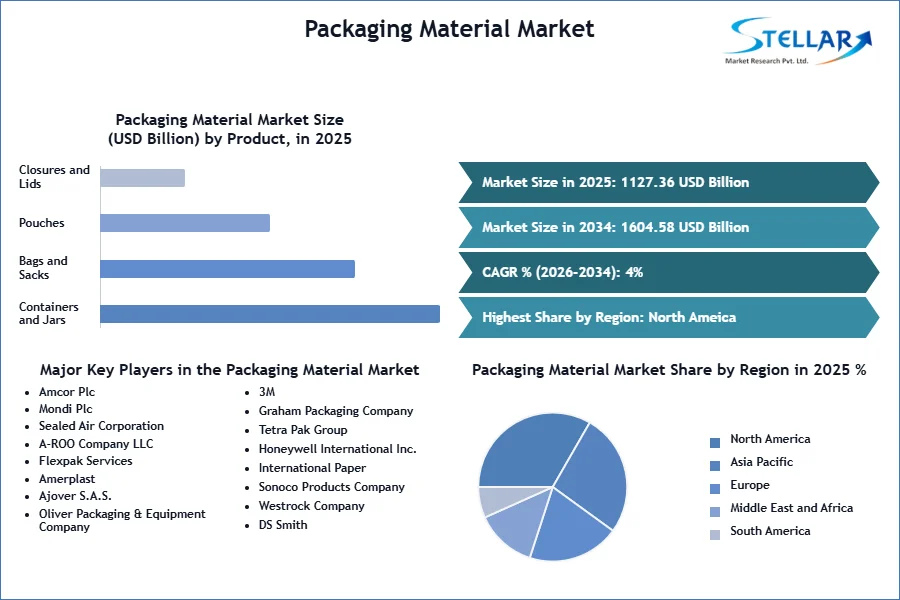
According to the latest Packaging Material Market Report by Stellar Market Research, the global market was valued at USD 1,127.36 billion in 2025 and is projected to reach nearly USD 1,604.58 billion by 2034, growing at a CAGR of 4% during 2026–2034.
Market Overview: Packaging Becomes a Sustainability-Critical Industry
The packaging industry is shifting from a traditional supply-chain function to a strategic sustainability and branding component. Companies are increasingly adopting recyclable, biodegradable, and bio-based materials to reduce environmental impact and comply with stricter global regulations such as Extended Producer Responsibility (EPR) frameworks.
The rise of e-commerce and direct-to-consumer retail has significantly increased demand for durable, lightweight, and cost-efficient packaging formats. At the same time, consumer expectations for convenience, safety, and visual appeal are pushing brands to innovate in both material science and packaging design.
Smart packaging technologies, including QR codes, RFID tracking, and sensor-based freshness indicators, are also reshaping the industry by improving transparency and supply chain efficiency.
𝐃𝐨𝐰𝐧𝐥𝐨𝐚𝐝 𝐅𝐫𝐞𝐞 𝐏𝐃𝐅 𝐁𝐫𝐨𝐜𝐡𝐮𝐫𝐞: https://www.stellarmr.com/report/req_sample/Packaging-Material-Market/1941
Key Findings from the Report
Market size was USD 1,127.36 billion in 2025, projected to reach USD 1,604.58 billion by 2034
Market is growing at a CAGR of 4% (2026–2034)
Asia-Pacific dominates the global market, driven by industrialization and e-commerce growth
Food & beverages is the largest application segment due to high demand for packaged goods
Paper and paperboard packaging is gaining strong traction due to sustainability trends
Primary packaging continues to dominate usage across industries
Smart and eco-friendly packaging solutions are expanding rapidly
Market Drivers and Restraints
Key Drivers
Increasing demand for sustainable packaging solutions is driving rapid adoption of recyclable, compostable, and bio-based materials across industries.
The expansion of e-commerce and online retail platforms is significantly increasing demand for protective and efficient packaging formats.
Rising consumption of packaged food, pharmaceuticals, and personal care products is boosting global packaging material demand.
Key Restraints
Environmental concerns and regulatory restrictions on plastic usage are challenging traditional packaging manufacturers.
Volatility in raw material prices, especially plastics and paper-based inputs, is impacting production costs and margins.
Technology, Sustainability, and Innovation Trends
The packaging material market is undergoing strong technological transformation. Companies are investing in smart packaging systems that enhance traceability, product authentication, and consumer engagement.
Sustainability is the strongest industry shift, with brands adopting recyclable mono-materials, biodegradable plastics, and paper-based alternatives to reduce carbon footprint. Regulatory frameworks such as EPR policies are pushing manufacturers to redesign packaging systems for circular economy compliance.
Additionally, digital printing and AI-based design optimization are enabling cost-efficient customization and improved shelf appeal.
Regional Insights
Asia-Pacific leads the global packaging material market due to rapid industrial growth, expanding consumer base, and strong demand from food delivery and e-commerce sectors, especially in China and India.
North America holds a significant share driven by advanced packaging technologies, strong retail infrastructure, and sustainability initiatives.
Europe is a key innovation hub for eco-friendly packaging, supported by strict environmental regulations and strong recycling systems.
Recent Industry Developments
Amcor (2025): Expanded recyclable flexible packaging solutions to strengthen sustainability portfolio
Sealed Air (2024): Introduced next-generation protective packaging systems for e-commerce logistics efficiency
International Paper (2025): Invested in expanding paper-based packaging production capacity to meet rising demand
Mondi Group (2024): Launched fully recyclable paper packaging solutions targeting food and beverage sector
Berry Global (2025): Advanced circular economy initiatives with recycled plastic packaging innovations
𝐃𝐨𝐰𝐧𝐥𝐨𝐚𝐝 𝐅𝐫𝐞𝐞 𝐏𝐃𝐅 𝐁𝐫𝐨𝐜𝐡𝐮𝐫𝐞: https://www.stellarmr.com/report/req_sample/Packaging-Material-Market/1941
Competitive Landscape
The packaging material market is highly competitive with global players focusing on sustainability, material innovation, and large-scale production capabilities.
Key companies include Amcor, Berry Global, Sealed Air, International Paper Company, Mondi Group, Ball Corporation, Crown Holdings, Smurfit Kappa, and Stora Enso. These companies are investing heavily in recycling technologies, sustainable material development, and digital packaging solutions.
Strategic mergers, acquisitions, and partnerships are also shaping the competitive landscape as companies expand their global footprint.
Future Outlook
The packaging material market is expected to maintain steady growth through 2034 as sustainability becomes the central theme of global manufacturing and retail industries. Increasing regulatory pressure, rising environmental awareness, and continued e-commerce expansion will further accelerate demand for innovative packaging solutions.
Future growth will be driven by bio-based materials, smart packaging technologies, and circular economy models that minimize waste and maximize recyclability. Companies that successfully integrate sustainability with cost efficiency and performance will remain competitive in the evolving global packaging ecosystem.
With the market projected to reach USD 1.60 trillion by 2034, packaging materials will continue to play a critical role in global supply chains, consumer experience, and environmental sustainability strategies.
