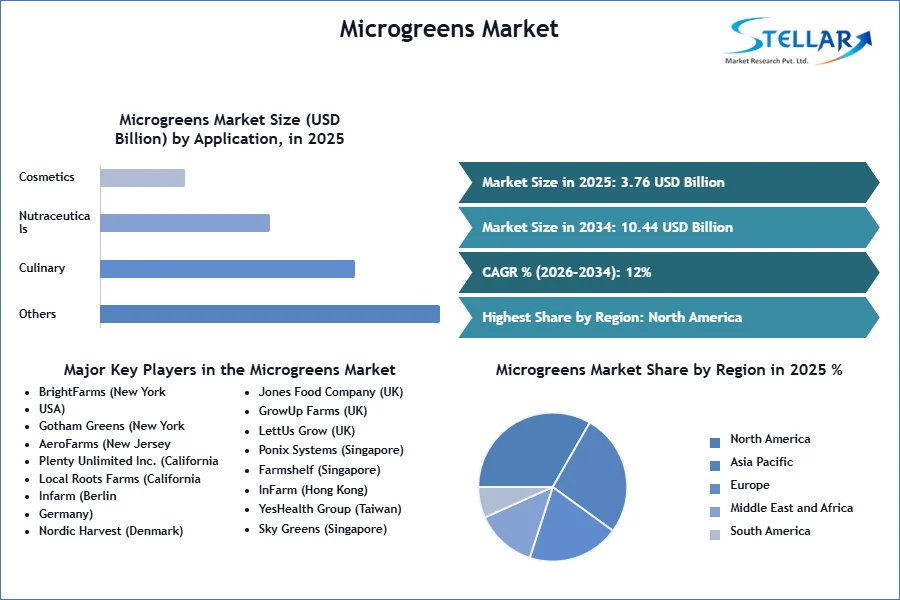
Microgreens Market: Urban Farming Revolution and Nutrient-Dense Superfoods Drive Global Growth
The global microgreens market is experiencing rapid expansion as consumers increasingly adopt nutrient-rich diets, functional foods, and sustainable urban farming practices. Microgreens—young vegetable greens harvested within 7–14 days of germination—are gaining strong popularity due to their concentrated vitamins, antioxidants, and intense flavors. Their rising use in gourmet cuisine, health-focused diets, and packaged food applications is accelerating global demand across retail, foodservice, and direct-to-consumer channels.
According to the latest Microgreens Market Report by Stellar Market Research, the global market was valued at USD 3.36 billion in 2024 and is projected to reach nearly USD 8.31 billion by 2032, growing at a CAGR of 12% during 2025–2032.
Market Overview: Superfoods Enter Mainstream Consumption
Microgreens have transitioned from niche culinary ingredients to mainstream health foods driven by rising awareness of preventive nutrition and clean eating trends. These tiny greens are considered a “superfood” due to their high nutrient density, often containing significantly higher levels of vitamins, minerals, and antioxidants compared to mature vegetables.
The market is strongly supported by urban agriculture trends, especially indoor farming and hydroponic systems that enable year-round cultivation regardless of climate conditions. Controlled environment agriculture (CEA) is making microgreens more accessible to urban populations while reducing transportation costs and improving freshness.
Restaurants, meal-kit providers, and health-focused retailers are increasingly incorporating microgreens into salads, smoothies, sandwiches, and gourmet dishes.
𝐃𝐨𝐰𝐧𝐥𝐨𝐚𝐝 𝐅𝐫𝐞𝐞 𝐏𝐃𝐅 𝐁𝐫𝐨𝐜𝐡𝐮𝐫𝐞: https://www.stellarmr.com/report/req_sample/Microgreens-Market/2027
Key Findings from the Report
Market size was USD 3.36 billion in 2024, projected to reach USD 8.31 billion by 2032
Market is growing at a CAGR of 12% (2025–2032)
North America leads the market with strong farm-to-table adoption
Asia-Pacific is the fastest-growing region due to rising health awareness
Broccoli microgreens dominate demand due to high nutrient concentration
Indoor farming and hydroponics are key production methods
Foodservice and retail sectors remain the largest application areas
Market Drivers and Restraints
Key Drivers
Rising demand for nutrient-dense superfoods is significantly driving microgreens adoption among health-conscious consumers.
Expansion of indoor farming and vertical agriculture systems enables year-round production and supports urban food supply chains.
Growing use of microgreens in gourmet restaurants and packaged health foods is further increasing market penetration.
Key Restraints
High production costs associated with controlled environment farming can limit scalability in price-sensitive markets.
Short shelf life of microgreens creates supply chain challenges and increases logistics pressure for retailers and distributors.
Technology and Innovation Trends
The microgreens market is being transformed by advancements in indoor farming technologies, including vertical farming systems, hydroponics, and smart greenhouse automation.
AI-based crop monitoring, LED lighting optimization, and climate-controlled growth environments are improving yield efficiency and nutritional quality. These technologies are enabling large-scale urban farming operations and reducing dependency on traditional agriculture.
Packaging innovations focused on freshness preservation and extended shelf life are also becoming increasingly important in retail distribution.
Regional Insights
North America dominates the global microgreens market due to strong consumer awareness, established health food culture, and widespread adoption in restaurants and retail chains.
Europe maintains strong demand driven by organic food consumption trends and sustainable agriculture initiatives.
Asia-Pacific is the fastest-growing region, supported by urbanization, rising disposable income, and increasing awareness of plant-based nutrition in countries such as China, India, Japan, and South Korea.
Recent Industry Developments (2024–2026)
AeroFarms (2025): Expanded indoor vertical farming facilities to scale microgreens production for retail and foodservice markets
Gotham Greens (2024): Increased greenhouse-based production capacity to support growing demand from supermarkets
BrightFarms (2025): Strengthened retail partnerships across major grocery chains in North America
Little Leaf Farms (2024): Expanded greenhouse lettuce and microgreens distribution network in the U.S.
Controlled Environment Agriculture startups (2026): Increased investment in AI-driven indoor farming systems for nutrient optimization
𝐃𝐨𝐰𝐧𝐥𝐨𝐚𝐝 𝐅𝐫𝐞𝐞 𝐏𝐃𝐅 𝐁𝐫𝐨𝐜𝐡𝐮𝐫𝐞: https://www.stellarmr.com/report/req_sample/Microgreens-Market/2027
Competitive Landscape
The microgreens market is moderately consolidated with a mix of vertical farming companies, greenhouse operators, and specialty produce brands competing for market share.
Key players include AeroFarms, BrightFarms, Gotham Greens, Little Leaf Farms, AppHarvest, Shenandoah Growers, and True Leaf Market. Companies are focusing on technological innovation, sustainability, and expansion of controlled environment agriculture facilities.
Strategic partnerships with grocery retailers, foodservice providers, and agri-tech firms are shaping competitive positioning in the market.
Future Outlook
The microgreens market is expected to continue strong growth through 2032 as consumer preference shifts toward functional foods, plant-based diets, and sustainable agriculture. Advancements in vertical farming, hydroponics, and AI-driven cultivation will further reduce production costs and improve scalability.
With increasing adoption in retail, foodservice, and direct-to-consumer channels, microgreens are transitioning from niche superfoods to mainstream dietary staples. The market’s expansion will be strongly supported by urban farming initiatives and global health and wellness trends.
