Key Highlights
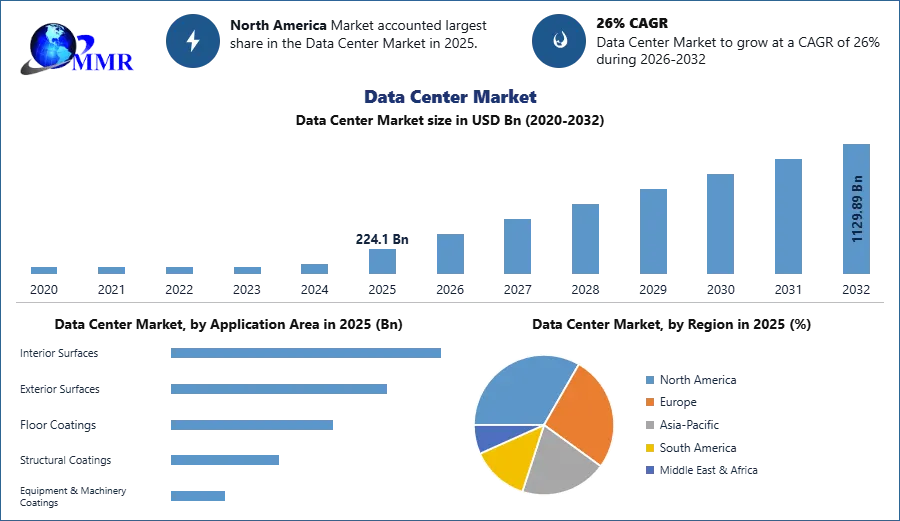
Market Valuation Realization: The global Data Center Market was valued at USD 224.10 Billion in 2025 and is projected to reach USD 1129.91 Billion by 2032, demonstrating a CAGR of 26%.
Hyperscale Sector Supremacy: Hyperscale facilities established a dominant market position, securing a 40% value share in 2025 due to optimized cooling efficiency and automated workload distribution.
On-Premise Deployment Retention: On-premise infrastructure retained a 56.4% market share in 2025, driven by enterprise requirements for consistent internal sensor tracking and secure localized data collection.
Institutional Capital Accumulation: Institutional investors, including pension funds, private equity firms, and sovereign wealth organizations, deployed over $100 billion into data center assets over the past decade.
XaaS Demand Explosion: Everything as a Service (XaaS) integration triggered an extraordinary 42% year-over-year surge in data center workload processing during the first half of 2022.
Why This Matters Now
The physical constraints of power grids and land availability are colliding with unprecedented digital demand, forcing global technology leaders to re-engineer their infrastructure strategies. Chief Information Officers (CIOs) and Chief Technology Officers (CTOs) can no longer treat computing capacity as an infinite cloud resource. The rapid shift toward resource-intensive computing requires an immediate re-evaluation of data facility placement, energy procurement, and platform architectures.
Enterprises that fail to secure long-term capacity face immediate operational risks, including restricted scaling capabilities and escalating lease expenditures. As larger capacity markets leverage deep institutional relationships to secure power allocations, early infrastructure positioning separates resilient digital leaders from resource-starved legacy operations. The battle for digital leadership is being fought at the utility grid level, transforming power availability into a primary competitive advantage.
Market Overview
The Data Center Market Size has transitioned from localized corporate storage rooms into a massive, globally distributed utility infrastructure. These physical facilities consolidate the critical networking, computing, and storage systems required to operate modern enterprise software ecosystems. The foundational architecture relies on a network of high-density routers, advanced switches, secure firewalls, and application delivery controllers designed to maintain constant uptime for shared digital tools.
A major driver of this structural expansion is the systemic outsourcing of data operations to specialized third-party operators. Enterprises are shifting workloads off-premises to mitigate high capital expenditures and navigate complex maintenance cycles. This transition has changed lease sizing dynamics, elevating major cloud platform providers to critical anchor tenants who routinely sign 30-megawatt (MW) commitments, making historical 10-MW layouts obsolete.
However, scaling these massive campuses introduces operational hurdles. Larger capacity markets benefit from established connections with municipal governments and local utility companies to secure grid connectivity and construction permits. Smaller, emerging markets present higher risk profiles due to unstable regulatory frameworks and prolonged power provisioning timelines. This reality reinforces why market leaders concentrate developments within primary technological zones where infrastructure support is guaranteed.
Key Trends Driving Growth
The core catalyst driving data center infrastructure expansion is the rapid proliferation of Everything as a Service (XaaS) software platforms. This structural shift was highlighted by a 42% year-over-year surge in demand during the first half of 2022, driven by the broad adoption of hybrid work models and virtual collaboration tools. The continuous reliance on cloud-native software requires a resilient, scalable backend architecture capable of handling unpredictable traffic spikes without performance degradation.
This application density is reflected in corporate software portfolios. A comprehensive enterprise survey revealed that corporations utilized over 100 distinct SaaS applications on average, representing a 38% increase from the previous year. This massive accumulation of software endpoints increases data generation across networks, forcing facilities to upgrade their internal switching fabrics and data ingestion pipelines to maintain acceptable latency bounds.
Concurrently, the emergence of edge computing applications is reshaping data center distribution models. The expansion of IoT sensor networks, the rollout of 5G wireless connectivity, and the development of autonomous vehicle platforms require data processing to occur closer to end-user devices. Industry leaders are responding by building hybrid architectural platforms that link massive, centralized hyperscale campuses with localized edge processing nodes located in high-density urban areas.
𝐃𝐨𝐰𝐧𝐥𝐨𝐚𝐝 𝐏𝐃𝐅 𝐁𝐫𝐨𝐜𝐡𝐮𝐫𝐞 @ https://www.maximizemarketresearch.com/request-sample/24271/
Segment Insights
Hyperscale Data Centers [Dominant Segment]: This architecture captured a 40% market share in 2025. Hyperscale facilities prioritize automated workload distribution and advanced cooling techniques to lower the cost of data interruptions and minimize operational downtime during peak demand periods.
On-Premise Deployment [Dominant Segment]: This model retained a 56.4% market share in 2025. On-premise solutions allow administrators to capture real-time sensor data regarding infrastructure availability, internal airflow, precise power consumption, room humidity, and local physical security boundaries.
The BFSI Vertical [Dominant Segment]: This sector secured a 26% application-level market share in 2025, operating as a key infrastructure user by employing Datacenter Facility Management (DCFM) and IT Service Management (ITSM) to monitor interdependent electrical networks and service lifecycles.
IT & Telecom [Fastest-Growing Segment]: This functional vertical is projected to expand at a CAGR of 7% through the forecast period, driving infrastructure modernization as telecom operators re-architect traditional facilities to support next-generation network virtualization.
Cloud Infrastructure Segment: This technology application area is projected to grow at a CAGR of 5.4% through the forecast period, driven by enterprise requirements for cross-device flexibility and high-speed data recovery protocols.
Regional Growth Story
North America maintained its dominant position in the global landscape, securing a 35% market share in 2025. This leadership is sustained by the heavy concentration of modular data center providers and substantial infrastructure investments from both private corporations and government bodies. During the first half of 2022, key United States regions—including Northern Virginia, Dallas, Silicon Valley, Chicago, Phoenix, the New York Tri-State area, and Atlanta—recorded 453.4 MW of positive net absorption, more than tripling the absorption levels observed in the first half of 2021.
However, this rapid expansion has created severe resource constraints within established primary hubs. Northern Virginia, the world’s largest data center market, implemented a multi-year pause on development across specific submarkets to allow local utility providers to upgrade strained electrical distribution lines. This regulatory hiatus has diverted institutional capital toward secondary markets, driving rapid land acquisition and development in regions like Portland, Phoenix, Columbus, and adjacent Canadian metropolitan areas.
Concurrently, the Asia-Pacific region is projected to expand at a CAGR of 6.7% through the forecast period. This acceleration is driven by the extensive deployment of 5G telecom infrastructure and rapid cloud service adoption across emerging commercial sectors. Regional operators are focusing investments on high-capacity urban centers to support the data processing needs of expanding industrial and digital economies.
Competitive Landscape
The competitive matrix is consolidating around massive capital platforms capable of funding multi-billion-dollar development pipelines. Pure-play data center developers face intense competition from global cloud providers and institutional consortia that buy entire corporate entities rather than acquiring individual data center assets. This investment shift has funneled over $100 billion from pension funds, private equity firms, and sovereign wealth funds into the sector over the past decade.
To maintain market leadership, top-tier operators like Digital Realty, Equinix Inc., and Hewlett Packard Enterprise Company are prioritizing infrastructure density, robust internal fiber connectivity, and direct cloud on-ramps. These structural attributes allow operators to maintain strong pricing power and retain premier corporate clients even during periods of high inflation and rising interest rates.
Simultaneously, semiconductor and technology giants like Nvidia, Oracle, Alphabet Inc., IBM Corporation, and Cisco Systems Inc. are shaping data center design specifications. The hardware requirements of these technology vendors—specifically regarding high-density computing racks and automated load balancing—force operators to continuously upgrade their power distribution and liquid cooling capabilities. This dynamic ensures that future market leadership will belong to operators whose facilities are pre-engineered to support dense, hardware-intensive processing.
Recent Developments
First Half 2022 Inventory Realization: Primary United States data center hubs expanded their operational capacity to reach a total inventory of 3,711.0 MW, signaling robust structural expansion across the North American continent.
First Half 2022 Absorption Surge: Top-tier domestic data center markets recorded 453.4 MW of positive net absorption, showing a three-fold volume increase compared to the absorption velocity tracked in H1 2021.
Institutional Ownership Realization: Global investment syndicates shifted away from asset-by-asset acquisition models, deploying over $100 billion to secure direct ownership positions in modular data center operating companies.
SaaS Integration Milestone: Global corporate infrastructure surveys confirmed that enterprises scaled their operational software usage to leverage over 100 distinct SaaS applications on average, representing a 38% annual expansion rate.
Strategic Implications
For global telecom operators and internet service providers, the expansion of the Data Center Market requires immediate investments in network virtualization and high-capacity fiber backbones. As data center locations shift toward secondary regional markets, telecom providers must modernize their routing paths to avoid bottlenecking traffic. Operators who build low-latency pathways directly into emerging data center hubs will secure valuable enterprise transport contracts.
Cloud providers must re-evaluate their hybrid hosting strategies to balance hyperscale deployment with localized edge processing. The continuous growth of SaaS application usage means cloud vendors must optimize their server workloads across both centralized and decentralized environments. Providers that offer seamless data synchronization between core hyperscale assets and edge nodes will capture a larger share of enterprise software spending.
For enterprise software vendors and technology buyers, the primary objective is optimizing data efficiency to mitigate rising colocation and infrastructure costs. As grid constraints drive up rental pricing for second-generation data facilities, software applications must be engineered to minimize unnecessary data processing and network transport. Organizations that modernize their software architectures to run efficiently on dense hardware will protect their margins from rising infrastructure costs.
Future Outlook
The next phase of the Data Center Market will be defined by a shift toward automated facility management and energy-resilient campus designs. As primary data center markets face power grid limitations, operators will invest heavily in onsite power generation, microgrid integration, and advanced liquid cooling technologies. These innovations will allow hyperscale facilities to operate independently of local utility strains, ensuring uninterrupted service delivery for critical global applications.
Furthermore, the expansion of 5G networks and autonomous infrastructure will accelerate the deployment of containerized, modular edge data centers. These compact facilities will operate as automated nodes that ingest, filter, and process localized sensor data before routing critical information back to centralized cloud environments. This structural evolution will transform data centers from isolated, large-scale storage hubs into a continuous, multi-tiered computing grid.
Ultimately, market leadership will be determined by speed-to-market and power availability. Data center operators that secure early access to high-capacity energy resources and automate their internal cooling and workload balancing will scale their platforms efficiently, creating a permanent operational gap between highly resilient infrastructure leaders and capacity-constrained laggards.
Analyst Perspective
“The structural transformation of the global Data Center Market is accelerating as institutional capital moves past traditional real estate investment models to finance high-density, automated digital utilities. By linking hyperscale facility design with advanced cooling mechanics and localized edge computing frameworks, operators are successfully scaling infrastructure to support massive XaaS demand. Success in this capital-intensive market is no longer determined by raw square footage, but by an operator’s ability to secure reliable power grid access and deliver low-latency connectivity to enterprise users.”
— Yash Ghosalkar, Research Analyst, Maximize Market Research
About Maximize Market Research
Maximize Market Research Pvt. Ltd. (MMR) is a global market research and consulting company that provides reliable, data-focused, and practical business insights. The firm serves a wide range of industries, including healthcare, pharmaceuticals, technology, automotive, electronics, chemicals, personal care, and consumer goods. Through market forecasts, competitive analysis, strategic consulting, and industry impact assessments, MMR helps organizations understand changing market conditions, identify growth opportunities, and make informed business decisions for long-term success.
2nd Floor, Navale IT Park Phase 3
Pune Banglore Highway, Narhe
Pune, Maharashtra 411041, India
+91 9607365656
sales@maximizemarketresearch.com
