Key Highlights
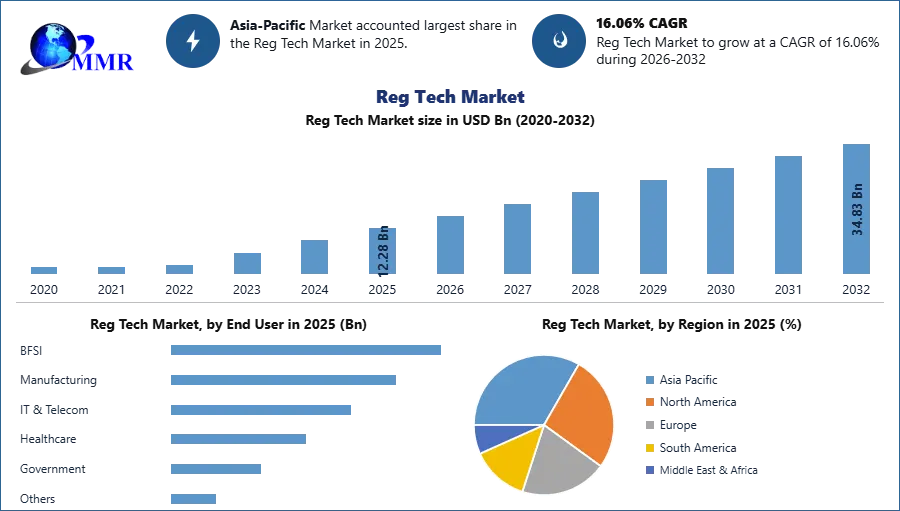
Market Capitalization Growth: The global RegTech Market was valued at USD 12.28 Billion in 2025 and is verified to reach nearly USD 34.84 Billion by 2032, sustaining a clear CAGR of 16.06%.
Cloud Infrastructure Domination: Cloud-based deployments achieved clear structural dominance, capturing a 60.22% share of the total market revenue in 2025.
Asia-Pacific Velocity: The Asia-Pacific regional market is projected to register the fastest growth rate globally, achieving a specific CAGR of 17.15% as localized entities expand structural partnerships.
Structural Financial Tailwinds: Escalating operational risks, an uptick in illicit transaction actions, and strict cross-border mandates operate as the primary drivers forcing automated technology adoption.
Ecosystem Capital Influx: Enterprise technology developers are increasing capital allocations toward modular systems to deliver scalable compliance tools for budget-constrained organizations.
Why This Matters Now
Corporate regulatory enforcement has reached a point of systemic friction, forcing a shift from manual oversight frameworks to automated operational systems. Global enterprises face an expanding wave of compliance updates, rendering legacy manual tracking methods legally and financially unviable. Chief Information Officers (CIOs) and Chief Technology Officers (CTOs) must implement active compliance architectures that translate dense legal text into automated software rules in real time.
This technology pivot occurs as cloud migration and decentralized network structures redefine corporate operational boundaries. Traditional firewalls cannot secure modern hybrid work applications or high-velocity financial payment streams against sophisticated fraud threats. Enterprise buyers must deploy intelligent automation systems that handle compliance validation without introducing latency into customer onboarding or multi-jurisdictional data transactions.
Market Overview
The RegTech Market Size has moved past basic data processing to become the core control layer for modern corporate data management. This industry comprises specialized software applications engineered to help organizations interpret complex guidelines, organize multi-jurisdictional records, and automate reporting workflows. By deploying targeted software components, organizations can track systemic risk indicators, verify user identities, and flag fraudulent activities before they impact the broader balance sheet.
A key driver of this expansion is the rapid shift toward cloud-based enterprise platforms. Cloud frameworks allow companies to replace fixed infrastructure expenditures with predictable, consumption-based operating models. This variable pricing model makes advanced compliance tools accessible to small and medium enterprises (SMEs) that operate on limited software budgets, expanding the addressable customer base for top-tier technology vendors.
Despite these clear growth drivers, implementation hurdles continue to limit full enterprise deployment. The high initial cost of comprehensive analytical dashboards and a lack of clear understanding regarding software deliverables prevent legacy organizations from executing timely system upgrades. Additionally, the lack of standardized global data formats, localized privacy mandates, and escalating cybersecurity risks require continuous development investments from core platform providers.
Key Trends Driving Growth
The integration of advanced automated intelligence within core business workflows is redefining modern corporate compliance strategies. Organizations are moving away from reactive, check-the-box audit processes in favor of predictive risk management frameworks. By embedding machine learning systems directly into transactional data layers, compliance platforms can parse massive datasets, identify operational anomalies, and generate regulatory reports automatically.
This technical transformation is further accelerated by the ongoing adoption of decentralized ledger infrastructure across institutional networks. In August 2022, blockchain technology emerged as a notable structural trend within the global compliance sector. This development allows platform providers to deliver transparent, tamper-proof transaction registries that simplify automated tracking across cross-border financial networks.
Concurrently, strict international data protection rules are forcing global enterprises to update their information storage architectures. Mandates like GDPR require companies to maintain strict control over customer data across different operating platforms. This regulatory pressure drives immediate demand for specialized identity management and data governance solutions, cementing software automation as a requirement for cross-border operations.
𝐃𝐨𝐰𝐧𝐥𝐨𝐚𝐝 𝐏𝐃𝐅 𝐁𝐫𝐨𝐜𝐡𝐮𝐫𝐞 @ https://www.maximizemarketresearch.com/request-sample/22473/
Segment Insights
Cloud-Based Deployments [Dominant Segment]: This infrastructure architecture secured a dominant 60.22% market share in 2025. Cloud systems allow organizations to convert fixed asset costs into variable expenditures, giving teams the flexibility to adjust resource consumption based on seasonal operational demands.
Compliance & Risk Management [Dominant Application]: This functional segment holds a leading operational position within the global landscape, as corporate buyers use automated software tools to monitor system uptime, handle inventory controls, and manage internal service lifecycles.
Identity Management and Fraud Management [Fastest-Growing Segment]: Driven by rising security threats and the expansion of digital onboarding systems, this segment is growing rapidly as companies prioritize real-time identity validation and automated fraud tracking across distributed networks.
Small and Medium Enterprises (SMEs) [Emerging Segment]: This segment represents a significant growth opportunity for platform vendors, as smaller businesses utilize cloud-delivered deployment models to automate compliance processes on limited operating budgets.
Regional Growth Story
North America maintained its position as the highest revenue-generating market in 2025. This leading market position is sustained by the high concentration of specialized software providers in the United States and Canada, coupled with high technology adoption rates across the regional financial and corporate sectors. Heavy investment injections—such as the surge in capital allocations recorded in October 2022—highlight the region’s focus on deploying automated compliance tools to manage complex legal environments.
Simultaneously, the Asia-Pacific region is projected to register the fastest growth rate globally, achieving a CAGR of 17.15% over the forecast period. The regional landscape is characterized by high fragmentation, with numerous local software vendors pursuing joint development partnerships, tactical corporate acquisitions, and ecosystem collaborations to expand their market reach. This corporate activity, alongside rising investments in commercial and security systems, positions the region to lead future software adoption.
In European technology markets, expansion is closely tied to evolving regional data sovereignty and operational resilience mandates. Organizations across major hubs like Germany and the United Kingdom are increasing technology investments to align with strict data classification rules and cross-border data transfer protocols. This targeted spending shows that European enterprises view compliance software as a core defensive asset rather than an optional administrative tool.
Competitive Landscape
The global competitive environment is intensifying as market leaders transition from point solutions toward integrated compliance platforms. Top-tier vendors focus on building comprehensive ecosystems where automated risk tracking, secure identity verification, and direct regulatory reporting operate on a unified architecture. This platform approach allows vendors to increase contract values and secure high customer retention across diverse industries.
To maintain market leadership, prominent software developers—including Accuity, Broadridge, Compliance Solutions Strategies (CSS), Deloitte, IBM, MetricStream, Nasdaq BWise, and Nice Actimize—are increasing investments in advanced system capabilities. This development focus helps vendors lower delivery costs and provide cost-effective compliance dashboards to mid-market buyers, effectively pressuring legacy software providers that lack native cloud capabilities.
At the same time, the boundaries between core corporate software, cybersecurity infrastructure, and automated compliance tracking are blurring. Leading platform vendors are designing modular applications that interface directly with enterprise cloud environments via standardized API layers. This architecture allows organizations to build resilient risk management workflows directly into their daily customer-facing platforms, shifting compliance from an isolated back-office function to an integrated operational asset.
Recent Developments
October 2022 Capital Realization: North American technology markets recorded an unprecedented surge in institutional funding directed toward enterprise compliance platforms, confirming strong investor confidence in automated software tools.
August 2022 Blockchain Convergence: Decentralized blockchain networks emerged as a core architectural trend within global compliance ecosystems, providing immutable ledgers for cross-border transaction verification.
Enterprise Infrastructure Integration: Major platform providers successfully rolled out low-cost cloud dashboards, helping small and medium enterprises automate complex reporting processes without incurring heavy upfront hardware expenses.
Strategic Implications
For global telecommunications operators and next-generation internet service providers, the expansion of the RegTech Market highlights the need for secure, low-latency network architectures. Compliance applications require continuous, secure data transmission to process identity verification and fraud tracking workflows in real time. Operators that build secure, certified data pathways directly into core compliance platforms can capture premium enterprise connectivity contracts.
Cloud service providers must optimize their hybrid infrastructure to meet strict compliance data sovereignty rules. Because automated software platforms must process sensitive personal records across multiple borders, cloud vendors must offer localized data storage and compliant hosting frameworks. Cloud providers that deliver native compliance tools within their core environments will attract larger enterprise accounts.
For enterprise technology leaders and corporate procurement managers, the main goal is eliminating manual data silos to reduce total compliance costs. Organizations must move away from fragmented legacy tracking systems in favor of unified, cloud-delivered automation platforms. Companies that modernize their data architectures to support real-time compliance tracking will insulate their operations from regulatory fines while protecting overall operating margins.
Future Outlook
The next phase of the market will be defined by the transition from reactive compliance monitoring to fully automated, predictive data governance. As national privacy laws and transaction tracking rules tighten globally, enterprise software must be engineered to automatically adjust its internal logic to match new guidelines. This evolution will eliminate manual configuration cycles, allowing global organizations to update their compliance postures instantly across all operating divisions.
Furthermore, the expansion of decentralized networks and automated cross-border trading platforms will drive adoption of continuous, real-time auditing models. Compliance systems will operate as persistent analytical layers that monitor corporate transactions, verify counterparty identities, and submit automated regulatory reports without human intervention. This transformation will establish automated data validation as the standard operating model for modern global businesses.
Ultimately, market leadership will be determined by the speed and accuracy of automated risk processing architectures. Corporate leaders that embed native, cloud-based automation tools into their core digital platforms will scale operations across new borders efficiently, creating a clear competitive advantage over legacy organizations constrained by manual oversight models.
Analyst Perspective
“The structural evolution of the global RegTech Market is accelerating as enterprise buyers abandon manual compliance checklists to deploy unified, cloud-based automation platforms. By linking real-time transactional monitoring with decentralized ledger systems and flexible cost structures, organizations are transforming compliance from an operational cost center into a resilient data asset. Long-term leadership belongs to software developers who successfully deliver low-cost, multi-jurisdictional dashboards that adapt to changing legal requirements without disrupting daily customer workflows.”
— Yash Ghosalkar, Research Analyst, Maximize Market Research
About Maximize Market Research
Maximize Market Research Pvt. Ltd. (MMR) is a global market research and consulting company that provides reliable, data-focused, and practical business insights. The firm serves a wide range of industries, including healthcare, pharmaceuticals, technology, automotive, electronics, chemicals, personal care, and consumer goods. Through market forecasts, competitive analysis, strategic consulting, and industry impact assessments, MMR helps organizations understand changing market conditions, identify growth opportunities, and make informed business decisions for long-term success.
2nd Floor, Navale IT Park Phase 3
Pune Banglore Highway, Narhe
Pune, Maharashtra 411041, India
+91 9607365656
sales@maximizemarketresearch.com
