Key Highlights
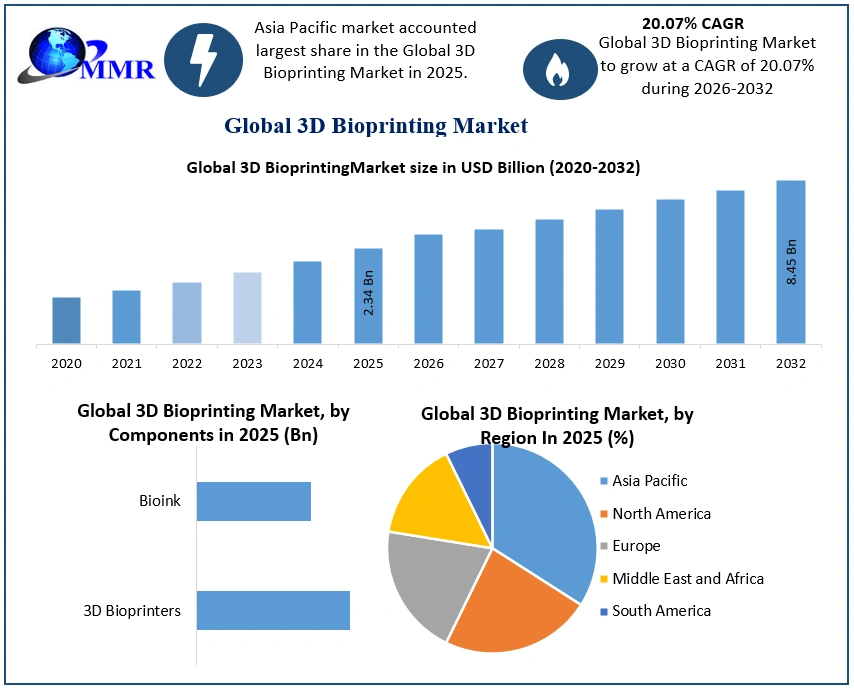
Market Capitalization Growth: The global 3D Bioprinting Market was valued at USD 2.34 Billion in 2025 and is verified to reach USD 8.45 Billion by 2032, expanding at an absolute CAGR of 20.07%.
Inkjet Technology Dominance: Inkjet printing configurations secured a dominant 44.4% share of the global market, providing industrial-grade precision-drop resolution for complex structural arrays.
Medical Sub-Segment Supremacy: The medical applications category led the overall functional landscape with a 36.8% revenue share in 2025, demonstrating an isolated CAGR of 15.5% over the forecast horizon.
Error Mitigation Realization: Next-generation magnetic levitation printing frameworks are projected to eliminate more than 80.0% of mechanical fabrication errors through scaffold-free bioassembly.
Vascularization Growth Vector: The specialized tissue and organ generation application sub-segment is projected to register the fastest growth profile, expanding at a targeted CAGR of 15.8%.
Why This Matters Now
The biological fabrication domain has passed the phase of basic laboratory testing and entered a phase of major industrial growth, driven by advanced computing power and automated cloud networks. Chief Information Officers (CIOs) and Chief Technology Officers (CTOs) within the pharmaceutical and biotechnology sectors face a massive shift as computing platforms replace traditional testing methods. Building vascularized, living human organs requires processing large, complex datasets that demand a complete update of existing enterprise data networks.
This operational shift is urgent due to global changes in healthcare rules and a critical shortage of donor organs, which leaves twenty people dying each day while waiting for transplants. At the same time, the regulatory environment is adapting to these challenges; the implementation of the FDA Modernization Act 2.0 allows companies to use high-throughput biofabricated tissue models instead of traditional animal testing for drug toxicity screenings. To leverage this development, technology buyers must deploy high-performance compute clusters and edge analytics engines capable of running complex multi-axis cell placement algorithms without crashing.
Market Overview
The 3D Bioprinting Market Size has transitioned from basic cell deposition into a highly automated data orchestration discipline. This technology sector involves specialized mechanical printers, custom bio-inks, and cloud-hosted design software working together to manufacture living human tissues layer by layer. By embedding precise mathematical coordinates within automated manufacturing software, these systems can position live cells, hydrogels, and extracellular matrices to duplicate natural biological systems.
A primary driver of this market expansion is the growing demand for accurate, human-specific models for drug discovery and vaccine development. The pandemic highlighted the need for flexible platforms that can accelerate treatment evaluations when facing new pathogens like SARS-CoV-2. By utilizing high-throughput bioprinted organ-on-a-chip models, pharmaceutical developers can identify human toxicities early in the process, reducing drug discovery timelines and lowering overall research expenditures.
However, widespread commercial deployment requires addressing significant technical and data transmission bottlenecks. Ensuring cell viability during long printing cycles requires real-time monitoring of temperature, fluid pressure, and environmental humidity. Managing these parameters generates large volumes of telemetry data that can strain legacy corporate networks, forcing infrastructure managers to invest heavily in network virtualization and hybrid cloud environments to protect data integrity.
Key Trends Driving Growth
The convergence of artificial intelligence, high-speed connectivity, and volumetric printing methods is redefining modern biofabrication workflows. Traditional layer-by-layer printing systems are being replaced by volumetric models that cure entire 3D structures at once using targeted light projections. This technical shift reduces total manufacturing times by 80%, lowering cell stress and ensuring that production processes can scale effectively to meet clinical demands.
This processing speed is supported by AI-driven lithographic optimization models. Machine learning algorithms run continuous simulations to predict cellular oxygen use and nutrient pathing within deep structures before printing begins. This automated design process addresses the chronic problem of inner cell death caused by nutrient starvation, allowing engineers to build intricate, functioning capillary networks in real time.
Concurrently, the industry is adopting 4D bioprinting methodologies, where stimuli-responsive bio-materials are programmed to transform over time after fabrication. This post-print maturation requires continuous data collection from IoT sensors embedded within specialized incubation systems. This requirement accelerates enterprise software demand for unified analytical dashboards that can monitor tissue growth metrics across multiple distributed research sites simultaneously.
𝐃𝐨𝐰𝐧𝐥𝐨𝐚𝐝 𝐏𝐃𝐅 𝐁𝐫𝐨𝐜𝐡𝐮𝐫𝐞 @ https://www.maximizemarketresearch.com/request-sample/3271/
Segment Insights
Inkjet Delivery Systems [Dominant Segment]: Capturing a 44.4% market share, these platforms provide high-precision droplet resolution. Their ability to manage high-throughput workflows while protecting cell health makes them an industry standard for building intricate tissue boundaries.
Living Cells Material Type [Dominant Segment]: This core component led total material revenue in 2025. The segment’s position is sustained by its essential role in regenerative applications, where researchers rely on viable human cell arrays to build functioning patches and vascular networks.
Medical Application Category [Dominant Segment]: Holding a 36.8% market share in 2025, this vertical is driven by the rising use of automated printing systems to manufacture specialized pharmaceutical pills, skin grafts, and bone structures for chronic disease management.
Magnetic Levitation Technology [Fastest-Growing Segment]: This scaffold-free assembly configuration is expanding rapidly because it eliminates more than 80.0% of mechanical printing errors, providing the precision needed to manufacture complex organoids without cell damage.
Tissue and Organ Generation [Fastest-Growing Segment]: Anticipated to expand at a CAGR of 15.8%, this sub-segment is propelled by the growing focus on engineering transplantable human organs to clear global donor backlogs.
Regional Growth Story
The global market shows distinct regional strengths tied to local infrastructure spending and healthcare IT adoption. North America remains a leading revenue contributor, holding a 31.8% revenue share in 2022. This position is anchored by the deep integration of enterprise software within the United States and Canadian healthcare ecosystems, alongside a solid base of research universities that use high-performance computing to run complex biological models.
Simultaneously, the Asia-Pacific region has established a strong presence, securing a 23.7% revenue share in 2025. This leading regional position is driven by heavy public and private investments in biotechnology research across China, India, Japan, and South Korea. Local operators focus on deploying automated manufacturing lines to scale the production of clinical tissue models, leveraging their established electronics and display supply chains to build affordable bioprinting hardware.
In Europe, market growth is focused on digital sovereignty, data integration, and clinical testing programs, as highlighted by projects like the 2026 ImPLANT initiatives. European organizations prioritize building highly secure, distributed data networks that connect research hospitals with automated manufacturing centers. This approach allows teams to share custom tissue designs across borders while maintaining strict alignment with regional data privacy laws.
Competitive Landscape
The competitive matrix is shifting from specialized hardware engineering toward integrated software and material platforms. Companies can no longer lead the market by simply selling printing hardware; they must provide full software ecosystems that combine automated tissue design tools, verified bio-inks, and cloud-delivered analytics. This platform integration increases vendor locking and gives market leaders strong pricing power over research laboratories.
To defend their market positions, prominent platform providers—including Biobots, Cellink, GeSiM, Rainbow Biosciences, regenHU, and TeVido BioDevices—are pursuing targeted strategic partnerships and product updates. These market leaders focus on releasing modular printheads and automated calibration tools that interface directly with standard enterprise software suites via secure APIs. This technical compatibility allows buyers to add bioprinting workflows into their existing IT environments without rebuilding their core infrastructure.
At the same time, the division between cloud processing companies and biotechnology manufacturers is shrinking. Hardware developers are building direct integrations with major public cloud vendors to offload heavy structural simulation workloads to remote data centers. This trend favors platform providers that invest early in secure cloud data integration, leaving behind legacy manufacturers that rely on isolated, local workstation software.
Recent Developments
ImPLANT Project Integration: The 2026 milestones for the European ImPLANT project accelerated the deployment of automated software models designed to track cell placement accuracy in real-time across distributed networks.
Volumetric Software Releases: Core technology vendors launched updated design tools that support volumetric printing, cutting physical tissue fabrication times by 80% through automated light-curing processes.
API Biomaterial Connectivity: Leading bio-ink developers deployed automated material databases that connect directly with cloud-hosted design platforms to verify cell viability metrics before manufacturing begins.
Strategic Implications
For global telecommunications operators and next-generation connectivity providers, the growth of the 3D Bioprinting Market highlights the need to build ultra-low-latency 5G infrastructure and edge computing nodes. Bioprinting software requires real-time data feeds from high-resolution optical sensors to adjust printing paths instantly when variations occur. Operators that provide secure edge processing capabilities can capture premium data contracts from advanced clinical networks.
Cloud service providers must tune their infrastructure to handle the storage and processing requirements of multi-gigabyte spatial tissue models. Because these applications process highly sensitive patient cell files, cloud platforms must offer secure, isolated compute zones that protect user privacy while running heavy machine learning algorithms. Cloud vendors that combine certified healthcare data silos with fast processing tools will attract major biotechnology clients.
For enterprise software vendors and corporate technology procurement managers, the main goal is eliminating disconnected data silos to improve total research efficiency. Organizations must replace old, local CAD tools with unified, cloud-delivered biofabrication dashboards that sync design files, material metrics, and quality reports automatically. Companies that modernize their software architectures to handle continuous simulation workflows will protect their research investments while accelerating clinical timelines.
Future Outlook
The next evolution of the market will be defined by a shift toward fully autonomous, closed-loop manufacturing centers. As high-speed connectivity and automated camera systems expand, printing setups will be engineered to autonomously detect and correct cell alignment errors during the fabrication process. This automated quality control will eliminate manual oversight, allowing production sites to scale up tissue manufacturing safely.
Furthermore, the expansion of 5G infrastructure will support the deployment of mobile, modular bioprinting pods located inside emergency response vehicles and remote military clinics. These connected units will download customized patient tissue layouts from centralized cloud servers, allowing operators to manufacture custom skin patches and vascular grafts directly at the point of care. This transition will turn bioprinting from an isolated laboratory technique into a highly distributed clinical service.
Ultimately, long-term market leadership will be determined by the data processing capabilities of an operator’s underlying software suite. Technology providers that embed real-time machine learning analytics into their core cloud platforms will scale their production workflows efficiently, creating a clear operational advantage over legacy manufacturers constrained by manual, low-throughput systems.
Analyst Perspective
“The structural transition of the global 3D Bioprinting Market is accelerating as clinical buyers move away from isolated laboratory testing to deploy unified, cloud-driven manufacturing platforms. By linking real-time machine learning simulations with high-speed volumetric printing and automated error checking, organizations are transforming cellular engineering into a scalable, data-driven industry. Long-term leadership belongs to platform vendors who deliver secure API ecosystems that connect physical printing hardware directly with edge-heavy cloud processing infrastructure.”
— Komal Patil, Research Analyst, Maximize Market Research
About Maximize Market Research
Maximize Market Research Pvt. Ltd. (MMR) is a global market research and consulting company that provides reliable, data-focused, and practical business insights. The firm serves a wide range of industries, including healthcare, pharmaceuticals, technology, automotive, electronics, chemicals, personal care, and consumer goods. Through market forecasts, competitive analysis, strategic consulting, and industry impact assessments, MMR helps organizations understand changing market conditions, identify growth opportunities, and make informed business decisions for long-term success.
2nd Floor, Navale IT Park Phase 3
Pune Banglore Highway, Narhe
Pune, Maharashtra 411041, India
+91 9607365656
sales@maximizemarketresearch.com
