Key Highlights
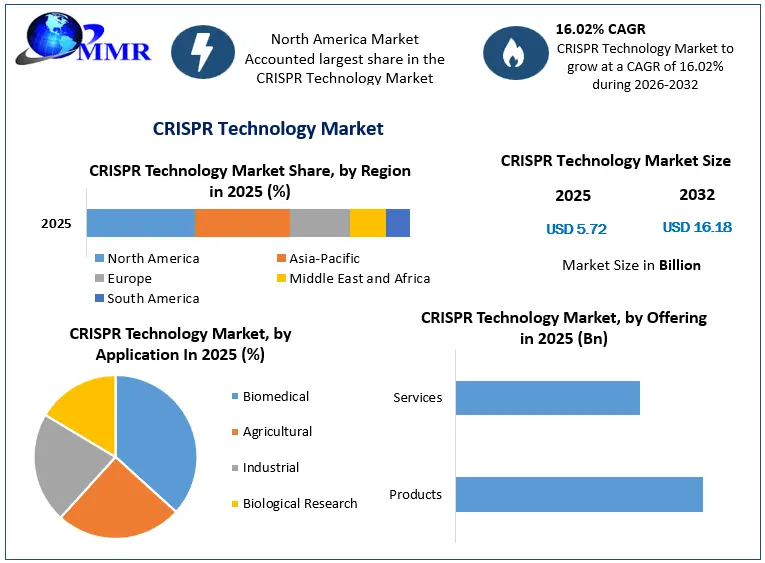
The global CRISPR technology market achieved an engineered valuation of USD 5.72 Billion in 2025.
Total market revenue is projected to grow at a compound annual growth rate (CAGR) of 16.02% between 2026 and 2032.
Overall market valuation is forecasted to reach approximately USD 16.18 Billion by the end of the analysis window in 2032.
The biomedical segment commands absolute application dominance due to expanding investments in gene therapies and rare disease mitigation.
Pharmaceutical and biopharmaceutical companies represent the dominant end-user segment, holding the largest structural market share.
North America, anchored by the United States, maintains technological leadership through concentrated research frameworks and capital pools.
The Asia Pacific region exhibits the highest latent expansion potential, driven by aggressive genetic research programs in China and Japan.
Why This Matters Now
The convergence of high-throughput automated genetic sequencing and distributed cloud computing architecture has triggered an immediate overhaul of the modern biotechnology pipeline. Technology executives and life-science enterprise buyers can no longer rely on legacy, localized computing systems to process dense molecular datasets without risking immediate loss of intellectual property and competitive positioning.
What changed? The global genome editing arena shifted from labor-intensive manual lab sequencing to automated, cloud-enabled genomic design. Why now? The exponential rise in private and public biotechnology investments has converged with mature machine learning algorithms capable of predicting off-target gene editing events in real time. Enterprise technology buyers benefit from this transition by deploying scalable cloud environments that compress drug development lifecycles from decades to months. What happens next is a massive industrial push toward fully virtualized hybrid cloud infrastructures that securely connect localized automated laboratories with global clinical simulation data registries.
Market Overview
The global CRISPR technology market Size achieved a baseline valuation of USD 5.72 Billion in 2025. Driven by an aggressive influx of capital and continuous refinement of gene-editing techniques, this high-growth sector is expanding at a CAGR of 16.02% from 2026 to 2032. This compounding trajectory will propel total market revenue to nearly USD 16.18 Billion by 2032, establishing genome editing as one of the most capital-dense vectors in the modern life-sciences and telecommunications technology integration landscapes.
This high-velocity market expansion requires deep enterprise deployment of secure cloud infrastructure to handle petabytes of raw genomic telemetry daily. Increasing incidences of genetic disorders and an aging global population have created an unprecedented strain on healthcare systems, driving high-volume automated testing and therapeutic screening. Consequently, data center operators are seeing a dramatic rise in demand for specialized high-performance computing clusters capable of executing continuous molecular modeling. The rapid commercialization of these genetic assets demands unyielding cybersecurity frameworks to insulate proprietary guide-RNA (gRNA) structures from coordinated industrial breaches.
Key Trends Driving Growth
The most significant trend accelerating this market is the deep integration of machine learning platforms into biomarker-based diagnostic testing and automated therapeutic synthesis. What changed is the transition away from unpredictable, trial-and-error gene adjustments to mathematically verified, algorithmic DNA modifications. Why now? Global regulatory bodies have updated health-tech compliance frameworks, rewarding organizations that use digital twin environments to demonstrate exact molecular precision prior to physical synthesis. This shift inherently benefits major pharmaceutical providers that possess the computational infrastructure required to run multi-variant simulations at scale.
As a direct consequence, network modernization has evolved into an essential operational standard across global biotechnology manufacturing hubs. Specialized laboratory operators are adopting 5G network slices to connect ultra-low latency edge computing nodes directly with automated liquid handling robotics and continuous-flow synthesizing platforms. This connectivity development allows real-time quality assurance feedback loops during the assembly of custom CRISPR-Cas9 complexes, dramatically lowering compound failure rates. Furthermore, the rising application of CRISPR in the agricultural sector for crop enhancement and disease resistance has forced international agribusinesses to implement secure SaaS supply chain tracking. These cloud-native solutions allow international distributors to verify the digital sovereignty and regulatory status of edited crops across multiple trade borders simultaneously.
𝐃𝐨𝐰𝐧𝐥𝐨𝐚𝐝 𝐏𝐃𝐅 𝐁𝐫𝐨𝐜𝐡𝐮𝐫𝐞 @ https://www.maximizemarketresearch.com/request-sample/62674/
Segment Insights
Biomedical Application (Dominant Segment): This application commands absolute dominance in the CRISPR technology market due to the high-density allocation of research budgets to human therapeutics, gene therapies, and oncology management. The business implication is a substantial, recurring requirement for specialized SaaS-based sequence modeling software that can reliably process cellular changes without service interruptions.
Pharmaceutical and Biopharmaceutical Companies (Dominant End-User): This segment holds the largest structural share of the global market, propelled by expanding corporate R&D budgets and the immense commercial value of patented gene-editing solutions. This dominance drives predictable, long-term enterprise demand for cloud-integrated product lifecycle management (PLM) architectures capable of synchronizing global validation records.
Agriculture and Functional Genomics: This segment represents a rapidly expanding avenue of the market, focused on altering plant phenotypes to withstand severe environmental anomalies. The accelerating adoption requires software vendors to develop distinct data management ecosystems tailored to handle field-trial telemetry and environmental variance models.
Regional Growth Story
North America commands structural dominance in the global CRISPR technology landscape, driven primarily by the dense concentration of biotechnology infrastructure and private venture funds within the United States. This regional market setup creates an incredibly lucrative ecosystem for enterprise software providers who can supply cloud environments that strictly comply with federal biosafety mandates. The direct business outcome is a highly competitive landscape where firms use premium infrastructure to expedite commercial timelines.
Conversely, the Asia Pacific region presents the most intense long-term expansion potential, led by sovereign investments in genetic sequencing across China, Japan, and South Korea. This geographic surge is forcing a major expansion of local telecommunications networks and decentralized data hubs to support massive, population-scale genomic database registries. Meanwhile, the European market remains heavily defined by stringent regulatory oversight, forcing companies across Germany and the United Kingdom to prioritize automated SaaS compliance reporting frameworks to manage shifting cross-border bio-legal alignments.
Competitive Landscape
The global market is characterized by rapid, high-stakes competition among native gene-editing pioneers and major healthcare delivery platforms. Elite industry participants shaping the direction of the market include Editas Medicine, Inc., Intellia Therapeutics, Inc., Caribou Biosciences, Inc., Beam Therapeutics Inc., Verve Therapeutics, Inc., and Mammoth Biosciences, Inc. These foundational innovators frequently collaborate with dominant manufacturing and pharmaceutical giants to achieve scalable distribution capabilities.
Strategic alignment patterns in this market indicate a definitive race for platform ecosystem supremacy rather than simple geographic scaling. For example, Mammoth Biosciences’ targeted collaborations with GlaxoSmithKline Plc, MilliporeSigma, and Hamilton Company to commercialize its CRISPR-based DETECTR platform illustrate how market leaders use cross-platform APIs to dominate the rapid diagnostic sector. Concurrently, Thermo Fisher Scientific’s deployment of advanced cell therapy production facilities at UCSF demonstrates that long-term pricing power belongs exclusively to firms that can link digital cloud-guided engineering with massive physical scale. These initiatives reveal that competitive readiness is no longer judged solely on laboratory breakthroughs, but on the speed with which an enterprise can virtualize its clinical pipeline.
Recent Developments
May 2023: Thermo Fisher Scientific opened an advanced cell therapy facility at UCSF, significantly accelerating the infrastructure pipeline for translating CRISPR discoveries into clinically validated patient therapies.
October 2020: Mammoth Biosciences secured commercialization agreements with MilliporeSigma and Hamilton Company, creating an interconnected distribution network for its CRISPR-based diagnostic testing systems.
May 2020: Mammoth Biosciences and GlaxoSmithKline Plc partnered to develop a disposable, fully integrated diagnostic platform using the DETECTR framework for high-precision, automated pathogen discovery.
Enterprise Software Shift: Global laboratory equipment providers began embedding automated SaaS compliance frameworks into high-throughput genetic synthesizers to automate real-time regulatory documentation.
Infrastructure Virtualization: Major biotechnology hubs in North America migrated core genomic indexing pipelines from on-premises servers to hyper-secure hybrid cloud environments to mitigate data-leakage vulnerabilities.
Strategic Implications
Enterprise technology buyers within the life-science domain must immediately pivot away from fragmented, legacy storage models toward holistic data management architecture. The sheer density of modern CRISPR modeling pipelines demands full enterprise migration to unified hybrid cloud strategies that bridge the gap between initial molecular design, clinical trials, and final batch manufacturing execution. Utilizing synchronized cloud-native data architecture allows organizations to apply complex generative AI routines to massive gene-sequence libraries, uncovering therapeutic candidates at a fraction of standard operational costs.
At the same time, digital security must be recognized as a critical structural liability at the highest level of corporate leadership. As gene-editing firms scale up direct digital integration with external contract research organizations (CROs) and university data nodes, their exposure to sophisticated threat actors expands exponentially. A single compromised database containing proprietary gRNA assets or patient clinical trial metadata can completely destroy an enterprise’s market position. Consequently, technical strategists must deploy zero-trust network access frameworks and end-to-end cryptographic verification protocols across all research and manufacturing endpoints globally.
Future Outlook
The long-term hierarchy of the global biotechnology ecosystem will be determined by the integration speed of next-generation digital architecture. Life-science organizations that successfully merge algorithmic molecular design with zero-trust hybrid cloud infrastructure will dictate the global therapeutic revenue pool, while legacy operators clinging to siloed computing methods will be rendered entirely obsolete by automated precision platforms.
Analyst Perspective
“The global CRISPR technology market has moved beyond basic experimental gene splicing,” stated Komal Patil, Research Analyst at Maximize Market Research. “Operational supremacy in this next decade belongs strictly to organizations that treat genomic data as a scalable, cloud-computed asset, leveraging automated workflows to secure immutable intellectual property.”
About Maximize Market Research
Maximize Market Research Pvt. Ltd. (MMR) is a global market research and consulting company that provides reliable, data-focused, and practical business insights. The firm serves a wide range of industries, including healthcare, pharmaceuticals, technology, automotive, electronics, chemicals, personal care, and consumer goods. Through market forecasts, competitive analysis, strategic consulting, and industry impact assessments, MMR helps organizations understand changing market conditions, identify growth opportunities, and make informed business decisions for long-term success.
2nd Floor, Navale IT Park Phase 3
Pune Banglore Highway, Narhe
Pune, Maharashtra 411041, India
+91 9607365656
sales@maximizemarketresearch.com
