Key Highlights
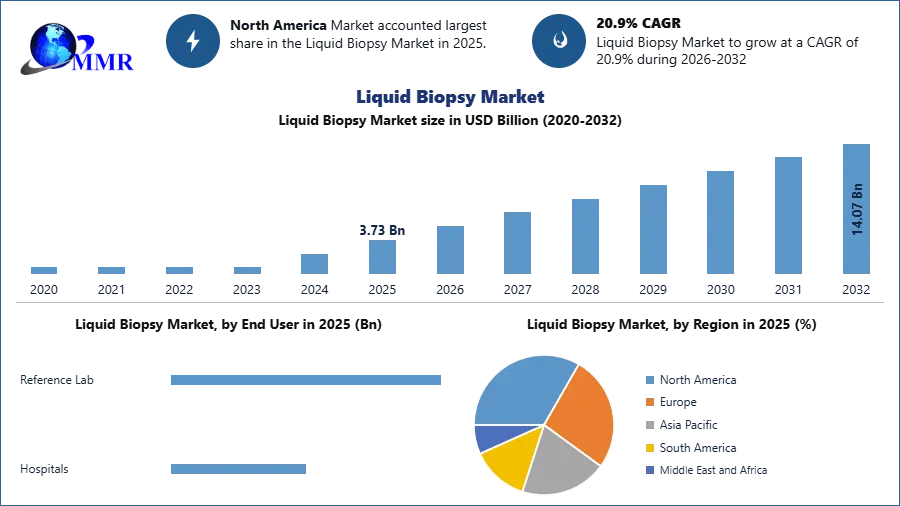
Market Scalability: Total market revenue expands from USD 3.73 Billion in 2025 to nearly USD 14.07 Billion by 2032, operating at a high-velocity CAGR of 20.9%.
Core Technological Core: Multi-gene-parallel Analysis via Next-Generation Sequencing (NGS) controls the technology domain, securing over 73% of global market revenue.
Biomarker Leadership: Circulating Nucleic Acids command a 36.67% dominant market share, fueled by the computational integration of circulating tumor DNA (ctDNA) tracking.
Geographic Concentration: North America dictates global market dynamics, capturing a 51% revenue share backed by robust biotechnology infrastructure and FDA-cleared analytical software.
Fastest-Growing Vector: Exosomes and microvesicles register the fastest compound annual growth rate, driven by advancements in automated clinical extraction techniques.
Why This Matters Now The conversion of physical biology into digital code is accelerating, positioning high-throughput genomics at the center of enterprise healthcare infrastructure. For information technology leaders, cloud providers, and data center operators, liquid biopsy workflows represent one of the most data-intensive compute workloads in modern medicine. A single patient tracking sequence generates terabytes of raw genomic data that require immediate, low-latency processing, advanced multi-gene parallel processing, and secure cloud storage architectures.
What changed is the technical capacity to isolate one detectable copy of a cancer mutation among millions of healthy cells. Why now is driven by the global convergence of hyper-scale computing, lower sequencing costs, and an urgent requirement to lower the operational strain of legacy oncology diagnostic pathways. For enterprise software vendors and network operators, this shift represents a massive opportunity to supply the specialized high-performance computing (HPC) environments, automated data pipelines, and strict compliance layers required to support real-time clinical decisions.
Market Overview The global liquid biopsy market Size is undergoing a rapid transition from proof-of-concept diagnostic validation to automated enterprise-scale integration. The total market size reached USD 3.73 Billion in 2025 and is projected to expand to USD 14.07 Billion by 2032, compounding at a CAGR of 20.9%. This structural growth is fundamentally driven by a critical macroeconomic factor: the escalating incidence of global oncological diseases.
According to estimates from the International Agency for Research on Cancer, global oncology metrics reached 19.3 million new cases and 9.96 million deaths in 2025. Facing this surge, the legacy tissue biopsy framework presents significant bottlenecks, including high operational costs, surgical risks, and an inability to track active tumor heterogeneity over time. Liquid biopsy circumvents these physical infrastructure limits by leveraging non-invasive, highly repeatable blood and fluid draws to extract real-time genetic insights.
Key Trends Driving Growth The primary catalyst driving market monetization is the integration of advanced computational multi-gene-parallel workflows. As legacy single-gene testing models fail to capture the complex, shifting landscape of drug-resistant tumors, the industry is shifting rapidly toward comprehensive Next-Generation Sequencing (NGS) panels. These systems sequence hundreds of genomic variations simultaneously, generating massive computational demands that require secure, high-throughput hybrid cloud infrastructure.
Concurrently, the rapid commercialization of companion diagnostics is transforming pharmaceutical development pipelines. Companion diagnostics act as integrated analytical layers that assist clinicians in matching specific targeted therapies to a patient’s real-time genetic profile. This software-driven approach to drug validation significantly compresses pharmaceutical trial timelines, creating a highly lucrative market segment for enterprise technology platforms capable of hosting and securing these sensitive analytical workloads.
𝐃𝐨𝐰𝐧𝐥𝐨𝐚𝐝 𝐏𝐃𝐅 𝐁𝐫𝐨𝐜𝐡𝐮𝐫𝐞 @ https://www.maximizemarketresearch.com/request-sample/3261/
Segment Insights
Multi-gene-parallel Analysis (NGS) [Dominant Technology Segment]: Accounting for over 73% of total revenue, high-throughput NGS platforms remain the dominant baseline technology. This architecture identifies a wide spectrum of mutations and acquired resistance mechanisms, allowing clinicians to detect minor allele frequencies as low as 0.1% in early-stage lung cancers.
Circulating Nucleic Acids [Dominant Biomarker Segment]: Capturing a 36.67% market share, this segment forms the primary structural data stream for liquid biopsy applications. It leverages circulating tumor DNA (ctDNA) to enable non-invasive molecular profiling, allowing researchers and clinicians to bypass traditional surgical tissue extraction completely.
Exosomes/Microvesicles [Fastest-Growing Segment]: Anticipated to register the highest CAGR during the forecast period, this category is expanding due to novel clinical product rollouts. A notable example includes the miR Sentinel Prostate Cancer Test, an exosome-based platform tracking a single urine sample with a 90% accuracy rate, signaling a clear shift toward highly specialized, automated extraction workflows.
Regional Growth Story North America maintains structural dominance over the global landscape, securing a 51% market share. The United States acts as the primary engine for this concentration, driven by intensive biotechnology capital deployment, a dense network of specialized sequencing centers, and strong regulatory backing from organizations like the American Society of Clinical Oncology. This mature ecosystem allows technology providers to deploy and scale advanced diagnostic platforms rapidly.
Canada is actively mirroring this trajectory by accelerating its adoption of regulatory-cleared liquid biopsy workflows. Growth in the Canadian market is further supported by dedicated public-private funding initiatives. For example, BioMark Diagnostic Solutions secured USD 825,000 in specialized financing from a consortium including the Canadian Cancer Society, Brain Canada Foundation, and the Canadian Institutes of Health Research to advance its automated lung cancer screening assays.
Competitive Landscape The competitive arena is shifting from isolated biotechnology development toward comprehensive platform-based ecosystems. Market consolidation and technology leadership are increasingly defined by a company’s ability to process massive genomics datasets, lower operational turnaround times, and establish strict analytical validity. Major instrumentation and platform providers, including Illumina, Thermo Fisher Scientific, PacBio, Oxford Nanopore Technologies, BGI Genomics, and MGI Tech, are focusing intensely on expanding their high-throughput compute workflows.
Simultaneously, specialized molecular diagnostic developers like Guardant Health, Exact Sciences, Natera, Biocept, and Burning Rock Biotech are driving the clinical application layer. Established global healthcare technology enterprises, including Roche, QIAGEN, Sysmex Corporation, and Bio-Rad Laboratories, are anchoring the market by embedding liquid biopsy capabilities directly into standard hospital lab frameworks. This platform-centric approach signals that future market dominance will belong to organizations that successfully bridge the gap between physical sample collection and automated digital insights.
Recent Developments
February 2026: GRAIL released breakthrough topline results from its NHS-Galleri trial involving over 142,000 participants, demonstrating that its multi-cancer early detection (MCED) test delivered a substantial reduction in Stage IV cancer diagnoses and a four-fold higher detection rate compared to legacy screening methods.
January 2026: Illumina announced the launch of its Billion Cell Atlas and unveiled a strategic expansion into AI-driven liquid biopsy workflows at the J.P. Morgan Healthcare Conference, aimed at drastically accelerating the throughput of minimal residual disease tracking.
April 2021: Biodesix expanded its clinical molecular testing ecosystem by launching a blood-based 52-gene NGS test, designed to run on high-throughput parallel sequencing architectures.
February 2021: Twist Bioscience introduced its automated NGS Methylation Detection System, providing critical epigenetic research infrastructure tailored specifically for liquid biopsy cancer analysis.
Strategic Implications The rapid digitization of oncology diagnostics introduces a critical operational challenge: managing the sheer volume and complexity of genomic data. For enterprise technology buyers and CIOs, this requires a fundamental re-evaluation of data center capacity, hybrid cloud strategies, and cybersecurity resilience. Genomic data is subject to strict digital sovereignty and privacy regulations, meaning that storage and analytical pipelines must feature ironclad security architecture.
Furthermore, the industry must navigate significant operational headwinds, most notably an unclear and highly fragmented global reimbursement scenario. The administrative complexity of managing payments for expensive multi-gene molecular testing, combined with varying insurance coverage policies, creates an urgent need for automated billing software and unified healthcare platform integration. Technology vendors that design solutions to streamline these complex administrative workflows will find substantial demand within the enterprise healthcare landscape.
Future Outlook Looking ahead, the liquid biopsy market will continue its transition toward an entirely automated, cloud-native paradigm. The integration of advanced artificial intelligence and machine learning pipelines will become mandatory to filter out the technical noise inherent in low-concentration ctDNA plasma samples, effectively minimizing the risk of false negatives. As these digital workflows solidify, the boundary between biotechnology and enterprise information technology will disappear completely, leaving the market divided between organizations with the infrastructure to process complex genetic data in real time and those restricted by slow, legacy analytical frameworks.
Analyst Perspective
“The structural expansion of the liquid biopsy market is no longer just a biological breakthrough; it represents a major data infrastructure milestone,” states Komal Patil, Research Analyst at Maximize Market Research. “As multi-gene parallel sequencing becomes the baseline standard for global oncology care, the true competitive differentiator will shift entirely to computational throughput, automated analytics pipelines, and secure cloud delivery models.”
About Maximize Market Research
Maximize Market Research Pvt. Ltd. (MMR) is a global market research and consulting company that provides reliable, data-focused, and practical business insights. The firm serves a wide range of industries, including healthcare, pharmaceuticals, technology, automotive, electronics, chemicals, personal care, and consumer goods. Through market forecasts, competitive analysis, strategic consulting, and industry impact assessments, MMR helps organizations understand changing market conditions, identify growth opportunities, and make informed business decisions for long-term success.
2nd Floor, Navale IT Park Phase 3
Pune Banglore Highway, Narhe
Pune, Maharashtra 411041, India
+91 9607365656
sales@maximizemarketresearch.com
