Key Highlights
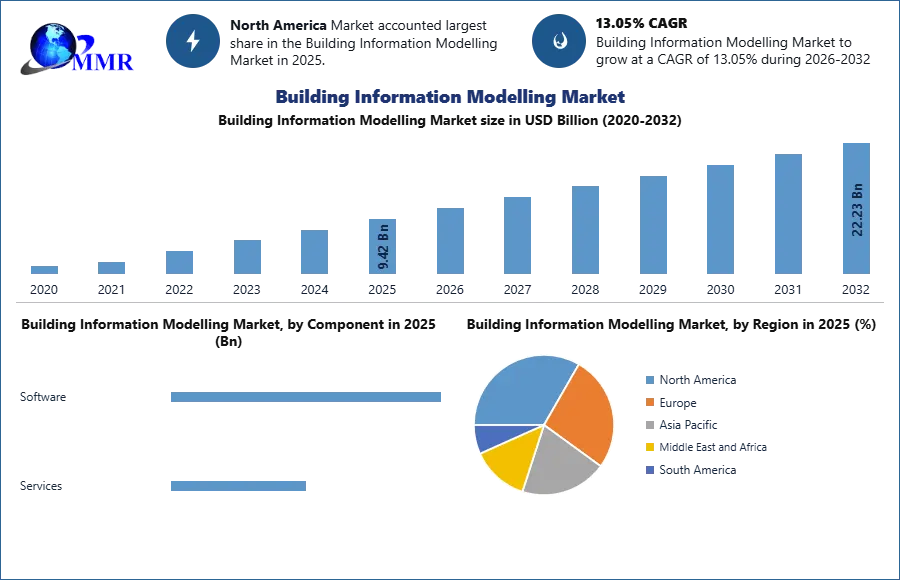
Market Valuation: The global market stands at USD 9.42 Billion in 2025, with enterprise software demand accelerating infrastructure modernization.
Growth Velocity: Compounding at a CAGR of 13.05%, the industry will scale to USD 22.22 Billion by 2032 as cloud computing displaces legacy desktop tools.
Deployment Evolution: Cloud-based hybrid platforms are outpacing on-premise installations, driving recurring SaaS business models.
Regulatory Catalysts: Government mandates across major economies are converting digital twinning from a competitive edge into a strict compliance framework.
Technological Inflection: Machine learning and generative AI integrations are shifting BIM from a static modeling framework into an active data ecosystem.
Why This Matters Now
The convergence of escalating material costs, structural engineering complexities, and stringent carbon neutrality targets leaves no room for analog errors in modern infrastructure. Enterprises that delay shifting to unified digital platforms face immediate margin erosion and systemic exclusion from public sector contracts. For Chief Information Officers and technology investors, this market represents a fundamental structural migration. Legacy, siloed design methodologies are being replaced by interoperable cloud infrastructure capable of processing real-time asset data.
This technological pivot is happening now because computing constraints have dissolved. The widespread availability of hyperscale cloud environments and low-latency edge computing enables the processing of massive, multi-layered data files in real time. This capacity allows global teams to collaborate simultaneously, eliminating version-control errors that historically derailed multi-million-dollar capital investments. Organizations failing to integrate these cloud-native workflows lose their operational agility, while early adopters establish an irreversible lead in asset lifecycle efficiency.
Market Overview
The Global Building Information Modelling Market is undergoing an aggressive expansion phase, moving from a specialized design tool to the core operational repository for the entire built environment. Valuation metrics place the market at USD 9.42 Billion in 2025. Driven by a consistent 13.05% CAGR, the market will secure a projected valuation of USD 22.22 Billion by 2032. This sustained momentum demonstrates that software deployment is no longer confined to the initial design phase of an asset; it now spans the complete operational lifecycle.
This rapid valuation increase signals a broader enterprise software modernization trend across the industrial sector. Companies are allocating significant capital to cloud-based BIM ecosystems to break down data silos between field engineers, corporate strategists, and supply chain partners. The software serves as a single source of truth, minimizing expensive rework and streamlining procurement processes. As asset complexity increases, the reliance on automated, data-driven design environments becomes a core business necessity.
Key Trends Driving Growth
The primary catalyst accelerating this market is the comprehensive shift toward cloud computing and hybrid cloud strategies. Historically, complex architectural models required localized, high-performance workstations, limiting collaboration to specific physical environments. The migration to SaaS business models allows teams to execute design alterations, clash-detection algorithms, and structural stress testing directly within the cloud. This shift drastically lowers the barrier to entry for smaller subcontractors, creating a highly interconnected ecosystem.
Concurrently, the integration of artificial intelligence and machine learning is changing how engineers interact with design software. Generative AI tools within modern BIM platforms analyze historical data sets, environmental variables, and structural requirements to propose optimal building configurations automatically. This automation reduces design cycles from weeks to hours. Furthermore, the expansion of 5G infrastructure and edge computing allows on-site personnel to stream heavy 3D models to mobile devices instantly, merging digital designs with real-world execution.
Segment Insights
Software Segment (Dominant Segment): Holding the largest market share, the software platform ecosystem remains the primary revenue driver as enterprises transition from transactional licenses to predictable, cloud-based subscription models.
Services Segment (Fastest-Growing Segment): Driven by the sheer complexity of digital transformation, this segment is expanding rapidly as organizations seek specialized consultants to integrate legacy databases into modern, cloud-native environments.
Pre-construction Phase: This operational segment continues to command substantial investment as firms prioritize automated clash detection and structural simulation to mitigate financial risks before groundbreaking.
Operations Phase: A rapidly emerging focus area where facility managers utilize BIM models as dynamic asset databases, linking software to IoT sensors for predictive maintenance.
Regional Growth Story
North America remains the dominant regional market, anchored by mature cloud infrastructure, significant enterprise software investments, and extensive data center developments. United States tech firms and government entities are driving the standardization of data exchange protocols, ensuring that software ecosystems remain interoperable across public and private sectors. The region’s focus on cybersecurity resilience ensures that high-value intellectual property within these centralized models remains protected against external vulnerabilities.
In the Asia-Pacific region, rapid urbanization and massive infrastructure initiatives in India and China are fueling exceptional growth rates. Governments in these economies are increasingly standardizing digital documentation requirements for large-scale transportation and energy projects. Meanwhile, in European markets like Germany and the United Kingdom, strict digital sovereignty laws and carbon footprint mandates force enterprises to adopt BIM tools capable of tracking material lifecycles and energy efficiency metrics from inception to demolition.
Competitive Landscape
The competitive environment is shifting away from isolated software applications toward expansive platform economics. Market leaders are no longer competing solely on feature sets; they are building comprehensive API ecosystems that allow third-party developers, IoT providers, and financial tracking software to connect directly into the core model. This openness transforms the software into an indispensable enterprise resource planning engine, securing long-term customer retention and high switching costs.
Strategic partnerships and consolidation characterize the current market phase. Established software vendors are actively acquiring niche AI startups and cloud-collaboration platforms to strengthen their technology portfolios. These moves prevent disruption from agile, cloud-native competitors while allowing legacy providers to offer an end-to-end digital thread. This consolidation establishes high capital barriers to entry, reinforcing the pricing power of dominant platform providers.
Recent Developments
API Integration Initiatives: Major market participants have expanded their open-API capabilities, allowing automated data synchronization between project management tools and core modeling engines.
AI-Driven Automation Launches: Vendors have introduced machine learning algorithms capable of predicting structural interference and material deficits before physical construction begins.
Cloud Security Enhancements: Providers are deploying zero-trust architecture within their cloud hosting environments to satisfy the rigid cybersecurity demands of defense and public infrastructure clients.
Mobile Edge Solutions: Software updates have optimized data compression, allowing field teams to render complex spatial models on low-power mobile devices via 5G networks.
Strategic Implications
For corporate executives and technology buyers, the implications of this digital transition are clear. The integration of BIM platforms requires a complete overhaul of organizational data architecture. Companies must treat physical assets as software challenges, ensuring that every piece of physical infrastructure has a corresponding digital twin. This integration enables predictive maintenance, optimizes energy utilization, and provides an audited historical record of the asset, drastically improving long-term valuation.
From an investment perspective, capital is moving rapidly toward platforms that demonstrate superior interoperability. Siloed, closed-loop software architectures are losing market relevance as buyers demand seamless cross-platform functionality. Technology providers that prioritize open standards and robust API frameworks will capture a disproportionate share of enterprise budgets, while rigid systems will face accelerating displacement.
Future Outlook
Looking forward, the convergence of BIM with real-time operational data will create entirely automated asset management systems. As machine learning algorithms become more sophisticated, these platforms will evolve from passive visualization tools into autonomous optimization engines capable of adjusting building systems without human intervention. The transition from isolated design files to interconnected, cloud-hosted digital infrastructure will divide the marketplace into two distinct categories. Organizations that build comprehensive digital twin ecosystems will capture unprecedented operational margins, while laggards restricted to legacy, fragmented workflows will face operational obsolescence.
Analyst Perspective
“The Global Building Information Modelling Market has crossed a critical threshold where digital integration is no longer optional,” states Yash Ghosalkar, Analyst at Maximize Market Research. “As enterprises scale their digital transformation initiatives, the reliance on cloud-native BIM architectures becomes the defining factor in operational efficiency. Organizations that master this data-driven environment will secure long-term market dominance, while those reliant on disconnected legacy tools will be phased out by automated, highly integrated competitors.”
About Maximize Market Research
Maximize Market Research Pvt. Ltd. (MMR) is a global market research and consulting company that provides reliable, data-focused, and practical business insights. The firm serves a wide range of industries, including healthcare, pharmaceuticals, technology, automotive, electronics, chemicals, personal care, and consumer goods. Through market forecasts, competitive analysis, strategic consulting, and industry impact assessments, MMR helps organizations understand changing market conditions, identify growth opportunities, and make informed business decisions for long-term success.
2nd Floor, Navale IT Park Phase 3
Pune Banglore Highway, Narhe
Pune, Maharashtra 411041, India
+91 9607365656
sales@maximizemarketresearch.com
