Key Highlights
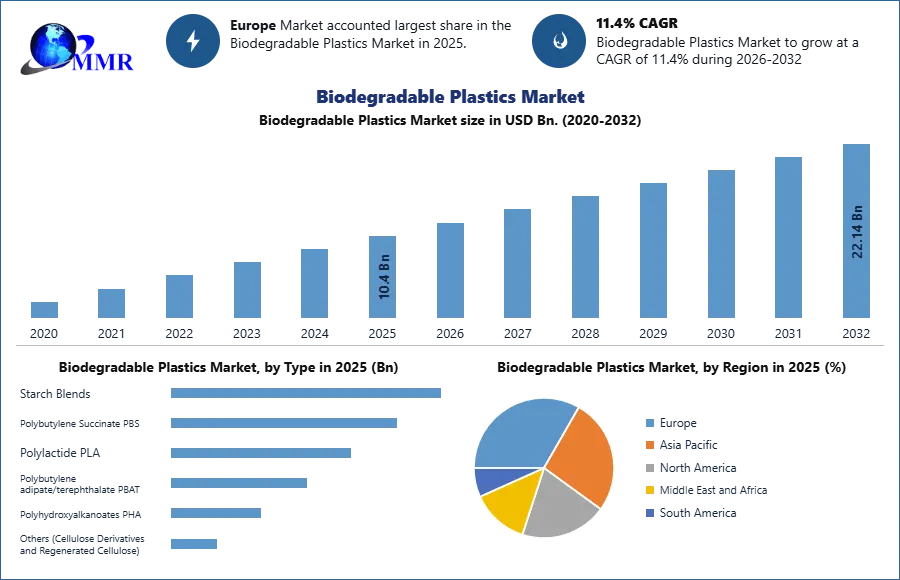
Global market valuation expanding from USD 10.4 billion in 2025 to USD 22.14 billion by 2032.
Compound annual growth rate sustained at 11.4% across the 2026–2032 forecast period.
Europe dominates the global marketplace, commanding a 53.45% market share in 2025.
Asia-Pacific positions itself as the fastest-growing region, driven by capacity surges in China and India.
Starch-based plastics lead structural consumption, maintaining a 10.4% CAGR segment forecast.
High manufacturing costs and lower material durability remain the primary operational constraints.
Why This Matters Now
Volatile fossil-fuel pricing, strict plastic-ban mandates, and rapid landfill depletion are disrupting traditional polymer supply chains globally. Chemical manufacturers, industrial procurement heads, and packaging executives can no longer treat bio-resins as niche alternatives; they are now essential for ensuring supply chain resilience and long-term regulatory compliance. This market transformation forces industrial buyers to restructure long-term material contracts around renewable feedstocks to protect against regulatory penalties and secure access to export markets.
What changed? The bioplastics ecosystem has moved away from low-volume premium packaging toward large-scale industrial applications in automotive, agriculture, and consumer goods. Why now? Tightening environmental regulations, shifting import-export rules, and a massive push for carbon reduction have made traditional single-use polymers an extreme compliance risk. Who benefits? Integrated chemical refiners with direct agricultural feedstock access, localized bio-resin compounders, and high-volume consumer goods packaging suppliers will capture the greatest value. What happens next? Market participants will scale up regional manufacturing plants, directly linking agricultural processing hubs to bio-plastic compounding lines to reduce logistics costs and secure volatile raw material pipelines.
Market Overview
The global biodegradable plastics market Size achieved a valuation of USD 10.4 billion in 2025. Driven by expanding downstream consumption and circular economy frameworks, the total revenue is on track to reach USD 22.14 billion by 2032, growing at a CAGR of 11.4%. These eco-friendly, non-toxic materials degrade quickly through the action of living microorganisms, such as Cupriavidus necator, providing a highly effective alternative to traditional petrochemical polymers that cause severe environmental contamination.
The business implication of this double-digit expansion is an immediate need for capital investment in scalable bio-resin processing infrastructure. Traditional plastics face severe regulatory restrictions, yet bio-resins suffer from performance constraints, including higher initial production costs and lower physical durability than virgin polymers. To overcome these limitations, chemical companies are investing heavily in advanced compounding technologies to close the performance gap, lower production costs, and satisfy the scaling demand from commercial buyers.
Key Trends Driving Growth
Rising consumer preference for eco-friendly packaging materials is driving a total structural redesign of commercial containment systems. Food, beverage, textile, and pharmaceutical companies are shifting toward compostable bags and sustainable wrapping configurations to comply with international carbon-reduction mandates. This long-term corporate adoption provides bioplastic manufacturers with predictable, high-volume procurement pipelines, protecting the market from sudden economic downturns.
Simultaneously, the agricultural sector is undergoing a major material transformation, significantly increasing its utilization of biodegradable alternatives. Changing consumer lifestyles and growing environmental awareness among farmers are boosting the adoption of advanced greenhouse technologies and high-efficiency mulch films. Because biodegradable mulch films decompose naturally in the soil, they eliminate the expensive labor costs associated with removing traditional plastic sheets, transforming modern agricultural economics.
Segment Insights
Starch-Based Plastics [Dominant Segment]: This segment commands the largest market share and is expected to grow at a 10.4% CAGR during the forecast period. It is widely utilized across automotive, agricultural, and high-volume packaging applications because the raw starch feedstock is highly accessible, easy to process, and offers a reliable cost structure compared to purely synthetic bio-polymers.
Polylactic Acid (PLA) [Fastest-Growing Segment]: Driven by rapid capacity expansions and competitive pricing relative to other bio-resins, PLA is expanding quickly, particularly within the European market. Representing over 30% of global biodegradable plastic production capacity, PLA is increasingly processed into polyester staple fibers, monofilaments, and high-purity sheets for textiles and consumer durables.
Regional Growth Story
Europe dominated the global biodegradable plastics market in 2025, capturing a commanding 53.45% market share. This regional concentration is sustained by strict environmental regulations, active carbon-reduction mandates, and high consumer willingness to pay for compostable alternatives. European chemical producers are focusing heavily on advanced recycling technologies and optimized bio-resin compounding to reduce dependency on imported fossil fuels and ensure regional material autonomy.
Conversely, the Asia-Pacific region is expanding at the fastest rate over the forecast window, driven by emerging manufacturing centers in China and India. The region benefits from easy raw material availability, lower labor costs, and a massive surge in domestic production capacity for bio-based resins. As regional governments enact new environmental standards, localized production facilities are scaling rapidly, turning the Asia-Pacific region into a major hub for both local consumption and global material export.
Competitive Landscape
The competitive environment is shifting away from fragmented, small-scale operations toward large-scale, integrated chemical platform ecosystems. Prominent global enterprises, including NatureWorks, BASF SE, and Total Corbion PLA, are consolidating their market influence by expanding raw material processing networks and establishing long-term feedstock agreements. This consolidation proves that future market leadership belongs to companies that can deliver consistent, high-purity resin volumes while maintaining strong pricing power against traditional petrochemical options.
Furthermore, capital investments are increasingly focused on scaling next-generation materials like marine-degradable polyhydroxyalkanoates (PHA) to address specific environmental vulnerabilities. Startups and established chemical joint ventures are securing multi-million-dollar funding rounds to move these advanced formulations out of pilot plants and into mass production. By expanding beyond traditional flexible packaging into durable consumer electronics and automotive parts, these market leaders are widening their competitive advantages.
Recent Developments
12 December 2025: Bioplastics startup Uluu secured $16 million in Series A funding to accelerate the commercialization of its marine-degradable PHA materials, aiming for mass-market consumer durable adoption.
Late 2025: India experienced a massive surge in regional manufacturing capacity for biodegradable plastics, positioning the country as a major global exporter of bio-based resins.
Mid 2025: NatureWorks, BASF SE, and Total Corbion PLA expanded their collaborative supply chains to integrate biodegradable materials into high-stress automotive and electronic components.
2022: Market data confirmed that polylactic acid (PLA) established a commanding position in the global bio-resin landscape, accounting for more than 30% of total global biodegradable plastic production capacity.
Strategic Implications
For chemical procurement managers and industrial product designers, this shifting market requires a major update to long-term raw material strategies. Material specifications must quickly evolve to incorporate starch-based and PLA compounds without sacrificing the physical durability required for commercial products. Procurement teams that do not secure long-term supply contracts with domestic bio-resin producers face vulnerable supply chains as demand outpaces current manufacturing capacities.
For major chemical manufacturers, expanding bio-resin production lines is essential for protecting market share against traditional polymer declines. Developing robust agricultural supply chains and securing regional feedstock networks will insulate chemical companies from volatile oil prices and strict plastic import-export restrictions. Strategic partnerships with regional agricultural processors are required to guarantee the steady stream of raw materials needed to run high-volume bioplastic compounding plants efficiently.
Future Outlook
The global biodegradable plastics market is moving toward complete integration with modern agricultural supply chains and large-scale industrial manufacturing hubs. As production technologies mature and regional processing plants scale up, the historic price gap between traditional petrochemical resins and bio-resins will narrow significantly. This shifting cost dynamic will allow high-volume, closed-loop composting systems to become standard across the global packaging, automotive, and agricultural industries.
The transition to a highly regulated, circular economy will ultimately reward future chemical leaders who secure reliable bio-feedstock pipelines, while leaving laggards exposed to intense regulatory penalties and shrinking markets for traditional polymers.
Analyst Perspective
“The combination of strict circular economy regulations and expanding manufacturing capacities is turning the biodegradable plastics market into a cornerstone of the modern materials sector,” said Ankita Kagwade, Research Analyst at Maximize Market Research. “As global chemical hubs scale up their starch-based and PLA production lines, the ability to deliver affordable, high-performance bio-resins will determine long-term market dominance.”
About Maximize Market Research
Maximize Market Research Pvt. Ltd. (MMR) is a global market research and consulting company that provides reliable, data-focused, and practical business insights. The firm serves a wide range of industries, including healthcare, pharmaceuticals, technology, automotive, electronics, chemicals, personal care, and consumer goods. Through market forecasts, competitive analysis, strategic consulting, and industry impact assessments, MMR helps organizations understand changing market conditions, identify growth opportunities, and make informed business decisions for long-term success.
2nd Floor, Navale IT Park Phase 3
Pune Banglore Highway, Narhe
Pune, Maharashtra 411041, India
+91 9607365656
sales@maximizemarketresearch.com
