Key Highlights
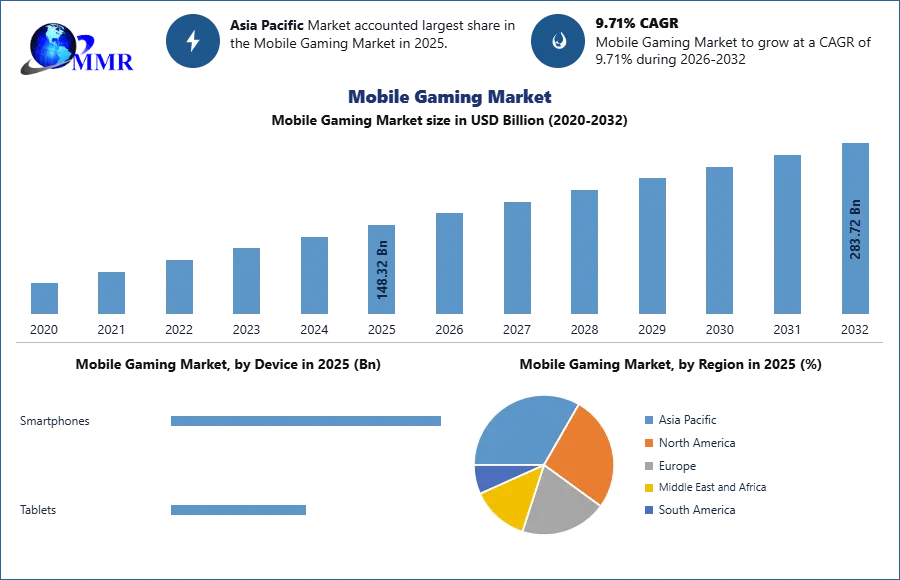
- Mobile Gaming Market valued at USD 148.32 Billion in 2025
- Forecast to reach USD 283.72 Billion by 2032
- CAGR of 9.71% during the forecast period
- Growth driven by mobile-first entertainment ecosystems and digital monetization models
- Expansion of cloud gaming, AI personalization, and 5G-enabled gameplay experiences
- Increasing convergence of telecom operators, cloud providers, and gaming platforms
Why This Matters Now
Mobile gaming has shifted from entertainment vertical to a core digital infrastructure layer of the global internet economy. The combination of high-performance smartphones, low-latency 5G networks, and cloud-rendered gaming environments is redefining how content is delivered and monetized. For telecom operators, cloud providers, and platform companies, mobile gaming is no longer a content category—it is a strategic battleground for user retention, bandwidth monetization, and ecosystem lock-in.
Market Overview
The Mobile Gaming Market reached USD 148.32 Billion in 2025 and is projected to climb to USD 283.72 Billion by 2032, expanding at a CAGR of 9.71%. This growth reflects a structural shift in global entertainment consumption toward mobile-first ecosystems.
The expansion is not linear entertainment growth. It signals deeper platform transformation where gaming intersects with cloud infrastructure, AI-driven engagement systems, and real-time multiplayer networks. Telecom operators and hyperscale cloud providers are increasingly embedded in the value chain, supporting compute-heavy gaming experiences at scale.
Smartphone ubiquity across emerging and developed economies continues to expand the addressable user base. At the same time, digital payment integration and app-store ecosystems are accelerating monetization efficiency through microtransactions, subscriptions, and hybrid ad-revenue models.
Key Trends Driving Growth
AI integration is reshaping how mobile games are designed, personalized, and monetized. Machine learning models are increasingly deployed to optimize player retention, dynamic difficulty balancing, and in-game recommendation systems. This creates adaptive gameplay loops that increase session duration and monetization density.
Cloud gaming is emerging as a parallel distribution layer. Instead of relying solely on device hardware, games are being rendered in centralized data centers and streamed to mobile devices. This reduces hardware barriers and expands premium gaming access in price-sensitive markets.
5G deployment is another structural driver. Low-latency connectivity enables real-time multiplayer environments, augmented reality gaming, and high-fidelity streaming experiences. Telecom operators are positioning gaming as a premium 5G use case to justify infrastructure investments.
Digital payment ecosystems are also accelerating in-app purchases and subscription models. Seamless payment integration reduces friction and increases conversion rates across casual and competitive gaming segments.
Segment Insights
- Dominant Segment: Not specified in the supplied report URL
- Fastest-Growing Segment: Not specified in the supplied report URL
While explicit segmentation is not detailed in the provided source, the market structure is increasingly shaped by monetization-driven categories such as casual gaming, competitive esports, and cloud-streamed premium titles. Each category reflects different infrastructure dependencies across telecom networks, cloud compute, and edge latency optimization.
Regional Growth Story
Asia-Pacific continues to anchor global mobile gaming demand, driven by high smartphone penetration, strong esports ecosystems, and advanced digital payment adoption. Markets such as China, India, Japan, and South Korea are central to platform scale and user engagement intensity.
North America remains a high-value monetization region, where in-app purchases, subscription models, and premium game titles generate disproportionate revenue compared to user base size. Cloud gaming adoption and 5G rollout further reinforce platform evolution.
Europe, led by Germany and the United Kingdom, is focusing on regulatory frameworks, data privacy compliance, and sustainable digital ecosystem development. This influences how global gaming platforms structure data governance and user engagement strategies.
Emerging markets across Latin America and the Middle East are expanding user bases through affordable smartphones and improving network infrastructure, creating long-term growth tailwinds for mobile-first gaming ecosystems.
Competitive Landscape
The competitive environment is defined less by standalone gaming publishers and more by ecosystem convergence. Global technology players such as Apple, Google, Tencent, Microsoft, and Sony operate across app distribution, cloud infrastructure, and content publishing layers.
This convergence signals a shift toward vertically integrated gaming ecosystems where platform control matters more than individual game success. Cloud providers are embedding gaming workloads into broader infrastructure strategies, while telecom operators position themselves as latency enablers for real-time experiences.
AI capability is becoming a competitive differentiator. Companies investing in predictive engagement systems and generative content creation tools are building higher retention loops and lower customer acquisition costs.
The strategic implication is clear: mobile gaming is transitioning into a platform economy. Control over distribution channels, cloud infrastructure, and AI personalization layers determines long-term pricing power and ecosystem dominance.
Recent Developments
- Expansion of cloud gaming infrastructure by global hyperscale providers to support mobile-first streaming environments
- Telecom operators integrating gaming bundles into 5G service offerings to increase ARPU
- Increased adoption of AI-based personalization engines for in-game monetization optimization
- Growth of cross-platform ecosystems linking mobile, console, and cloud gaming environments
- Rising investment in edge computing infrastructure to reduce latency in multiplayer gaming networks
Strategic Implications
Mobile gaming is becoming a convergence layer between telecom infrastructure, cloud computing, and AI-driven digital engagement. This shifts investment priorities from content creation alone to infrastructure ownership and platform orchestration.
For telecom operators, gaming traffic is a monetizable 5G use case that can justify network densification and edge deployment. For cloud providers, gaming workloads are expanding compute demand and strengthening multi-cloud ecosystem strategies.
For enterprises in the digital entertainment value chain, success increasingly depends on AI readiness, latency optimization, and integration across distributed computing environments. Monetization efficiency is now tied directly to infrastructure performance and personalization intelligence.
The competitive boundary between gaming companies and technology infrastructure providers is dissolving, creating a unified digital entertainment stack.
Future Outlook
The next phase of the Mobile Gaming Market will be defined by AI-native game design, cloud-first distribution, and telecom-integrated gaming ecosystems where latency becomes the primary competitive currency separating digital leaders from laggards.
Analyst Perspective
“The Mobile Gaming Market is evolving into a platform-driven ecosystem where AI, cloud infrastructure, and telecom networks converge to define engagement economics,” said Yash Ghosalkar, Analyst.
About Maximize Market Research
Maximize Market Research Pvt. Ltd. (MMR) is a global market research and consulting company that provides reliable, data-focused, and practical business insights. The firm serves a wide range of industries, including healthcare, pharmaceuticals, technology, automotive, electronics, chemicals, personal care, and consumer goods. Through market forecasts, competitive analysis, strategic consulting, and industry impact assessments, MMR helps organizations understand changing market conditions, identify growth opportunities, and make informed business decisions for long-term success.
2nd Floor, Navale IT Park Phase 3
Pune Banglore Highway, Narhe
Pune, Maharashtra 411041, India
+91 9607365656
sales@maximizemarketresearch.com
