Key Highlights
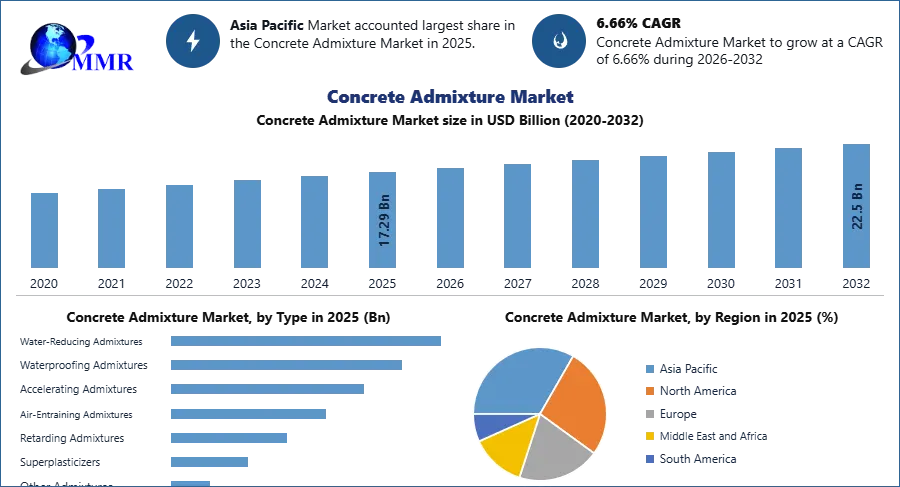
- Market valued at USD 17.29 billion in 2025.
- Forecast to reach USD 22.5 billion by 2032.
- Expected CAGR stands at 6.66% during 2026–2032.
- Water-reducing admixtures remain the leading product category.
- Residential construction continues to generate the largest demand.
- Asia Pacific dominates global consumption and production.
- Sustainable and bio-based admixtures are becoming a major innovation focus.
- Infrastructure megaprojects continue to reshape competitive positioning.
Why This Matters Now
Governments are accelerating investments in transport networks, housing, airports, and smart cities while tightening environmental standards for construction. These trends are increasing demand for concrete that is stronger, more durable, and less carbon intensive. Chemical innovation is shifting from performance enhancement alone toward sustainability, creating new opportunities for manufacturers capable of delivering advanced admixture technologies at scale.
Market Overview
Concrete admixtures Market are chemical or mineral additives incorporated into concrete during mixing to improve workability, durability, setting time, water resistance, and long-term structural performance. These products have become essential for modern construction projects where higher efficiency, lower maintenance costs, and faster project completion are critical.
Urbanization remains the strongest demand driver. Governments worldwide continue expanding investments in transportation infrastructure, residential housing, industrial facilities, airports, bridges, and water management projects. These investments directly increase consumption of advanced admixtures capable of improving concrete quality while reducing construction time.
Supply-side competition is increasingly driven by innovation rather than volume. Manufacturers are developing low-carbon formulations, bio-based products, and high-performance superplasticizers that meet stricter environmental regulations without sacrificing structural performance.
However, volatility in specialty chemical prices continues to pressure production costs. Rising prices for raw materials and increasing restrictions on hazardous chemicals remain key challenges for suppliers, particularly in price-sensitive emerging markets.
Key Trends Driving Growth
Advanced water-reducing technologies continue to gain adoption as contractors seek stronger concrete with lower water consumption. These products improve compressive strength while maintaining workability under challenging weather conditions.
Sustainability has become a defining competitive factor. Manufacturers are investing in bio-based formulations and environmentally friendly production methods as governments introduce stricter building standards and carbon reduction targets.
Large infrastructure investments are supporting long-term demand. Airports, highways, rail corridors, bridges, ports, and smart city developments require high-performance concrete capable of meeting durability requirements under demanding operating conditions.
The market is also experiencing increasing consolidation. Strategic acquisitions allow major manufacturers to expand regional manufacturing capacity, strengthen distribution networks, and broaden specialized product portfolios.
Raw material inflation remains an ongoing concern. Higher costs for specialty chemicals continue to pressure margins, encouraging manufacturers to optimize production efficiency and increase localized manufacturing.
Explore detailed analysis, insights, and growth opportunities
Segment Insights
Dominant Segment: Water-Reducing Admixtures
Water-reducing admixtures represent the largest product segment because they simultaneously improve workability, strength, and durability while reducing overall water consumption during mixing.
The segment delivers measurable economic benefits by lowering cement requirements and improving structural performance. Contractors increasingly specify water-reducing formulations for residential foundations, commercial buildings, and transportation infrastructure where long-term durability is critical.
Business impact is significant as demand shifts toward premium-value admixtures rather than commodity construction chemicals, supporting higher margins for technology-focused suppliers.
Fastest-Growing Segment: Residential Construction
Residential construction remains the fastest-growing application segment due to expanding urban populations, rising housing demand, and government-backed affordable housing programs.
Rapid urban development across India, China, and several Southeast Asian countries continues to generate sustained demand for efficient construction materials capable of reducing project timelines and improving building quality.
Manufacturers benefit from higher recurring demand as residential projects require consistent volumes across multiple construction phases.
Additional Key Sub-segments
Infrastructure applications continue gaining strategic importance as governments prioritize bridges, tunnels, airports, railways, and highways. These projects increasingly require specialized admixtures capable of delivering enhanced durability under demanding environmental conditions.
Commercial and industrial construction also continue expanding alongside industrialization and logistics infrastructure development. These projects require advanced admixtures that improve concrete performance while supporting faster construction schedules.
Chemical admixtures remain the dominant source category because they offer greater flexibility in controlling setting time, strength development, corrosion resistance, and long-term durability. Mineral admixtures continue gaining interest where sustainability and cement reduction are strategic priorities.
Regional Growth Story
Asia Pacific remains the largest and fastest-growing regional market, supported by rapid urbanization, rising disposable incomes, expanding manufacturing activity, and substantial public infrastructure investment. China, India, Japan, and South Korea continue leading both consumption and production. Investment in local manufacturing facilities is strengthening regional supply chains while reducing dependence on imports.
Europe maintains strong demand through renovation activity, sustainable construction initiatives, and healthcare infrastructure investment. Environmental regulations are accelerating adoption of advanced, low-carbon admixture technologies across the region.
North America continues benefiting from infrastructure modernization and commercial construction activity. Higher adoption of premium concrete technologies supports demand for high-performance admixtures capable of improving durability and reducing lifecycle maintenance costs.
Middle East, Africa, and Latin America are emerging as important growth markets due to airport expansion, tourism infrastructure, industrial diversification, and urban development. These regions are attracting increased manufacturing investment from global construction chemical companies seeking geographic expansion.
Competitive Landscape
Competition is increasingly concentrated among global construction chemical leaders with broad manufacturing networks, advanced research capabilities, and diversified product portfolios.
Sika AG, BASF SE, Holcim Limited, Master Builders Solutions, Fosroc Inc., Mapei SpA, Saint-Gobain S.A., Arkema Group, Dow Chemical Company, and Heidelberg Materials AG continue strengthening their market positions through acquisitions, manufacturing expansion, and product innovation.
Acquisitions have become a primary growth strategy as companies seek immediate access to regional production capacity and established distribution channels. Manufacturing investments improve supply reliability while reducing logistics costs for rapidly growing construction markets.
Innovation increasingly differentiates market leaders. Companies introducing sustainable admixtures, bio-based materials, and next-generation superplasticizers are positioning themselves for higher-value infrastructure and environmentally regulated construction projects.
Recent Developments
- March 2026: Holcim agreed to acquire Cemex’s Colombian operations, expanding its Latin American admixture manufacturing footprint.
- March 2026: Vicat Sysnergie introduced the bio-based Miscanbloc construction system using natural cement technology.
- January 2026: Master Builders Solutions completed a Saudi Arabian acquisition to strengthen regional production for major infrastructure projects.
- September 2025: Master Builders Solutions acquired Brexton Construction Products, expanding its Caribbean concrete admixture business.
- June 2025: Master Builders Solutions opened two manufacturing plants focused on sustainable admixture production.
- March 2025: MasterEase® 5000 received the 2025 Innovative Product Award for improving concrete rheology and pumpability.
Future Outlook
Companies that combine sustainable admixture innovation with localized manufacturing and strategic acquisitions will capture the greatest competitive advantage as global infrastructure investment increasingly favors high-performance, low-carbon construction solutions.
Analyst Perspective – ankita Kagawade
The Concrete Admixture Market is entering a phase where value creation is increasingly driven by innovation rather than production volume. Infrastructure modernization, smart city development, and stricter sustainability standards are accelerating demand for high-performance admixtures that improve concrete durability while reducing water consumption and carbon emissions. Market leaders are strengthening their positions through acquisitions, regional manufacturing expansion, and investments in environmentally friendly product portfolios.
About Maximize Market Research
Maximize Market Research Pvt. Ltd. (MMR) is a global market research and consulting company that provides reliable, data-focused, and practical business insights. The firm serves a wide range of industries, including healthcare, pharmaceuticals, technology, automotive, electronics, chemicals, personal care, and consumer goods. Through market forecasts, competitive analysis, strategic consulting, and industry impact assessments, MMR helps organizations understand changing market conditions, identify growth opportunities, and make informed business decisions for long-term success.
Contact Us :
2nd Floor, Navale IT Park Phase 3
Pune Banglore Highway, Narhe
Pune, Maharashtra 411041, India
+91 9607365656
sales@maximizemarketresearch.com
