Key Highlights
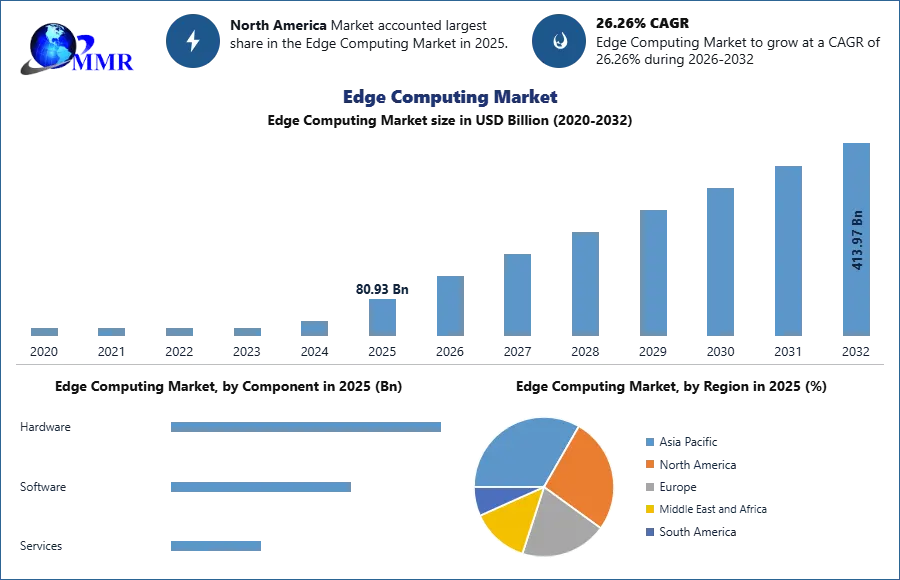
- Market size: USD 80.93 Billion in 2025, expected USD 413.97 Billion by 2032
- CAGR: 26.26% driven by real-time computing and AI workload distribution
- Rapid convergence of edge computing with 5G and hybrid cloud architectures
- Telecom operators shifting toward distributed network intelligence models
- Enterprises prioritizing low-latency analytics for automation and AI inference
- Expansion of edge data centers supporting decentralized digital infrastructure
Why This Matters Now
Edge computing has moved from an efficiency layer to a core digital infrastructure strategy. Enterprises are no longer treating latency as a technical constraint but as a competitive variable. The rise of AI-native applications, autonomous systems, and real-time decisioning has forced compute closer to endpoints.
This shift is redefining how telecom operators, cloud providers, and enterprises architect networks. Control is moving away from centralized cloud-only models toward distributed intelligence across edge nodes, 5G towers, and micro data centers.
Market Overview
The Edge Computing Market is undergoing structural expansion as digital ecosystems demand real-time responsiveness and localized processing power. The market is valued at USD 80.93 billion in 2025 and is projected to reach USD 413.97 billion by 2032, expanding at a CAGR of 26.26%. Each stage of this growth reflects a deeper enterprise dependence on distributed computing architectures that reduce latency and improve operational autonomy.
The scale of expansion signals a fundamental redesign of cloud computing models. Instead of centralizing workloads in hyperscale data centers, enterprises are increasingly distributing compute resources closer to endpoints such as factories, vehicles, retail stores, and telecom base stations. This transition is directly tied to AI-driven workloads that require instant inference rather than delayed processing.
Key Trends Driving Growth
AI integration is the dominant structural force reshaping edge computing adoption. Machine learning inference at the edge is reducing dependency on centralized cloud processing, enabling real-time automation in industries such as manufacturing, logistics, and smart cities. Generative AI workloads are also beginning to push hybrid deployment models where models are trained centrally but executed at the edge.
5G deployment is accelerating this transformation by providing the bandwidth and ultra-low latency required for edge-native applications. Telecom operators are repositioning their infrastructure as distributed compute networks rather than traditional connectivity providers. This shift is enabling new revenue models around edge-as-a-service.
Cloud migration strategies are evolving into hybrid and multi-edge frameworks. Enterprises are no longer migrating entirely to cloud environments; instead, they are distributing workloads between cloud, edge, and on-premise systems. This has increased demand for orchestration platforms capable of managing distributed workloads across environments.
Cybersecurity requirements are also reshaping architecture. With more endpoints generating and processing data locally, security models are shifting toward zero-trust frameworks and edge-native threat detection systems. Data sovereignty regulations in major markets are further reinforcing localized data processing.
Segment Insights
- Dominant Segment: Not specified in the provided source
- Fastest-Growing Segment: Not specified in the provided source
- Enterprise adoption of edge computing is broadly driven by demand for real-time analytics and automation
- Telecom infrastructure edge deployments are expanding alongside 5G rollout
- Industrial and IoT-based applications are key consumption areas for distributed compute
Regional Growth Story
The Edge Computing Market is expanding across major technology economies including the United States, China, India, Germany, Japan, South Korea, and the United Kingdom. These regions are investing heavily in digital infrastructure modernization, 5G rollout, and AI-enabled enterprise systems.
In the United States, hyperscale cloud providers and telecom operators are converging on distributed edge architectures to support AI workloads and enterprise SaaS platforms. In China, large-scale industrial automation and smart city initiatives are accelerating edge deployment at national scale.
India is emerging as a high-growth environment due to rapid digitalization, telecom expansion, and enterprise cloud adoption. Meanwhile, European markets such as Germany and the UK are focusing on industrial edge computing for manufacturing, automotive systems, and regulatory-compliant data processing.
Across Asia-Pacific, Japan and South Korea are advancing edge computing integration with robotics, 5G networks, and AI-powered consumer applications, reinforcing the region’s leadership in advanced digital infrastructure.
Competitive Landscape
The competitive environment in edge computing is shifting from hardware-centric infrastructure provision to platform-driven ecosystem control. Technology vendors, cloud hyperscalers, and telecom operators are competing to define orchestration layers that manage distributed compute resources across networks.
Cloud providers are extending infrastructure to the network edge, signaling a transition from centralized cloud dominance to hybrid cloud-edge ecosystems. This shift increases platform stickiness, allowing providers to lock in enterprise workloads across distributed environments.
Telecom operators are repositioning themselves as edge infrastructure providers. This strategic shift signals a move toward higher-margin enterprise services, particularly in manufacturing, automotive, and logistics sectors that require low-latency processing.
Hardware vendors are embedding AI accelerators and edge-optimized chipsets into network equipment. This reflects a broader industry transition toward AI-native infrastructure where compute is embedded directly into network nodes.
The competitive direction indicates consolidation around integrated ecosystems that combine connectivity, compute, storage, and AI orchestration. Future leadership will depend less on standalone infrastructure strength and more on ecosystem control and developer adoption.
Recent Developments
- Expansion of edge data center deployments supporting distributed cloud architectures
- Telecom operators increasing investment in 5G-enabled edge infrastructure
- Cloud providers extending hybrid cloud services toward network edge environments
- Enterprises accelerating adoption of AI inference at distributed computing nodes
- Growth in partnerships between telecom firms and hyperscale cloud platforms
Strategic Implications
Edge computing is reshaping enterprise IT architecture from centralized control to distributed intelligence. CIOs are prioritizing latency reduction, operational resilience, and AI readiness as core infrastructure requirements rather than optional enhancements.
For telecom operators, edge computing represents a structural revenue transition from connectivity-only models to compute-enabled service platforms. For cloud providers, it introduces competitive pressure to decentralize infrastructure without losing platform control.
Enterprises adopting edge-first architectures gain operational advantages in automation, predictive analytics, and real-time decision-making. However, they also face increased complexity in managing distributed security, interoperability, and workload orchestration.
The broader implication is a shift in digital competitiveness. Infrastructure leadership will increasingly depend on the ability to integrate AI, 5G, and cloud-edge ecosystems into a unified operational layer.
Future Outlook
Edge computing will evolve into the foundational layer of AI-driven digital infrastructure, where latency, intelligence, and connectivity converge into a single distributed system defining enterprise competitiveness.
Analyst Perspective
“Edge computing is moving from a support technology to a primary execution layer for AI and real-time enterprise systems. The next phase of competition will be defined by who controls distributed intelligence across networks, not who owns centralized compute capacity,” says Yash Ghosalkar, Analyst, Maximize Market Research.
About Maximize Market Research
Maximize Market Research Pvt. Ltd. (MMR) is a global market research and consulting company that provides reliable, data-focused, and practical business insights. The firm serves a wide range of industries, including healthcare, pharmaceuticals, technology, automotive, electronics, chemicals, personal care, and consumer goods. Through market forecasts, competitive analysis, strategic consulting, and industry impact assessments, MMR helps organizations understand changing market conditions, identify growth opportunities, and make informed business decisions for long-term success.
2nd Floor, Navale IT Park Phase 3
Pune Banglore Highway, Narhe
Pune, Maharashtra 411041, India
+91 9607365656
sales@maximizemarketresearch.com
