Key Highlights
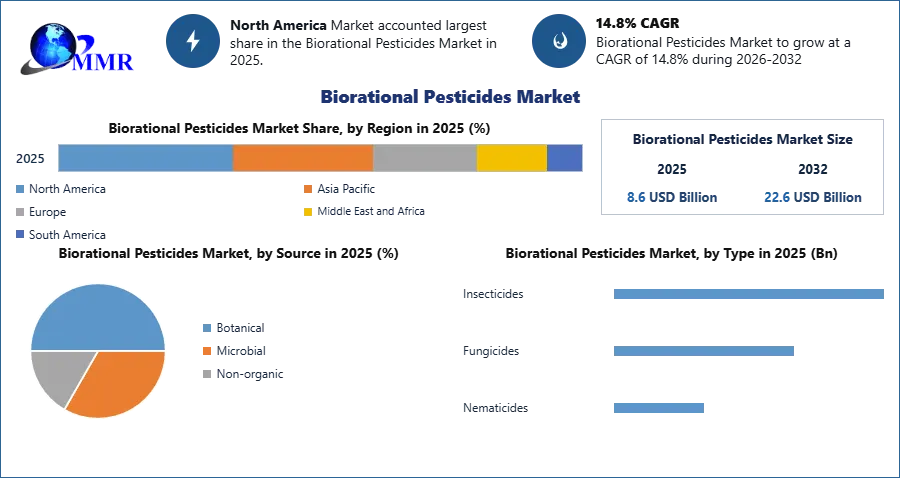
- Market valued at USD 8.6 billion in 2025.
- Forecast to reach USD 22.6 billion by 2032.
- Expected CAGR of 14.8% during 2026–2032.
- Fruits & vegetables remain the leading crop application.
- North America accounts for approximately 42% of global demand.
- Organic food consumption continues to accelerate adoption.
- Government support for Integrated Pest Management strengthens market expansion.
- Microbial and botanical solutions gain traction as sustainable alternatives.
Why This Matters Now
Agriculture is shifting toward sustainable crop protection as regulators tighten restrictions on chemical pesticides and consumers increasingly demand residue-free food. Biorational pesticides offer growers an effective way to improve productivity while meeting environmental standards and export requirements. This transition is reshaping investment priorities across the crop protection industry.
Market Overview
Biorational pesticides Market are biological or naturally derived crop protection products designed to control insects, fungi, nematodes, and other agricultural pests with minimal environmental impact. These products are produced from microorganisms, plant extracts, and naturally occurring biological compounds, making them safer alternatives to conventional synthetic pesticides.
Demand is being driven by the rapid expansion of organic farming and increasing consumer preference for chemical-free fruits and vegetables. Food producers and exporters are adopting biorational pesticides to comply with stringent residue regulations while maintaining crop quality and yield.
Integrated Pest Management (IPM) programs are becoming a major catalyst for market expansion. Governments and agricultural agencies increasingly recommend biological pest management practices that reduce dependence on synthetic chemicals without compromising agricultural productivity.
Supply-side innovation continues to improve product efficacy and application flexibility. However, limited product availability and shorter shelf life compared with conventional pesticides remain important commercial challenges for manufacturers.
Key Trends Driving Growth
Growing demand for organic food is increasing adoption of biological crop protection products across both developed and emerging agricultural markets.
Integrated Pest Management programs are expanding globally as governments encourage environmentally responsible farming practices through policy support, farmer education, and agricultural subsidies.
Innovation is focused on microbial and botanical formulations capable of delivering targeted pest control while minimizing environmental impact and preserving beneficial insects.
Sustainability has become a competitive advantage for agricultural input suppliers. Companies are investing in environmentally friendly formulations that align with global climate and biodiversity objectives.
Export-oriented agriculture is strengthening demand as international food safety regulations require lower pesticide residues on fresh produce, creating new opportunities for biological alternatives.
Explore detailed analysis, insights, and growth opportunities
Segment Insights
Dominant Segment: Fruits & Vegetables
The fruits and vegetables segment represents the largest application category due to the high economic value of horticultural crops and their vulnerability to insects, fungal diseases, and other biological threats.
Growers increasingly rely on biorational pesticides to satisfy strict domestic and international food safety standards while maintaining crop quality and shelf life. Reduced chemical residues improve export competitiveness and support premium pricing for fresh produce.
Business impact is significant because high-value horticultural crops generate greater demand for advanced biological crop protection solutions compared with commodity crops.
Fastest-Growing Segment: Microbial-Based Solutions
Microbial pesticides are expected to experience rapid adoption as advances in biological research improve product effectiveness against a broader range of agricultural pests.
These products support sustainable farming practices while reducing environmental contamination and resistance issues associated with repeated chemical pesticide use.
Manufacturers investing in microbial technologies are positioned to benefit from expanding regulatory support for biological crop protection.
Additional Key Sub-segments
Insecticides remain the largest product category as insect infestations continue to threaten agricultural productivity across major crop-producing regions.
Botanical pesticides continue gaining market acceptance because they are naturally derived and align with organic farming standards.
Liquid formulations dominate commercial applications due to ease of handling, uniform crop coverage, and compatibility with modern spraying equipment.
Foliar spray remains the preferred application method because it provides rapid pest control while maximizing treatment efficiency across large agricultural fields.
Regional Growth Story
North America remains the largest regional market with approximately 42% market share. Strong organic farming adoption, advanced agricultural technologies, and extensive fruit and vegetable production continue to support regional leadership. Government agencies actively promote sustainable pest management practices, strengthening long-term demand.
Europe continues expanding through strict environmental regulations, ambitious sustainability targets, and increasing restrictions on conventional chemical pesticides. Organic farming initiatives further accelerate adoption of biological crop protection products.
Asia Pacific is emerging as one of the fastest-growing regional markets. Rising food demand, expanding agricultural production, growing awareness of sustainable farming, and increasing government support for environmentally friendly crop protection are driving market expansion across China, India, Japan, and Southeast Asia.
South America benefits from large-scale commercial agriculture, particularly in Brazil and Argentina, where biological pest management is increasingly adopted to improve export competitiveness.
Middle East and Africa represent emerging opportunities as governments invest in improving agricultural productivity while promoting sustainable farming practices under challenging climatic conditions.
Competitive Landscape
The market remains moderately consolidated, with multinational crop protection companies expanding biological product portfolios while specialized biological pesticide manufacturers strengthen innovation capabilities.
Bayer, Syngenta, BASF SE, Monsanto BioAg, Valent Biosciences, Koppert, Marrone Bio Innovations, Russell IPM, Gowan Company LLC, Godrej Agrovet Limited, Prisms India Private Limited, Suterra, Agralan Ltd, Rentokil Initial plc, McLaughlin Gormley King Company, Summit Chemical Inc., and Isagro S.p.A. continue investing in research, product development, and regional market expansion.
Competition is increasingly shifting toward biological innovation, integrated crop management solutions, and strategic partnerships with agricultural distributors. Companies capable of delivering highly effective microbial and botanical formulations are expected to strengthen their competitive positions as demand moves away from conventional chemical pesticides.
Recent Developments
The provided MMR report does not include company-specific recent developments, investments, product launches, partnerships, or acquisitions for the Biorational Pesticides Market. Therefore, no verified recent developments are presented to maintain factual accuracy.
Future Outlook
Companies that scale biological innovation, expand microbial product portfolios, and align with global sustainable agriculture policies will capture the strongest long-term opportunities as conventional chemical pesticide use continues to decline.
Analyst Perspective- Ankita kagawade
The Biorational Pesticides Market is transitioning from a niche biological crop protection segment to a mainstream component of sustainable agriculture. Rising regulatory pressure on synthetic pesticides, expanding organic farming, and broader adoption of Integrated Pest Management (IPM) are accelerating demand for environmentally friendly alternatives. Leading manufacturers are investing in microbial and botanical technologies to improve product efficacy, extend shelf life, and expand commercial applications.
About Maximize Market Research
Maximize Market Research Pvt. Ltd. (MMR) is a global market research and consulting company that provides reliable, data-focused, and practical business insights. The firm serves a wide range of industries, including healthcare, pharmaceuticals, technology, automotive, electronics, chemicals, personal care, and consumer goods. Through market forecasts, competitive analysis, strategic consulting, and industry impact assessments, MMR helps organizations understand changing market conditions, identify growth opportunities, and make informed business decisions for long-term success.
Contact Us :
2nd Floor, Navale IT Park Phase 3
Pune Banglore Highway, Narhe
Pune, Maharashtra 411041, India
+91 9607365656
sales@maximizemarketresearch.com
