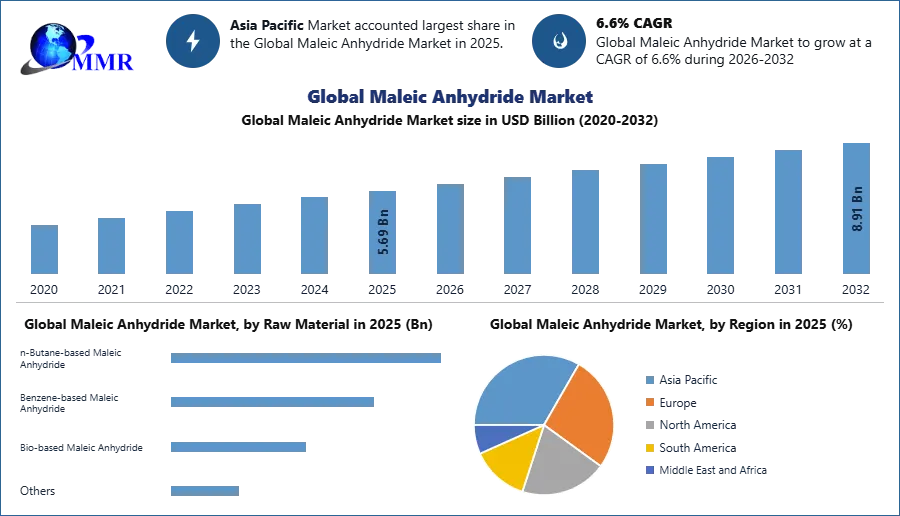
The global chemical manufacturing landscape is undergoing a rigorous transformation as the Maleic Anhydride Market Size enters a period of capital-intensive rationalization. With market valuations hitting USD 5.69 billion in 2025 and an trajectory toward USD 8.91 billion by 2032 at a 6.6% CAGR, industrial players are moving beyond simple volume growth to prioritize supply chain resilience and feedstock efficiency.
Why This Matters Now
The divergence between legacy production models and modern manufacturing imperatives has reached a breaking point. Procurement leaders and investors must account for the dual pressure of environmental regulation and the structural shift away from benzene-based production. As capacity is shuttered in high-cost, high-toxicity zones, the competitive advantage is migrating toward producers capable of leveraging low-cost, n-butane-based efficiencies and regional production hubs.
Market Overview
Maleic Anhydride is no longer a peripheral chemical commodity; it is a critical building block for lightweight, corrosion-resistant materials central to the automotive and construction sectors. The market is defined by a consistent demand for unsaturated polyester resins (UPR), which underpin the fabrication of fiberglass-reinforced plastics. While spot prices remain sensitive to crude oil and alternate feedstock fluctuations, the long-term forecast suggests a stabilization driven by higher-yield production technologies.
Key Trends Driving Growth
Feedstock Pivot: Industry reliance is shifting aggressively toward n-butane. Its superior cost-effectiveness and lower environmental impact compared to toxic benzene-based feedstocks make it the primary choice for new capacity expansions.
Downstream Material Preference: The automotive industry’s aggressive pursuit of electric vehicle (EV) lightweighting is increasing the penetration of high-performance composites, directly inflating demand for maleic anhydride-based UPR.
Regulatory-Induced Rationalization: Stringent environmental policies are forcing producers to modernize or exit. This consolidation is creating localized supply tightening, shifting pricing power toward operators with compliant, modern infrastructure.
Bio-based Emerging Opportunities: While still in the developmental stage, the adoption of bio-based production pathways is gaining momentum, signaling a potential long-term hedge against volatile traditional feedstock prices.
Segment Insights
Dominant Feedstock: The n-butane segment is the clear market leader. Its dominance is anchored in high-yield efficiency and the abundance of raw materials in the Middle East and Asia Pacific, providing a structural cost advantage that benzene-based producers currently struggle to match.
Fastest-Growing Segment: The Unsaturated Polyester Resins (UPR) segment maintains the largest market share and remains the primary driver of consumption. This segment’s growth is fundamentally tied to the necessity for durable, lightweight materials in infrastructure development and transportation.
Regional Growth Story
Asia Pacific maintains undisputed leadership, driven by a convergence of rapid industrialization, lower production costs, and easy access to feedstocks in China, India, and Japan. The region serves as both the largest production hub and the most significant consumption market for infrastructure-related chemical components.
Europe represents a complex paradox. Despite being a legacy hub for specialty chemicals, recent plant closures—such as the shuttering of large-scale benzene-dependent facilities—have led to immediate supply tightening and localized price spikes. The region is now prioritizing high-value, sustainable production to offset its higher operational overhead.
North America remains a mature, stable market. New facility construction, particularly in the United States, focuses on utilizing n-butane to secure a competitive edge, though the overall growth rate is constrained by market saturation and strict regulatory environments.
Competitive Landscape
The competitive landscape is transitioning from volume-based rivalry to technical and geographical agility. Market leaders are those actively optimizing capacity to favor high-yield feedstock while managing the exit of obsolete, non-compliant infrastructure. The ability to integrate vertically or secure long-term n-butane supply contracts has become a critical indicator of long-term solvency.
Recent Developments
Capacity Expansion: Thirumalai Chemicals (TCLS USA) initiated site construction for a 25-kiloton facility in West Virginia, signaling a push to increase North American self-sufficiency via n-butane feedstock by early 2026.
Market Rationalization: Huntsman Corporation permanently closed a 105-kiloton facility in Germany in mid-2025. This move forced a 2% localized price increase in European markets, illustrating the volatility inherent in current supply chain adjustments.
Technical Optimization: Sumitomo Seika Chemicals Co. established a pilot plant for superabsorbent polymers (SAP), focusing on high-performance derivatives to capture value in the specialized medical and agricultural sectors.
Strategic Implications
For industrial buyers and investors, the current environment presents both risk and opportunity. Reliance on legacy benzene-based supply chains is now a liability; procurement strategies must pivot toward producers with n-butane-based operational footprints. Furthermore, the closure of high-volume plants in Europe suggests that volatility will persist; those who secure stable, regional supply lines now will be better positioned to mitigate future price shocks.
Future Outlook
The winners in this cycle will be the operators who successfully navigate the transition from legacy, toxic-feedstock production to high-yield, n-butane-optimized processes, as the market moves away from commodity volume reliance toward specialized, sustainable chemical delivery.
Analyst Perspective
“The global Maleic Anhydride market is in the midst of a critical structural pivot. Manufacturers who cling to legacy feedstock models are facing inevitable margin erosion, while those betting on n-butane efficiency and regional production density are positioned to lead the market’s evolution through 2032,” says Ankita Kagawade, Analyst at Maximize Market Research.
About Maximize Market Research
Maximize Market Research Pvt. Ltd. (MMR) is a global market research and consulting company that provides reliable, data-focused, and practical business insights. The firm serves a wide range of industries, including healthcare, pharmaceuticals, technology, automotive, electronics, chemicals, personal care, and consumer goods. Through market forecasts, competitive analysis, strategic consulting, and industry impact assessments, MMR helps organizations understand changing market conditions, identify growth opportunities, and make informed business decisions for long-term success.
2nd Floor, Navale IT Park Phase 3
Pune Banglore Highway, Narhe
Pune, Maharashtra 411041, India
+91 9607365656
sales@maximizemarketresearch.com
