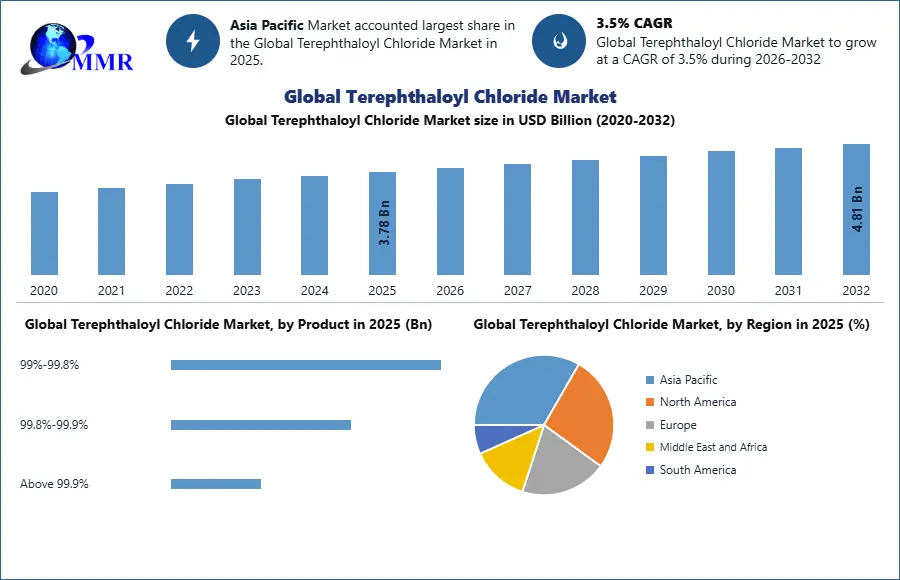
The global chemical manufacturing sector is facing a critical juncture in the supply of high-performance intermediates. With the Terephthaloyl Chloride (TPC) Market Size valued at USD 3.78 billion in 2025 and an anticipated climb to USD 4.81 billion by 2032, chemical producers and industrial end-users must prepare for a landscape defined by technical precision and supply chain density.
Why This Matters Now
Performance demands in aerospace, defense, and electric vehicle (EV) manufacturing are reaching a new intensity, requiring materials that are simultaneously lighter, stronger, and thermally stable. Terephthaloyl Chloride acts as the fundamental monomer for these high-performance applications. As global industrial standards evolve, manufacturers failing to secure high-purity, stable supply chains risk losing competitive positioning in the lucrative aramid fiber and specialty polymer markets.
Market Overview
Terephthaloyl Chloride is a cornerstone of advanced material science. Its role as a diacid chloride derivative in the synthesis of aramid polymers—notably poly(p-phenylene terephthalamide)—is the primary catalyst for current revenue generation. While the market’s 3.5% CAGR may appear measured compared to volatile commodity sectors, it masks a deep-seated transformation: a move toward specialized, high-margin manufacturing that prioritizes structural integrity and extreme environment resistance over sheer volume.
Key Trends Driving Growth
The Aramid Fiber Imperative: The insatiable demand for para-aramid fibers in protective gear and high-tensile composites is tightening the supply of high-grade TPC. These materials are becoming non-negotiable components for modern defense equipment and specialized industrial textiles.
EV-Driven Material Shifts: The transition to electric mobility is forcing a redesign of battery management systems and power electronics. TPC-derived liquid crystal polymers (LCPs) are increasingly replacing conventional plastics, providing the flame retardancy and heat stability required for long-range, high-safety battery packs.
Technical Purity Constraints: As downstream industries push for higher performance, the barrier to entry has risen. Producers are shifting capital toward advanced chlorination technologies to meet the “greater than 99% purity” threshold, which is now the industry standard for aerospace and electronic-grade intermediates.
Supply Chain Localization: Recent geopolitical and logistical shifts have prompted a movement toward regional production resilience. Key manufacturing hubs in China, India, and the U.S. are increasingly prioritizing local self-sufficiency to mitigate the risks associated with global import dependencies.
Segment Insights
Dominant Segment: The Aramid Fibers segment remains the market leader. Its dominance is secured by the material’s essential status in the production of high-tensile, heat-resistant components that are critical for aerospace, civil engineering, and military applications.
Fastest-Growing Segment: The Performance Polymers segment is seeing the most rapid acceleration. Fueled by the automotive and electronics industries, this segment is capitalizing on the urgent need for engineering plastics that offer superior chemical resistance and thermal stability.
Regional Growth Story
Asia Pacific currently commands the largest share of the global TPC market. Rapid industrialization across China and India has fostered a massive footprint for synthetic fiber production and polymer processing. This region effectively acts as the global nerve center for chemical manufacturing, benefiting from integrated supply chains and extensive downstream demand from the electronics and construction industries.
North America remains the primary center for high-end material innovation. With the U.S. automotive and aerospace sectors maintaining strict quality mandates, producers in this region prioritize technical excellence and regulatory compliance. This focus on specialty-grade output allows North American players to maintain market stability despite intense pricing pressure from overseas.
Europe is navigating a shift toward “green chemistry” and sustainable production. While industrial demand in Germany and France remains robust, the region is heavily focused on optimizing manufacturing processes to meet stringent carbon-reduction targets, which is gradually reconfiguring the regional production landscape.
Competitive Landscape
The competitive environment for TPC is characterized by high technical barriers and a focus on operational stability. Leading players are prioritizing vertical integration—securing the supply of terephthalic acid—to insulate themselves from the raw material price volatility that frequently disrupts downstream chemical production. Strategic investments are shifting away from capacity expansion alone, focusing instead on proprietary manufacturing processes that ensure product purity and reduce hazardous waste.
Recent Developments
Purity Optimization: Major manufacturers have intensified R&D into microfluidic and continuous-flow synthesis to achieve higher conversion rates, aiming to reduce the cost of high-purity TPC grade production.
Sustainability Integration: Leading firms are pivoting toward waste-minimization technologies, implementing closed-loop chlorination systems that align with modern environmental, social, and governance (ESG) reporting requirements for chemical producers.
Capacity Modernization: Several key players in the Asia Pacific region have initiated plant upgrades to replace legacy batch-processing infrastructure with automated, high-precision manufacturing modules designed for higher yield.
Strategic Implications
The Terephthaloyl Chloride market is shifting toward a “quality-over-quantity” business model. For procurement officers, the risk lies in the lack of diversity among high-purity suppliers. Strategic partnerships with producers who have mastered the synthesis of high-grade monomers are becoming essential for downstream companies. Failure to lock in reliable, high-spec supply chains could result in significant project delays in automotive and aerospace development pipelines.
Future Outlook
The winners in this segment will be producers who effectively bridge the gap between technical purity requirements and sustainable manufacturing, as the market transitions from bulk-commodity sourcing to specialized, value-added supply chain partnerships.
Analyst Perspective
“The Terephthaloyl Chloride market is essentially moving toward a premium-tier structure. Manufacturers who prioritize the high-purity demands of aerospace and EV electronics are capturing the most significant value, as the market increasingly shuns lower-grade alternatives in favor of high-performance stability,” says Ankita Kagawade, Analyst at Maximize Market Research.
About Maximize Market Research
Maximize Market Research Pvt. Ltd. (MMR) is a global market research and consulting company that provides reliable, data-focused, and practical business insights. The firm serves a wide range of industries, including healthcare, pharmaceuticals, technology, automotive, electronics, chemicals, personal care, and consumer goods. Through market forecasts, competitive analysis, strategic consulting, and industry impact assessments, MMR helps organizations understand changing market conditions, identify growth opportunities, and make informed business decisions for long-term success.
2nd Floor, Navale IT Park Phase 3
Pune Banglore Highway, Narhe
Pune, Maharashtra 411041, India
+91 9607365656
sales@maximizemarketresearch.com
