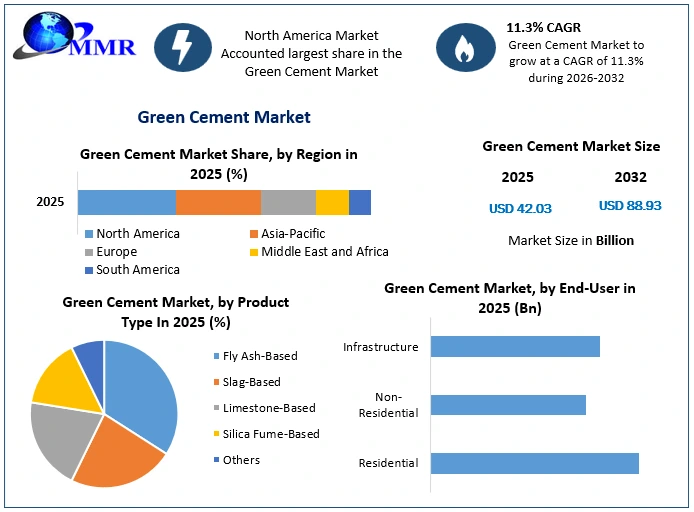
The construction sector is no longer a silent contributor to global carbon emissions; it is now the primary site of a massive industrial pivot. With the global Green Cement Market Size valued at USD 42.03 billion in 2025 and an anticipated growth trajectory of 11.3% CAGR throughout the forecast period, stakeholders are forced to confront a reality where carbon-intensive production is a significant financial liability. Investors, procurement leaders, and chemical manufacturers must now align their capital with the shift toward lower-carbon building alternatives or risk being sidelined by tightening environmental mandates.
Why This Matters Now
Concrete production is responsible for roughly 8% of global carbon dioxide emissions. As cities globally legislate net-zero targets and sustainable building codes, the demand for conventional cement is hitting a regulatory ceiling. The green cement market has reached a maturity point where it is no longer a niche, experimental alternative but a fundamental necessity for infrastructure longevity and compliance. Organizations that integrate green cement today are insulating their supply chains against future carbon taxes and securing competitive advantages in the rapidly expanding green building sector.
Market Overview
Green cement serves as a critical, lower-carbon substitute for ordinary Portland cement, utilizing industrial waste materials such as fly ash, blast furnace slag, and other aluminosilicates. Its manufacturing process consumes less energy and significantly reduces the carbon footprint—up to 40%—of traditional production. While initial setup and production costs remain higher than legacy methods, the economic landscape is shifting due to government incentives, tax benefits for energy-efficient commercial projects, and the increasing cost of waste disposal for industrial byproducts.
Key Trends Driving Growth
Infrastructure Decarbonization: Governments across India, China, and the United States are pouring billions into zero-carbon infrastructure. This is not merely a policy preference but a structural mandate for all new construction projects.
Circular Economy Adoption: The utilization of industrial waste—specifically fly ash and slag—is transforming waste management from an operational cost into a revenue-generating feedstock stream for cement producers.
Performance Parity: Advanced research into clinker innovation and chemical additives has closed the performance gap between green and traditional cement, making it a viable standard for high-stress infrastructure like bridges, dams, and structural columns.
Resource Efficiency: Beyond emission reduction, green cement is gaining traction for its water-saving properties, reducing freshwater consumption in ready-mix concrete (RMC) by nearly 50%, a critical factor in regions facing water scarcity.
Segment Insights
Dominant Segment: The Fly Ash-Based segment commands the largest market share. Its dominance is anchored in its widespread availability, cost-effectiveness, and established track record in large-scale residential and non-residential projects.
Fastest-Growing Segment: The Residential segment is seeing the most rapid acceleration. Increased urbanization and the implementation of government-backed green building initiatives are driving widespread adoption of energy-efficient, sustainable residential frameworks.
Regional Growth Story
North America remains the dominant force, accounting for a significant market share. The regional growth is heavily bolstered by the Green Building Incentive Program (GBIP) and various federal-to-local tax incentives. These financial frameworks have effectively de-risked the transition to sustainable building materials, making North America the most advanced market for green cement deployment.
Asia Pacific acts as the engine for long-term volume growth. The sheer scale of urbanization in China and India is fueling an insatiable demand for construction materials. In these markets, government investment is heavily weighted toward sustainable infrastructure to manage the environmental impact of rapid population growth, turning Asia Pacific into the most dynamic theatre for industrial capacity expansion.
Europe continues to emphasize carbon reduction and energy conservation. The regulatory environment in Europe is the most stringent globally, compelling manufacturers to invest heavily in R&D to improve the efficacy of green cement, ultimately positioning the region as a leader in technological innovation.
Competitive Landscape
The competitive hierarchy is shifting from volume-based production to technical capability and portfolio sustainability. Market leaders are those who have successfully diversified into high-performance, waste-based cement derivatives. The current market structure shows a clear distinction between legacy cement giants investing in green modernization and agile, specialized entrants focusing on R&D for next-generation, zero-carbon binders. M&A activity is intensifying, as traditional players seek to buy the technical expertise needed to transition their existing plants without losing market share.
Recent Developments
R&D Acceleration: Major industry players are increasing capital allocation toward advanced clinker substitution technologies to address the high initial setup costs of production.
Strategic Partnerships: Collaborative efforts between chemical manufacturers and construction firms are rising, focused on creating pilot projects for large-scale infrastructure using slag-based green cement.
Capacity Expansion: In key manufacturing hubs like India and China, large-scale production facilities are being upgraded to integrate fly ash and slag feedstocks into their core production lines, reducing dependency on raw natural minerals.
Strategic Implications
Procurement leaders must shift from a price-per-ton mindset to a total-cost-of-ownership model. Green cement, while carrying a higher upfront cost, offers significant long-term savings through reduced energy and cooling costs for the finished structure, as well as reduced regulatory exposure. For investors, the risk lies in continuing to support high-emission, carbon-exposed projects. The winners will be those who actively diversify their portfolios into sustainable alternatives that meet the evolving requirements of local and international green building codes.
Future Outlook
The path ahead is clear: the integration of green cement into global construction is not a trend but a requirement for industrial survival, with the ultimate winners being those who lead in the technological transition to zero-carbon binders and waste-based feedstock utilization.
Analyst Perspective
“The green cement market has transitioned from a sustainability initiative to an industrial requirement. Manufacturers who fail to adopt lower-carbon feedstock strategies now are essentially betting against the inevitable tightening of global building regulations and carbon taxation,” says Ankita Kagawade, Analyst at Maximize Market Research.
About Maximize Market Research
Maximize Market Research Pvt. Ltd. (MMR) is a global market research and consulting company that provides reliable, data-focused, and practical business insights. The firm serves a wide range of industries, including healthcare, pharmaceuticals, technology, automotive, electronics, chemicals, personal care, and consumer goods. Through market forecasts, competitive analysis, strategic consulting, and industry impact assessments, MMR helps organizations understand changing market conditions, identify growth opportunities, and make informed business decisions for long-term success.
2nd Floor, Navale IT Park Phase 3
Pune Banglore Highway, Narhe
Pune, Maharashtra 411041, India
+91 9607365656
sales@maximizemarketresearch.com
