Key Highlights
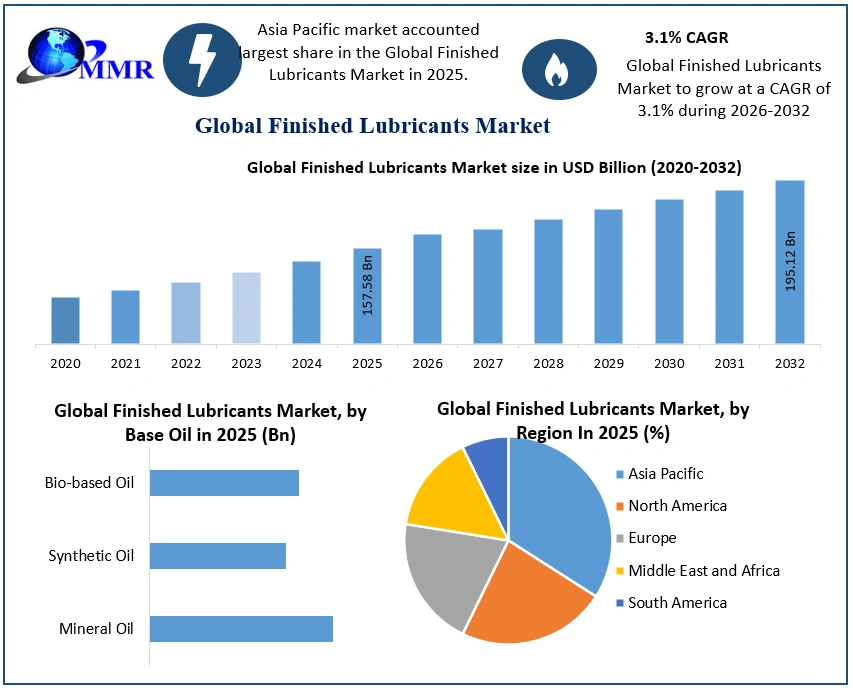
Finished Lubricants Market valued at USD 157.58 billion in 2025.
Market projected to reach USD 195.12 billion by 2032 at a 3.1% CAGR.
Automotive lubricants account for nearly 65% of total finished lubricant demand.
Commercial vehicles represent roughly half of automotive lubricant consumption.
China continues to shape global supply-demand dynamics through production, imports, exports, and domestic consumption.
Bio-based lubricants and renewable power applications are creating new long-term opportunities.
Industry consolidation and operational efficiency remain strategic priorities across major suppliers.
Why This Matters Now
Lubricant manufacturers are navigating a market where demand remains resilient but profitability depends increasingly on feedstock management, technology differentiation, and regional supply chains. Rising industrial production supports consumption, while electrification and stricter emissions policies are changing the long-term demand mix.
The Finished Lubricants Market was valued at USD 157.58 billion in 2025 and is expected to reach USD 195.12 billion by 2032, growing at a CAGR of 3.1%. That steady expansion signals dependable demand, but it also means suppliers must compete through product performance, manufacturing efficiency, and portfolio diversification rather than volume alone.
Market Overview
Finished lubricants size remain essential across transportation, manufacturing, mining, power generation, agriculture, marine, and industrial machinery. Their performance directly affects equipment reliability, maintenance intervals, fuel efficiency, and operating costs.
Industrial activity and expanding vehicle fleets continue to support consumption worldwide. At the same time, fluctuations in crude oil prices are influencing production economics because base oils remain the industry’s primary feedstock. The report highlights the impact of changing crude prices on lubricant production costs and regional profitability, making procurement strategy increasingly important for producers.
Demand is also becoming more diversified. While internal combustion engines continue to dominate lubricant consumption today, manufacturers are simultaneously investing in products designed for advanced engines, industrial equipment, and renewable energy applications.
Key Trends Driving Growth
Automotive demand continues to define the industry’s direction. Approximately 65% of finished lubricant demand comes from automotive applications, making vehicle production and fleet maintenance the industry’s primary revenue engine. This concentration means any recovery in commercial transportation or passenger mobility quickly translates into lubricant demand.
Feedstock economics remain equally influential. The report notes that changes in global crude oil demand directly affect lubricant manufacturing costs and profitability. Companies with diversified sourcing strategies and efficient blending operations are therefore better positioned to manage pricing volatility while protecting margins.
Technology is shifting purchasing priorities. High-performance engines generate greater operating temperatures, increasing demand for premium lubricant formulations capable of maintaining viscosity and reducing wear under more demanding conditions. This creates opportunities for suppliers specializing in higher-value synthetic and advanced lubricant products.
Sustainability is emerging as another competitive differentiator. Bio-based oils and renewable power applications, particularly wind power generation, are creating new demand segments as governments encourage cleaner industrial operations and lower-carbon energy infrastructure.
Request a Free Sample Copy or View Report Summary: https://www.maximizemarketresearch.com/request-sample/80899/
Segment Insights
Dominant Segment: Automotive lubricants account for approximately 65% of the Finished Lubricants Market, supported by commercial vehicles, passenger vehicles, two-wheelers, agricultural equipment, marine applications, and stationary engines. Commercial vehicles alone represent roughly half of automotive lubricant consumption, demonstrating the sector’s dependence on freight, logistics, and industrial transportation.
Fastest-Growing Opportunity: Renewable power generation and green energy applications are emerging as attractive growth areas. Expanding wind power capacity and increasing government support for renewable infrastructure are creating incremental demand for specialized turbine and industrial lubricants.
Mineral oil, synthetic oil, and bio-based oil continue to define the industry’s base oil landscape, allowing manufacturers to balance cost competitiveness with premium performance requirements.
Product portfolios increasingly extend beyond engine oils into hydraulic fluids, gear oils, turbine oils, compressor oils, greases, and metalworking fluids, helping suppliers diversify revenue streams.
Regional Growth Story
China occupies a pivotal position in the global Finished Lubricants Market through its influence on domestic production, raw material sourcing, imports, exports, and manufacturing demand. The country’s industrial scale means changes in Chinese production or consumption quickly ripple through global lubricant supply chains.
Across Asia-Pacific, expanding automotive manufacturing and industrialization continue supporting lubricant consumption. India benefits from growing transportation activity, industrial production, and infrastructure investment, while Japan and South Korea remain important markets for premium, technology-intensive lubricant formulations.
Germany continues to represent Europe’s advanced manufacturing base, where industrial machinery and automotive production sustain demand for high-performance lubricants. In the United States, commercial transportation, manufacturing, and industrial operations maintain stable lubricant consumption despite increasing electrification initiatives.
Regional differences increasingly revolve around regulation, feedstock access, and manufacturing specialization rather than simple consumption growth.
Competitive Landscape
The competitive environment is becoming more efficiency-driven than capacity-driven.
Shell remains the leading global supplier of finished lubricants by sales volume, reinforcing the importance of scale, distribution reach, and integrated refining operations. Market leadership increasingly depends on maintaining supply reliability while investing in premium product development.
Industry consolidation also signals changing competitive dynamics. The report highlights ConocoPhillips’ acquisition of Concho Resources for US$9.7 billion, a move expected to generate significant annual capital savings. Beyond cost reduction, transactions of this scale strengthen feedstock security, improve capital allocation, enhance pricing resilience, and increase operational flexibility across integrated energy businesses.
For smaller manufacturers, specialization in synthetic, bio-based, and application-specific lubricants may become the most practical path to maintaining pricing power.
Recent Developments
Growing adoption of mergers and acquisitions to improve operational efficiency and lower production costs.
Rising investment in premium lubricant technologies for high-performance engines.
Increasing development of bio-based lubricant solutions supporting sustainability objectives.
Expansion of renewable energy infrastructure creating additional demand for industrial lubricants.
Strategic Implications
Procurement teams should expect continued sensitivity to crude oil pricing because feedstock economics remain closely linked to finished lubricant profitability. Manufacturers capable of securing diversified raw material supplies will be better positioned during commodity price fluctuations.
Investment priorities are also shifting toward premium formulations rather than commodity products. Higher-performance lubricants generate stronger margins while supporting increasingly sophisticated industrial equipment and modern vehicle technologies.
At the same time, bio-based products and renewable energy applications provide manufacturers with opportunities to diversify revenue beyond conventional automotive demand, reducing long-term exposure to vehicle electrification.
Future Outlook
The Finished Lubricants Market is entering a period of disciplined expansion rather than rapid acceleration. Industrial production, commercial transportation, and advanced engine technologies continue to sustain demand, while renewable energy and sustainable lubricants gradually reshape future opportunities. However, increasing adoption of hybrid and battery-electric vehicles introduces structural challenges that will require continuous product innovation and portfolio diversification. Companies that combine feedstock resilience, premium formulation capabilities, and strategic investment in sustainable lubrication technologies will be best positioned to capture long-term market value.
Related Reports
Commercial Single-ply Membrane Market https://www.maximizemarketresearch.com/market-report/commercial-single-ply-membrane-market/256671/
Global Smart Coatings Market https://www.maximizemarketresearch.com/market-report/global-smart-coatings-market/6341/
Global Photosensitive Materials Market https://www.maximizemarketresearch.com/market-report/global-photosensitive-materials-market/82483/
Analyst Perspective
“The Finished Lubricants Market is evolving beyond conventional volume growth. Competitive advantage will increasingly depend on feedstock efficiency, premium product innovation, and the ability to address emerging demand from renewable energy and sustainable industrial applications.” — Ankita Kagawade
About Maximize Market Research
Maximize Market Research Pvt. Ltd. (MMR) is a global market research and consulting company that provides reliable, data-focused, and practical business insights. The firm serves a wide range of industries, including healthcare, pharmaceuticals, technology, automotive, electronics, chemicals, personal care, and consumer goods. Through market forecasts, competitive analysis, strategic consulting, and industry impact assessments, MMR helps organizations understand changing market conditions, identify growth opportunities, and make informed business decisions for long-term success.
2nd Floor, Navale IT Park Phase 3
Pune Banglore Highway, Narhe
Pune, Maharashtra 411041, India
+91 9607365656
sales@maximizemarketresearch.com
