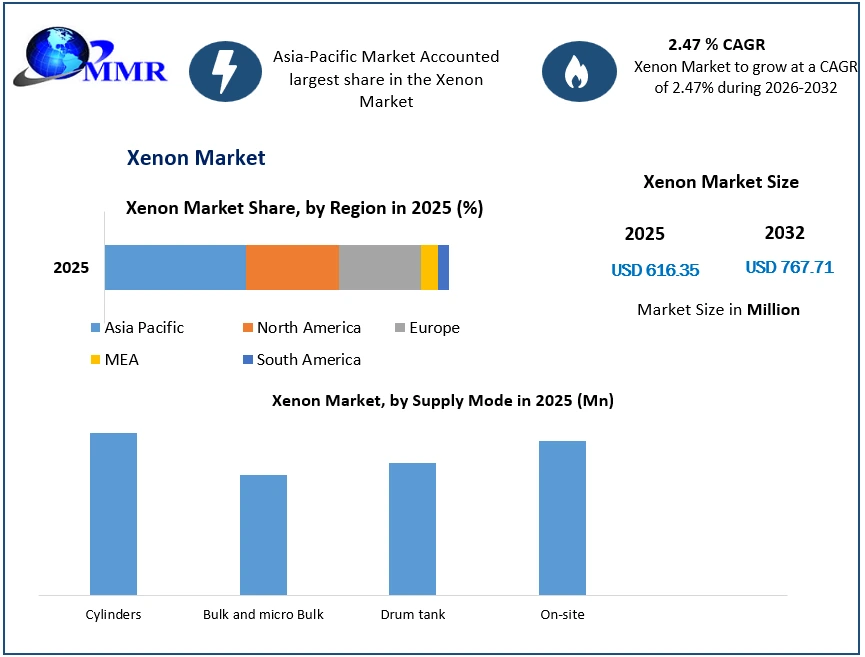
The global Xenon Market Size is shifting from a niche specialty gas to a mission-critical utility for the aerospace and semiconductor industries. With the market valued at US$ 616.35 million in 2025 and a clear trajectory to reach US$ 767.71 million by 2034, the scarcity of this noble gas is no longer just a technical hurdle—it is a strategic bottleneck. For industrial players and procurement leaders, the ability to secure ultra-high-purity N5 grade xenon is now a primary determinant of operational capacity in advanced manufacturing and satellite deployment.
Why This Matters Now
Xenon represents less than one-billionth of the Earth’s atmosphere, making its extraction a process of extreme technical complexity and high cost. As the semiconductor industry scales nodes for AI and 5G, and as the private space sector accelerates satellite constellation deployments, the demand for high-purity xenon is decoupling from general industrial trends. Procurement leaders who fail to diversify their supply chains or invest in gas recovery infrastructure now will face escalating costs and systemic project delays.
Market Overview
Xenon is a colorless, odorless, and chemically inert noble gas that provides indispensable properties in high-precision environments. Its value is concentrated in its rarity and its physical performance in electrical discharges. The market is currently characterized by a steady 2.47% CAGR, reflecting the sustained, non-discretionary demand from specialized end-users. The dominance of the N5 grade segment—boasting 99.999% purity—highlights a market where technical specification is the ultimate currency, rendering standard commodity grades increasingly secondary to the needs of modern fabrication.
Key Trends Driving Growth
The Semiconductor Lithography Requirement: The relentless pursuit of miniaturization in chip fabrication creates an unwavering demand for N5-grade xenon. It is essential in plasma etching and deposition processes that define modern high-aspect-ratio memory architectures.
The Aerospace Ion Propulsion Revolution: Satellites and spacecraft are increasingly turning to ion thrusters, which utilize xenon as an efficient, inert propellant. As the “New Space” economy expands with mega-constellations, this sector is creating a sovereign-level demand for reliable xenon supply.
Supply-Side Fragility: Because xenon is primarily produced as a byproduct of large-scale air separation units (ASUs), supply is inherently limited by global oxygen and nitrogen production volumes. This structural constraint is forcing manufacturers to explore advanced recovery and recycling technologies to sustain long-term operational needs.
Medical Diagnostic Versatility: Beyond industrial tech, xenon is gaining traction in medical imaging and anesthesia, where its non-toxic, rapid-acting profile offers clinical benefits that justify its premium price point.
Segment Insights
Dominant Segment: The N5 Grade segment stands as the undisputed leader in the market. Its ultra-high purity is the mandatory standard for semiconductor etching and advanced satellite propulsion, ensuring that it commands the highest market share and pricing power.
Fastest-Growing Segment: The Aerospace and Satellite propulsion segment is emerging as the fastest-growing application. As commercial satellite operators increase launch cadences to support global broadband initiatives, the consumption of xenon as a high-efficiency propellant is projected to outpace legacy lighting and industrial uses.
Regional Growth Story
Asia-Pacific continues to exert dominance, serving as the global nerve center for semiconductor manufacturing. With major fabrication clusters in China, Japan, South Korea, and India, this region consumes the largest volume of high-purity gas, forcing producers to focus their logistics and purification capacity here to minimize transportation risks for this sensitive, high-value asset.
North America remains a critical hub for space-related consumption. Driven by the presence of major aerospace contractors and private launch providers, the regional market focuses heavily on maintaining redundant, high-reliability supply lines.
Europe plays a pivotal role in the refinement and purity technology sector. European industrial gas leaders are the primary investors in the fractionation technologies required to extract xenon from air, setting the global standard for purity and recovery efficiency.
Competitive Landscape
The market is consolidated among a few dominant industrial gas suppliers who manage the high-capital-intensity air separation assets required to produce xenon. These players are moving from being simple gas vendors to becoming “supply-chain partners” for semiconductor OEMs and space agencies. Competitive advantage is now defined by the ability to guarantee supply through exclusive recovery contracts, shielding downstream customers from the volatility of the spot market.
Recent Developments
Technological Purity Standards: Major players have recently updated their purification arrays to meet the stringent “Six-Nines” (N6) demand for next-generation chip architectures, effectively raising the barrier to entry for smaller regional producers.
Capacity Rationalization: Large chemical conglomerates are prioritizing xenon output in their newest ASUs, signaling a long-term commitment to capturing the high margins inherent in the N5 and N6 gas markets.
Recovery Partnerships: Several strategic collaborations between space agencies and gas suppliers focus on “closed-loop” xenon usage, where propellant is captured or recycled post-mission to extend the longevity of limited terrestrial supplies.
Strategic Implications
Procurement leaders must shift from transactional buying to long-term “life-of-program” supply agreements. The structural scarcity of xenon means that inventory management and recovery systems should be integrated into the product design phase. Furthermore, as geopolitical tensions influence trade flows of high-tech commodities, manufacturers should prioritize sourcing from politically stable and logistically optimized corridors.
Future Outlook
The winners in this industrial cycle will be the operators who successfully integrate xenon recovery into their manufacturing workflows and secure long-term, high-purity supply partnerships, effectively insulating themselves from the inevitable price shocks of a supply-constrained rare gas market.
Analyst Perspective
“The xenon market has moved firmly into the high-stakes domain of strategic resource management. As semiconductor node sizes shrink and the space economy scales, the ability to control and recycle ultra-high-purity xenon will become a primary competitive differentiator for the world’s leading technology firms,” says Ankita Kagawade, Analyst at Maximize Market Research.
About Maximize Market Research
Maximize Market Research Pvt. Ltd. (MMR) is a global market research and consulting company that provides reliable, data-focused, and practical business insights. The firm serves a wide range of industries, including healthcare, pharmaceuticals, technology, automotive, electronics, chemicals, personal care, and consumer goods. Through market forecasts, competitive analysis, strategic consulting, and industry impact assessments, MMR helps organizations understand changing market conditions, identify growth opportunities, and make informed business decisions for long-term success.
2nd Floor, Navale IT Park Phase 3
Pune Banglore Highway, Narhe
Pune, Maharashtra 411041, India
+91 9607365656
sales@maximizemarketresearch.com
