Key Highlights
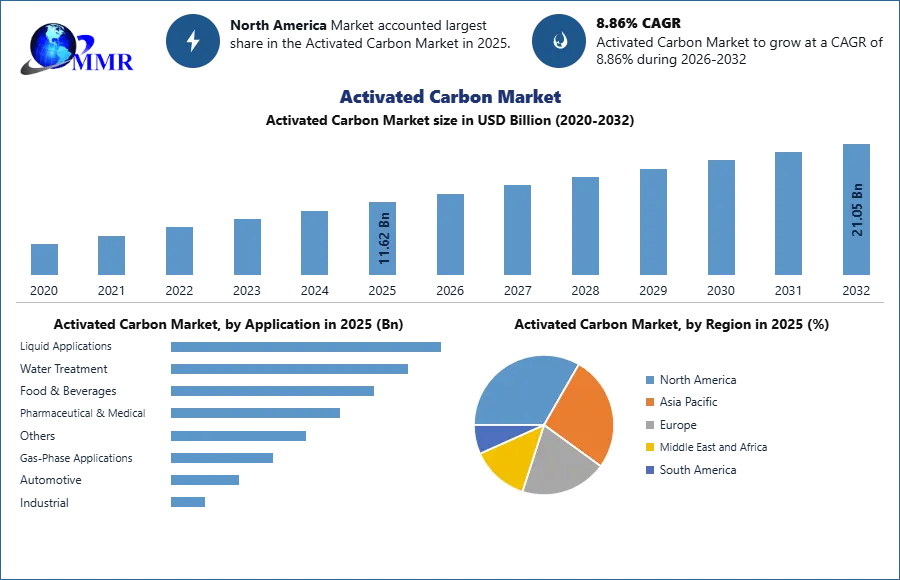
Market valuation to scale from USD 11.62 billion in 2025 to USD 21.05 billion by 2032, yielding an 8.86% CAGR.
Severe feedstock shortages reduce operational capacity by 50% to 60% among major Asia Pacific producers.
Powdered activated carbon dominates type segments due to superior surface-to-volume adsorption efficiency.
Liquid phase applications hold the leading market position, anchored heavily by municipal and industrial water treatment.
Asia Pacific retains regional dominance, capturing a 39.26% market revenue share in 2025.
Thermal reactivation emerges as a critical strategy, cutting costs by 20% to 30% and lowering CO2 emissions fivefold.
Why This Matters Now
The operational equilibrium of the global activated carbon market has broken down. Industrial operators can no longer treat purification media as an on-demand commodity. Stringent regulatory mandates—such as the US Environmental Protection Agency’s Maximum Achievable Control Technology (MACT) standards and the European Commission’s IPPC Directive (Directive 2008/1/EC)—are forcing coal-fired power plants and heavy manufacturers to deploy advanced mercury-control and volatile organic compound (VOC) adsorption setups. This legal compulsion is hitting the market at the exact moment raw material supply chains are fracturing, creating an unprecedented supply-demand imbalance.
Market Overview
The Activated Carbon Market stood at USD 11.62 billion in 2025 and is on track to reach USD 21.05 billion by 2032, accelerating at an annual compounding growth rate (CAGR) of 8.86%. This rapid growth reflects an industrial manufacturing sector caught between strict compliance mandates and raw material scarcity. Activated carbon possesses a highly porous internal structure, with one single gram yielding an internal surface area of nearly 3,000 square meters. This immense surface area makes it indispensable for removing gaseous pollutants, odors, and heavy metals. However, global macroeconomic headwinds and fluctuating crude oil prices have directly volatileized downstream operations across the chemical, petrochemical, and automotive sectors, creating uneven commercial demand patterns.
Key Trends Driving Growth
Enforcement of carbon pricing architectures acts as a major catalyst for structural industry change. Global carbon values vary wildly, spanning from USD 1 per ton of CO2 equivalent to USD 119 per ton. This price signal has prompted immediate changes across Asian regulatory frameworks, seen in recent price jumps within the South Korean Emission Trading Scheme (ETS) and Chinese pilot markets where allowance shortages have restricted baseline margins.
Simultaneously, the European Union Green Deal’s goal of total carbon neutrality by 2050 is driving a broader application of carbon taxes. Germany is building out a national carbon market to cover heat and road travel, while Luxembourg and Austria are advancing dedicated carbon pricing structures for non-ETS industries. These legal developments increase the total cost of manufacturing virgin material, shifting commercial interest toward circular recovery models.
Segment Insights
Powdered Activated Carbon (Dominant Segment): This form retains the majority share of global revenue. Its very small particle size—typically ranging from an average diameter of 0.15 mm to 0.25 mm—gives it a much higher surface-to-volume ratio than granular alternatives. This allows chemical processing units to pump the powder directly into rapid mix basins, clarifiers, and gravity filters to maximize contaminant extraction.
Liquid Phase Applications (Dominant Segment): This segment commands the application landscape, driven by potable water treatment, groundwater remediation, industrial wastewater processing, and precious metal recovery. Emerging industrial sub-sectors like ultrapure water fabrication for electronics and specialized boiler feedwater treatments are further expanding this segment’s lead.
Gas-Phase Applications (Fastest-Growing Segment): Driven by stricter air quality rules, this segment is accelerating rapidly due to the mandatory installation of flue gas cleaning and mercury-trapping systems in power generation facilities.
Regional Growth Story
The Asia Pacific region dominated the global arena in 2025, accounting for 39.26% of total market revenue. This geographic concentration stems from a deep baseline pool of industrial labor and ready access to core agricultural and mineral feedstocks. China and Japan operate as the primary economic anchors of this regional demand, supported by expanding chemical and petrochemical complexes that require massive volumes of filtering media.
However, this high geographic concentration has exposed global supply lines to major disruption. Industrial coal demand within China’s power, cement, and steel sectors has surged, triggering a severe shortage of the specific coal grades needed for carbon activation. Compounding this, natural disasters across top agricultural exporting countries like India, Sri Lanka, Indonesia, and the Philippines have severely disrupted coconut shell collection networks, starving factories of vital raw materials.
Competitive Landscape
The current supply crunch has completely shifted pricing power back to the manufacturers, fundamentally altering the market’s pricing dynamics. Faced with soaring raw material and energy costs, major producers have abandoned historical pricing structures to protect their operating margins.
For example, the Jacobi Group instituted a blanket 10% price increase across its entire portfolio of coconut-based products. Similarly, Cabot Norit Activated Carbon pushed through global price hikes ranging from 3% to 8% depending on the specific product grade and region. These coordinated upward price adjustments show that producers can pass raw material inflation directly down the value chain to industrial buyers.
Recent Developments
Producers face widespread feedstock shortages, forcing a 50% to 60% capacity reduction at several Asian manufacturing facilities.
The Jacobi Group enacted a 10% price hike across all coconut-shell charcoal product lines to offset severe raw material cost inflation.
Cabot Norit Activated Carbon executed a global price increase of 3% to 8% across its product portfolio to counter rising input costs.
Portugal lifted its domestic carbon tax rate to €24 per ton (USD 26 per ton) ahead of its planned integration with the wider EU ETS network.
Switzerland tripled its domestic carbon allowances, moving its local pricing structure into direct alignment with EU ETS market rates.
Strategic Implications
The 50% to 60% drop in Asian manufacturing output means procurement leaders must quickly diversify their sourcing strategies away from volatile spot markets. Relying solely on virgin, asset-heavy production models in Asia now carries significant supply chain risk.
This disruption creates a major opening for thermal reactivation technologies. Spent carbon media can be thermally restored for active reuse, completely bypassing the costs and long-term liabilities of environmental disposal. Reactivated carbon costs 20% to 30% less than virgin material, giving buyers a clear economic alternative. Furthermore, the reactivation process generates five times less carbon dioxide than manufacturing virgin carbon, allowing industrial consumers to meet strict regulatory emissions targets while insulating themselves from raw material shocks.
Future Outlook
As environmental regulations tighten globally, the long-term viability of this market will depend entirely on mastering circular recycling technologies. Success will belong to operators who aggressively transition from volatile virgin feedstocks to localized thermal reactivation assets.
Analyst Perspective
“The raw material crunch across the Asia Pacific region is a structural wake-up call for the entire chemical sector,” stated Ankita Kagwade, Analyst at Maximize Market Research. “With virgin manufacturing capacity down by more than half in key hubs, industrial buyers cannot rely on traditional supply lines. Embracing reactivated carbon is no longer just a sustainability goal—it has become a core operational necessity to manage costs and secure supply.”
About Maximize Market Research
Maximize Market Research Pvt. Ltd. (MMR) is a global market research and consulting company that provides reliable, data-focused, and practical business insights. The firm serves a wide range of industries, including healthcare, pharmaceuticals, technology, automotive, electronics, chemicals, personal care, and consumer goods. Through market forecasts, competitive analysis, strategic consulting, and industry impact assessments, MMR helps organizations understand changing market conditions, identify growth opportunities, and make informed business decisions for long-term success.
2nd Floor, Navale IT Park Phase 3
Pune Banglore Highway, Narhe
Pune, Maharashtra 411041, India
+91 9607365656
sales@maximizemarketresearch.com
