Key Highlights
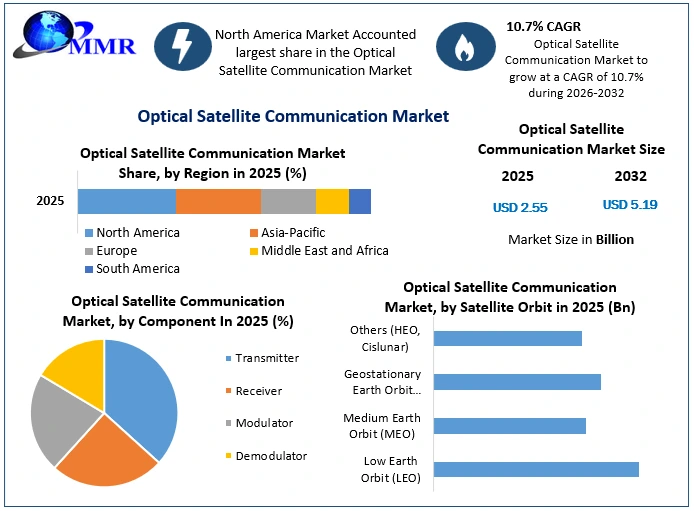
The global optical satellite communication market achieved an enterprise valuation of USD 2.55 billion in 2025, with an expected 10.7% CAGR driving revenue to nearly USD 5.19 billion by 2032.
North America asserted structural dominance in 2025, capturing over 50% of the total global market share due to concentrated aerospace R&D investments and massive constellation projects.
The Ka-band frequency segment maintained a leading market position in 2025, offering optimized spectrum efficiency and the high bandwidth needed for next-generation telecommunications backhaul.
Parabolic reflector antennas commanded the highest market share among hardware types in 2025, sustained by their high gain, reliable directivity, and proven long-distance tracking capabilities.
Asia-Pacific is positioned as the fastest-growing regional market through 2032, driven by expanding national space budgets and a surging commercial requirement for accessible digital connectivity.
Why This Matters Now
The rapid deployment of massive low Earth orbit (LEO) constellations and the commercial reality of quantum-secure data routing have turned laser-based orbital networks into a critical priority for enterprise technology buyers and defense planners. Legacy radio frequency (RF) bands are facing extreme spectrum congestion and rising vulnerability to electronic interception. For Chief Information Officers (CIOs) and Chief Technology Officers (CTOs), adopting optical satellite communication is no longer an experimental venture; it is a vital step toward securing high-bandwidth, resilient global data paths. This technology addresses the fundamental limitations of ground infrastructure by delivering high-speed links directly through orbital routes.
What has changed is the arrival of operational quantum key distribution (QKD) methods over laser links, which make data interception practically impossible. This level of security is shifting space networks from general communication platforms into highly secure data environments capable of protecting sensitive financial, government, and corporate data. Enterprises that fail to integrate optical satellite capabilities into their broader hybrid cloud and network strategy risk falling behind in terms of data security and transmission speed.
Market Overview
The global optical satellite communication market size was valued at USD 2.55 billion in 2025. Driven by ongoing telecom modernization and deep-space observation missions, the sector is expanding at a steady 10.7% CAGR, tracking toward a global valuation of USD 5.19 billion by 2032. At its core, optical satellite communication uses focused laser beams rather than traditional radio waves to transmit data across space. This shift enables much faster data transfers, requires smaller and lighter payloads, and provides excellent protection against electromagnetic interference.
This market expansion is directly answering the global need for reliable 5G backhaul, in-flight connectivity, and remote broadband access. By utilizing free-space optical systems, satellite operators can deploy high-speed connections across their networks without being constrained by regulatory RF spectrum coordination. The technology forms the primary infrastructure layer for the next stage of global telecommunications, allowing data-heavy enterprise applications to move seamlessly between ground-based fiber networks and orbital satellite arrays.
Key Trends Driving Growth
A major driver pushing the adoption of optical satellite communication is the deployment of quantum-secure technologies. The integration of QKD across satellite networks provides an exceptionally high level of security by using the laws of physics to detect any attempt at eavesdropping. This capability makes optical links highly attractive to sectors that handle high-value data, such as international finance, defense, and national security operations. Recent breakthroughs by technology providers have proven that ultra-secure space data transfers are achievable at scale, removing historical concerns regarding atmospheric distortion and alignment vulnerabilities.
Concurrently, space exploration missions and commercial observation networks are generating unprecedented volumes of real-time data. Modern imaging satellites, climate tracking arrays, and deep-space probes require high-capacity links to transmit large datasets back to ground stations without creating major backlogs. This surge in data volume is forcing satellite manufacturers to integrate advanced optical communication payloads as a standard feature. By upgrading these communication payloads, operators can optimize how they utilize space-to-ground links, reducing transmission delays and maximizing the economic value of the data they gather.
Get Free Sample: https://www.maximizemarketresearch.com/request-sample/31827/
Segment Insights
Ka-band (Dominant Frequency Band): This segment led the market in 2025 and is projected to retain its dominant share. Its leadership is driven by its high bandwidth, rapid transmission speeds, and superior spectrum efficiency, making it crucial for 5G backhaul, enterprise networks, and maritime broadband.
Q/V-band and Ku-band: These frequency allocations are seeing selective deployment as operators look to expand their total network capacity and build redundant systems alongside primary optical channels.
Parabolic Reflector Antenna (Dominant Antenna Type): Holding the largest market share in 2025, this hardware type remains preferred due to its high gain, exceptional directivity, and proven long-distance reliability in deep-space and ground-station environments.
Phased Array and Flat Panel Antennas (Fastest-Growing Antenna Types): These agile, low-profile antenna designs are experiencing rapid adoption because they allow satellites to track multiple moving targets simultaneously without relying on mechanical parts.
LEO Satellite Constellations (Fastest-Growing Application Segment): The massive expansion of commercial low Earth orbit constellations is the primary growth driver for optical links, as operators deploy inter-satellite laser systems to create seamless, global mesh networks.
Regional Growth Story
North America commanded a leading position in the global optical satellite communication market in 2025, accounting for over 50% of total revenue. This strong market share is sustained by heavy defense spending, large-scale space exploration budgets, and pioneering commercial projects led by regional companies like SpaceX and Ball Corporation. The concentration of advanced aerospace manufacturing and laser communication research centers within the United States allows the region to set global technical standards and capture high-value contracts for military and intelligence space networks.
Meanwhile, the Asia-Pacific region is emerging as the fastest-growing market through 2032. This rapid growth is supported by expanding economic activity across developing countries and increased government investment in sovereign space programs. Nations like India and China are actively funding satellite modernization projects to bring affordable, high-speed connectivity to rural communities and support expanding industrial zones. This regional push is opening up major commercial opportunities for hardware suppliers and software developers who can deliver cost-effective, scalable optical payloads tailored for new regional satellite networks.
Competitive Landscape
The competitive environment in the optical satellite communication market is defined by rapid hardware innovation and strategic platform integration. Leading aerospace corporations, including Airbus, are focusing heavily on perfecting optical communication payloads to maximize data throughput and lower production costs. At the same time, specialized technology firms like Germany-based Mynaric AG are achieving major milestones in free-space optical systems, providing the commercial components needed for secure, high-capacity data transfers between satellites.
These technical achievements signal a broader shift within the industry away from custom, low-volume manufacturing toward standardized, mass-produced optical components. Major satellite operators, such as SpaceX with its ongoing Starlink deployment, are demonstrating the immense scale that can be reached by using inter-satellite laser links to establish global broadband networks. This trend is altering market dynamics by giving early adopters significant advantages in network capacity and pricing power, forcing traditional telecommunications companies to either partner with these new orbital platforms or invest in building their own laser-based communication systems.
Recent Developments
Mynaric AG achieved a significant breakthrough in free-space optical communication, demonstrating advanced capabilities for ultra-secure space-based quantum data transmission.
Airbus successfully upgraded its latest optical communication payloads, improving the overall data handling efficiency and reducing the structural weight of satellite communication subsystems.
Commercial LEO operators scaled up the integration of inter-satellite laser links across their active constellations, enabling low-latency data routing directly through space without relying on intermediate ground stations.
Aerospace engineering teams introduced automated beam-pointing mechanisms to reduce the time required to establish stable laser connections between fast-moving satellites.
Strategic Implications
Integrating advanced optical systems into existing satellite networks presents significant technical and operational challenges for engineering teams. Retrofitting legacy satellite models with laser communication payloads requires precise structural planning, as any misalignments can disrupt data transmission across long distances. Additionally, the introduction of sensitive quantum communication hardware adds complexity to manufacturing and testing processes, creating potential compatibility issues with older ground-station equipment and traditional network architectures.
Beyond these technical hurdles, operators must navigate evolving international regulations and spectrum allocation policies. Conflicting frequency management rules and varying regional guidelines can delay deployment timelines and create legal challenges for cross-border satellite networks. To address these issues, forward-looking enterprise buyers and space agencies are investing in flexible, multi-band communication systems and working to establish unified regulatory frameworks that support the smooth integration of laser-based systems into the global telecom infrastructure.
Future Outlook
The future of the optical satellite communication market will be shaped by the complete integration of laser-based orbital networks into global enterprise and telecom routing architectures. As quantum communication technologies mature, the deployment of QKD-enabled satellite arrays will become standard practice for protecting high-value international data assets. This architectural shift will transform space networks from supplementary data paths into primary, high-capacity communication lifelines. Organizations that successfully transition to these secure, cloud-integrated laser networks will secure long-term advantages in data security and transmission speed, while those reliant on older, congested radio networks face operational bottlenecks and growing security risks.
Analyst Perspective
“The commercialization of free-space optical communication and the deployment of quantum-secure laser links are fundamentally rewriting the rules of global telecommunications infrastructure. We are moving away from congested radio frequencies toward an era of high-capacity, secure orbital data networks that can support the heavy data demands of modern enterprise operations.”— Yash Ghosalkar
About Maximize Market Research
Maximize Market Research Pvt. Ltd. (MMR) is a global market research and consulting company that provides reliable, data-focused, and practical business insights. The firm serves a wide range of industries, including healthcare, pharmaceuticals, technology, automotive, electronics, chemicals, personal care, and consumer goods. Through market forecasts, competitive analysis, strategic consulting, and industry impact assessments, MMR helps organizations understand changing market conditions, identify growth opportunities, and make informed business decisions for long-term success.
2nd Floor, Navale IT Park Phase 3
Pune Banglore Highway, Narhe
Pune, Maharashtra 411041, India
+91 9607365656
sales@maximizemarketresearch.com
