Key Highlights
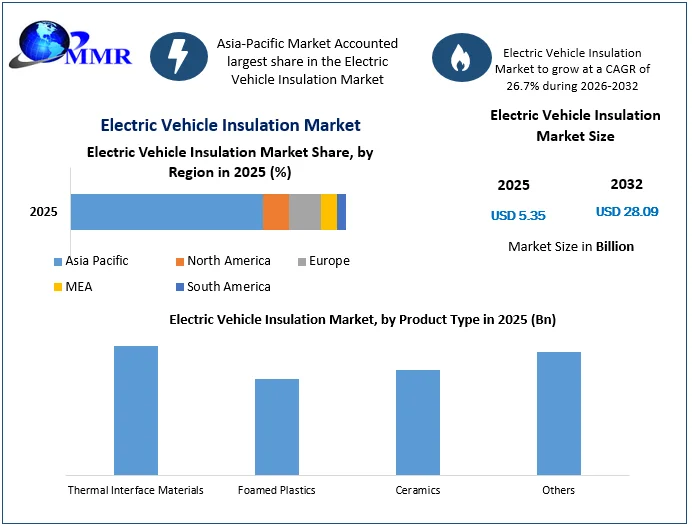
Market Valuation: The Electric Vehicle Insulation market was valued at USD 5.35 billion in 2025.
Growth Forecast: Expected to reach USD 28.09 billion by 2032, expanding at a CAGR of 26.7%.
Dominant Segment: Hybrid Electric Vehicles (HEV) currently lead propulsion types, while “Under the Hood & Battery Pack” remains the primary application.
Key Driver: Rising demand for battery performance optimization and passenger acoustic comfort.
Regional Leadership: Asia Pacific maintains a dominant market share, fueled by large-scale EV manufacturing and aggressive emission reduction mandates.
Why This Matters Now
The shift to electric mobility is forcing a fundamental redesign of vehicle thermal and acoustic management systems. For chemical manufacturers and automotive procurement leaders, the stakes are rising: inefficient battery insulation directly correlates to reduced vehicle range and diminished battery lifecycle. This market is transitioning from a niche automotive component segment to a high-volume, performance-critical industry as global fleets pivot toward electrification.
Market Overview
Electric vehicle insulation is no longer merely about noise reduction; it is a critical engineering requirement for thermal stability and component protection. By managing the heat, sound, and vibrations inherent in electrified powertrains, these materials prevent premature fluid evaporation and mechanical damage.
Electric Vehicle Insulation Market Size Valued at USD 5.35 billion in 2025, the market is on a trajectory to reach USD 28.09 billion by 2032, reflecting a 26.7% CAGR. This rapid expansion is underpinned by the essential role insulation plays in protecting high-voltage components and battery packs, which operate within strictly limited temperature windows. As the industry moves toward mass-market EV adoption, the ability to supply reliable, high-performance insulation at scale has become a primary bottleneck and opportunity for chemical material suppliers.
Key Trends Driving Growth
The core driver is the intense focus on battery efficiency. Lithium-ion packs require precise thermal regulation to maintain capacity; wide temperature fluctuations lead to accelerated degradation. Consequently, materials such as mica-based insulation and advanced thermal interface materials (TIMs) are seeing massive demand.
Simultaneously, “forward integration” is reshaping the supply chain. Raw material providers are increasingly moving downstream to manufacture finished insulating products. This vertical integration allows firms to secure captive consumption of their materials, lowering production costs and enabling a faster response to specific automotive design requirements. However, this shift also exerts pressure on standalone component manufacturers to innovate rapidly or face displacement by integrated material giants.
Segment Insights
Dominant Segment (Propulsion): Hybrid Electric Vehicles (HEVs). HEVs combine internal combustion engines with electric motors, requiring a complex mix of heat-resistant insulation for the engine bay and specialized electrical insulation for the electric drivetrain.
Fastest-Growing Segment (Propulsion): Battery Electric Vehicles (BEVs). The acceleration of BEV production, driven by massive investments in new platform architectures and battery technology, is pushing the BEV segment to grow at a CAGR of 22.6% over the forecast period.
Dominant Segment (Application): Under the Hood & Battery Pack. Accounting for over 43% of global sales, this application is the primary site for thermal management, where insulation is required to prevent the failure of power electronics and ensure battery longevity.
Dominant Segment (Product Type): Foamed Plastics. Currently leading with over 58% of revenue, these materials are favored for their light weight and impact resistance, providing critical shock absorption for battery cells.
Regional Growth Story
Asia Pacific stands as the undisputed center of the market, accounting for over 57% of global sales. Massive government support, coupled with the regional concentration of high-volume battery and vehicle manufacturing, creates an unparalleled demand environment.
North America is tracking as a high-growth region, driven by large-scale domestic investment and the presence of major pure-play EV manufacturers. Europe remains a sophisticated, albeit regulatory-heavy, market; EU-wide incentives for EV adoption and stringent sustainability mandates are accelerating the integration of advanced thermal management systems across the region.
Competitive Landscape
Competition is intensifying as the market matures. Market leaders are prioritizing high-performance thermal interface materials (TIMs) that offer low viscosity and superior thermal conductivity. The competitive landscape is shifting from traditional component suppliers toward material scientists who can offer custom-engineered solutions for the high-temperature environments characteristic of EV powertrains.
Recent investments in the sector signal a move toward “total solution” partnerships, where suppliers provide the material, the manufacturing process, and the testing validation for battery packs. This strategy is essential for capturing the pricing power that comes with being a preferred partner for global OEMs.
Recent Developments
Thermal Interface Evolution: Rapid adoption of materials capable of maintaining insulating properties at extreme operating temperatures.
Regulatory Adaptation: Increased focus on developing recyclable or sustainable plastic insulation to counter the environmental impact of traditional non-biodegradable foamed plastics.
Vertical Integration: Major raw material providers expanding into finished product assembly to streamline costs and capture greater margins.
Battery Management Integration: Collaborative efforts between insulation providers and battery manufacturers to integrate cooling/insulating layers directly into the pack design.
Strategic Implications
The rapid scaling of the EV insulation market requires a shift from commodity supply models to high-tech partnership models. Procurement leaders should prioritize suppliers who demonstrate vertical integration capabilities and can guarantee long-term thermal performance consistency. The risk for manufacturers lies in the regulatory scrutiny of traditional plastics; those who invest early in sustainable, high-performance alternatives will be better positioned to satisfy both the technical and ESG requirements of global automotive OEMs.
Future Outlook
Market winners will be those who successfully transition from providing basic protective components to delivering integrated, thermal-management-as-a-service solutions, effectively linking their materials to the mission-critical performance of the battery pack.
Analyst Perspective
“The Electric Vehicle Insulation market is moving at a velocity rarely seen in the automotive sector. As battery technology becomes more dense and temperature-sensitive, insulation is shifting from an auxiliary material to a core vehicle performance component. Manufacturers that align their product portfolio with the rigorous thermal and acoustic demands of the next generation of BEVs will command a significant share of the projected USD 28.09 billion market by 2032,” says Ankita Kagawade, Analyst at Maximize Market Research.
About Maximize Market Research
Maximize Market Research Pvt. Ltd. (MMR) is a global market research and consulting company that provides reliable, data-focused, and practical business insights. The firm serves a wide range of industries, including healthcare, pharmaceuticals, technology, automotive, electronics, chemicals, personal care, and consumer goods. Through market forecasts, competitive analysis, strategic consulting, and industry impact assessments, MMR helps organizations understand changing market conditions, identify growth opportunities, and make informed business decisions for long-term success.
2nd Floor, Navale IT Park Phase 3
Pune Banglore Highway, Narhe
Pune, Maharashtra 411041, India
+91 9607365656
sales@maximizemarketresearch.com
