Key Highlights
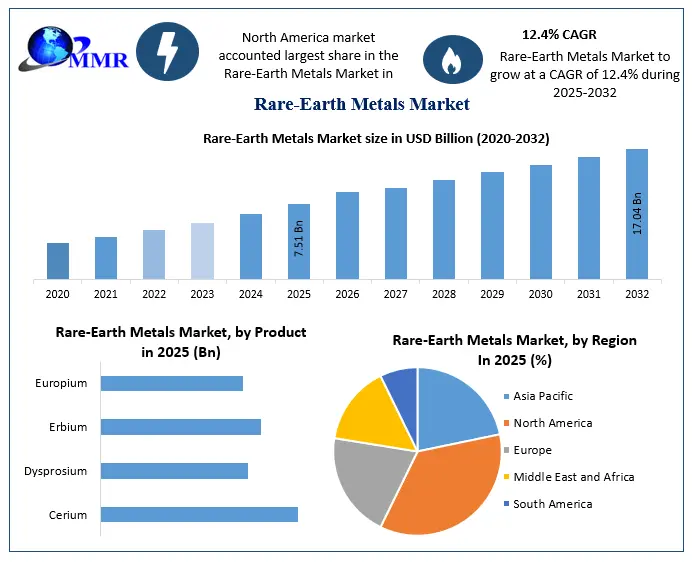
Market Valuation: The global Rare-Earth Metals market was valued at USD 7.51 billion in 2025.
Growth Forecast: Expected to reach USD 17.04 billion by 2032, expanding at a robust CAGR of 12.4%.
Dominant Segment: Neodymium remains the market leader, essential for the high-energy density required in advanced electric motors.
Key Driver: Accelerated adoption of electric vehicle (EV) powertrains and direct-drive wind turbine technology.
Regional Leadership: Asia Pacific currently dominates production and consumption; however, North American and European initiatives are aggressively pursuing supply chain localization.
Why This Matters Now
The rare-earth metals industry has moved from a commodity concern to a top-tier national security and industrial priority. For chemical and manufacturing leaders, the dependency on concentrated supply chains is no longer just a procurement risk—it is a potential single point of failure for entire production lines. As the market climbs to a projected USD 17.04 billion by 2032, those who secure diversified sources and invest in circular recycling loops will gain a decisive competitive advantage in an increasingly protectionist global economy.
Market Overview
Rare-earth metals—comprising seventeen elements critical to modern electronics, defense, and green technology—are experiencing an unprecedented surge in industrial importance. From the neodymium-iron-boron (NdFeB) magnets in EV motors to cerium-based catalysts in energy production, these elements are the structural foundation of the 21st-century technology stack.
The Rare-Earth Metals Market Size transition from USD 7.51 billion in 2025 to USD 17.04 billion by 2032 reflects a structural change in how global industries value resource security. This 12.4% CAGR is not just about price inflation; it tracks the mass-market rollout of energy transition technologies. The industry is currently shifting from a linear, “extract-and-ship” model to a more complex, multi-layered ecosystem that emphasizes refining capabilities and secondary-source recovery.
Key Trends Driving Growth
The most potent driver is the electrification of the automotive sector. Permanent magnets, which rely heavily on neodymium and dysprosium, are the preferred technology for EV drivetrains due to their superior power-to-weight ratio. As vehicle fleets go electric, the demand for these specific “magnet metals” is outpacing the growth of the overall market.
Furthermore, geopolitical shifts are forcing a “de-risking” of supply. Recent policy frameworks, such as the U.S. Inflation Reduction Act and the EU’s Critical Raw Materials Act, are incentivizing massive capital investments in non-Chinese refining capacity. This shift is turning rare-earth production into a regional battleground for industrial autonomy, forcing manufacturers to rethink their tier-N supplier strategies to identify and mitigate “hidden” exposure to concentrated supply nodes.
Segment Insights
Dominant Segment (Metal Type): Neodymium. Its critical role in high-performance permanent magnets makes it the primary volume and value driver for the sector.
Fastest-Growing Segment (Application): Permanent Magnets. Driven by EV motor demand and wind turbine expansion, magnets currently represent the most intense focus for R&D and capacity expansion.
Emerging Segment (Source): Recycled Rare-Earth Elements. As primary extraction faces environmental and social scrutiny, companies are moving toward urban mining—extracting metals from end-of-life electronics—to satisfy sustainability mandates and stabilize input costs.
Regional Growth Story
Asia Pacific remains the unrivaled center of gravity, controlling the majority of global refining and separation capacity. This dominance has historically allowed the region to dictate pricing and flow. However, the narrative is changing. North America and Europe are rapidly scaling up local extraction and processing plants, using co-investment models to subsidize the high-CAPEX nature of rare-earth separation facilities. The goal is clear: establishing a “counter-coercion” supply network that ensures continuity of supply regardless of shifts in trade policy.
Competitive Landscape
Competition has moved beyond mere mining. The industry’s new winners are vertically integrated players. Companies that control the full lifecycle—from mining and chemical separation to alloy production—are successfully insulating themselves from the volatile pricing of raw rare-earth oxides. Strategic partnerships between OEMs (like automotive and wind manufacturers) and junior miners are becoming standard, with companies opting to “lock in” future production through offtake agreements rather than relying on spot markets.
Recent Developments
Vertical Integration: Major players are acquiring downstream separation and magnet-manufacturing capabilities to capture value across the entire chain.
Recycling Scale-up: Announcements of massive investments in rare-earth element recycling facilities, moving from pilot phases to 30,000-tonne capacity targets over the next 24 months.
Government-Backed Offtake: Increasing use of government funding, including Department of Defense-backed investments, to secure primary production equity and shield critical supply lines.
Patent Diversification: Industrial focus shifting toward magnet designs that use less dysprosium and terbium, mitigating the impact of heavy rare-earth supply shocks.
Strategic Implications
For procurement leaders, the primary risk is no longer price, but availability. The transition to high-performance, magnet-dependent motors requires long-term, multi-year supply contracts that transcend traditional commodity procurement. Investors should monitor companies with “source-to-separation” capabilities, as these firms will likely maintain the highest margins during inevitable price cycles. The move toward circularity isn’t just a green initiative—it is a necessary insurance policy against the concentration of upstream mining assets.
Future Outlook
Market winners will be defined by their ability to achieve supply chain transparency; those failing to audit their bill-of-materials and diversify their sourcing footprints remain highly vulnerable to trade-driven price spikes and geopolitical bottlenecks.
Analyst Perspective
“The Rare-Earth Metals market is undergoing a fundamental transformation from a fragmented, supply-led industry into a strategic, demand-driven ecosystem. With a CAGR of 12.4% through 2032, the push to reach a USD 17.04 billion valuation will be defined by the race to localize refining and the scaling of recycled feedstocks, rewarding firms that treat rare-earth elements as a core strategic asset rather than a basic raw material,” says Ankita Kagawade, Analyst at Maximize Market Research.
About Maximize Market Research
Maximize Market Research Pvt. Ltd. (MMR) is a global market research and consulting company that provides reliable, data-focused, and practical business insights. The firm serves a wide range of industries, including healthcare, pharmaceuticals, technology, automotive, electronics, chemicals, personal care, and consumer goods. Through market forecasts, competitive analysis, strategic consulting, and industry impact assessments, MMR helps organizations understand changing market conditions, identify growth opportunities, and make informed business decisions for long-term success.
2nd Floor, Navale IT Park Phase 3
Pune Banglore Highway, Narhe
Pune, Maharashtra 411041, India
+91 9607365656
sales@maximizemarketresearch.com
